

All posts by Robert Wright
What is risk appetite?
By Robert Wright /February 18,2021/

For some people, risk means excitement and opportunity. For others, it invokes feelings of fear and discomfort. We all experience a degree of risk in our everyday lives – whether it’s simply walking down the street or having investments in the share market.
Everyone has a risk profile that defines their willingness to accept risk. It’s usually shaped by age, lifestyle and goals and is likely to change over time.
Risk is about tolerating the potential for losses, the ability to withstand market movements and the inability to predict what’s ahead. In financial terms, risk is the chance that an outcome will differ from the expected outcome or return.
It includes the possibility of losing some or all of your original investment. Often you may not be aware of your risk appetite until you’re facing a potential loss, so loss aversion becomes a significant factor when making decisions related to risk.
As an investor, you should have a good understanding of your attitude towards risk. If you take on too much risk, you might panic and sell at a bad time. But if you don’t expose yourself to enough risk, you may be disappointed with your returns and potentially unable achieve your objectives.
How do I work out my risk appetite?
Generally speaking, your age, income and investment objectives all help determine your risk appetite.
Age:
Generally younger investors with a longer time horizon to invest are more willing to take greater risk with their money to earn higher potential returns. Older investors with a shorter investment timeframe may be more cautious as they’ll need their money to be more readily available and have less time to recover from a loss.
Income:
People who earn more money and have a higher disposable income can typically afford to take greater risks with their investments.
Investment objectives:
Be clear about why you’re investing and when you think you’ll need to withdraw your money, as well as how long you need the money to last. Saving for a holiday or a deposit on a home is quite different from investing for your retirement.
Risk and Return
The relationship between risk and return underpins all financial decisions. The more risk an investor is willing to take, the greater the potential return. However, investors expect to be compensated for taking on this additional risk and should realise that taking on more risk doesn’t guarantee higher returns.
Whatever your risk appetite, you should always consider both risk and return before making decisions about what to do with your money. Although shares and property are generally considered to be higher-risk investments, even more conservative investments like bonds can experience short-term losses. No investment is completely risk free.
This explains why smart investors typically have a diversified portfolio that includes several different types of investments.
Risk and Diversification
Don’t think that just because your friends invest in shares you should too. If you don’t have a lot to invest or you’ll want to access your money in a few years, shares may not be the right type of investment for you.
By understanding your risk appetite and being honest about what you want to achieve, you’re more likely to be comfortable with your investment decisions.
The simplest way to minimise investment risk is through diversification. A well-diversified portfolio will usually include different asset classes, like shares, property, bonds and cash, with exposure across different industries, markets and countries.
The idea is to reduce the correlation between the different types of investment and have a good balance of assets which move in different directions and at different times. So, if some of your assets perform poorly, others may be performing well, offsetting the poor performers.
Although diversification doesn’t guarantee you won’t suffer a loss, it’s an effective way to minimise risk and help investors realise their financial goals.
Make informed decisions
You should monitor both your risk appetite and your investment portfolio over time. Your risk appetite is likely to change as you get older, and as your income or family situation changes.
Similarly, you should review your portfolio to ensure the risk level is still suited to your overall investment objectives. Financial markets are constantly changing, which means the underlying assets you’re invested in could change too.
If you’re a confident investor, you should check that it’s still on track to generate the level of return you want and importantly, at a comfortable level of risk. If you prefer to speak with a financial adviser, they too can help you undertake regular reviews and rebalance your portfolio, as necessary.
By understanding your risk appetite, you’re in a better position to make well-informed and transparent financial decisions. It will help you identify opportunities to take on more risk where appropriate or see where you’re exposed to unnecessary risk and adjust accordingly. You’ll also avoid being caught up in the emotion of market activity, where panic can lead to a poorly timed and costly decision.
Source: BT
How much super should I have at my age?
By Robert Wright /February 18,2021/

A healthy super balance is a key ingredient to living comfortably in retirement. But for many people, retirement is a long way off, and it can be hard to know if your super is on track. If you’ve ever been curious about how your super savings match up, read on to find out.
How much super do I need?
The amount of super you need to live comfortably in retirement depends on a range of factors, such as your cost of living, any outstanding debts you owe including a home loan, and whether or not you have other income streams such as investment returns.
The Association of Superannuation Funds of Australia (ASFA) retirement standard estimates if you own a home outright, singles will need retirement savings of $545,000 for a comfortable retirement, while couples will need combined retirement savings of $640,000.
How does your super compare?
Curious to know how your super account balance shapes up against others your age? The table below shows the average super balances for employed Australian men and women of different ages (excluding those with no super):
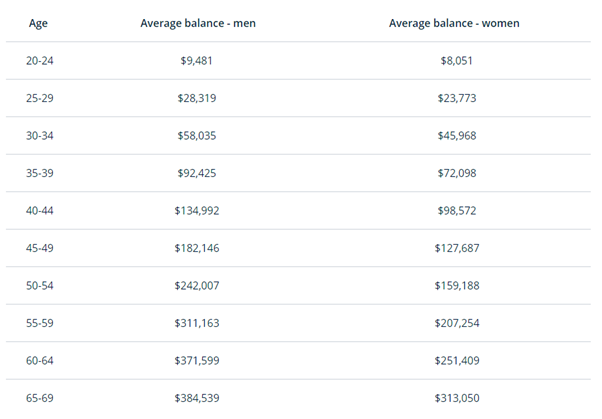
If your balance looks low, there could be several reasons why your super is lagging behind your peers – taking time out of the workforce to study, travel or care for older relatives, or perhaps being out of work, working part-time or earning a lower wage than others your age.
As the figures show, women are more likely to have lower super balances than their male counterparts – likely due to factors impacting their financial situation, such as taking time off work to raise children.
What to do if your super balance needs a boost?
If you check your super every 6-12 months and notice your balance isn’t as high as you’d like it to be, start with these quick and easy steps to give it a potential boost:
- Search for lost super. Money belonging to you might be sitting in an account you’ve forgotten about.
- If you have accounts with multiple super funds, think about consolidating it into one account. You could save on fees and charges that may be eating into your balance. However, you’ll need to check for exit or termination fees and ensure your insurance cover isn’t affected.
- Consider how your super is invested. Depending on how far you are from retirement you might think about switching it into a more growth-focused investment option. But bear in mind that returns aren’t guaranteed, and that higher risk accompanies the opportunity for higher returns. There’s also a risk you may lock in losses, so seek financial advice or contact your super fund.
Here are some ways to boost your balance over the long term by making additional contributions:
- Salary sacrificing: You can contribute extra cash into your super from your before-tax salary. The amount contributed will only be taxed at 15% if you earn under $250,000 a year or 30% if you earn $250,000 or more a year, rather than at your usual marginal tax rate. However, make sure your total concessional super contributions (including any your employer makes on your behalf) don’t exceed $25,000 per year. You’ll need to speak to your payroll department to set up a salary sacrifice arrangement.
- Personal tax-deductible contributions: If your employer doesn’t offer salary sacrifice, you’re unemployed, self-employed or you don’t want to salary sacrifice, you can make a personal tax-deductible contribution to your super. The amount you contribute is taxed at 15% if you earn under $250,000 a year, 30% if you earn $250,000 or more a year, and subject to the $25,000 per year limit.
- After-tax contributions (also known as non-concessional contributions): There’s a $100,000 limit per financial year on the amount of after-tax contributions you can make. If you are under age 65 at 1 July of the year the contribution is made, you can also ‘bring forward’ up to two years’ worth of after-tax contributions and make up to $300,000 contribution in a financial year.
- Spouse contributions: If your partner is out of work, a stay-at-home parent, working part-time or earning less than $40,000, adding to their super could benefit you both financially.
- Government contributions: If you’re a low or middle-income earner, you may be eligible for a co-contribution from the government when you add after-tax money to your super.
Need more help with your super?
To help make sure your retirement income will give you a comfortable life after work, speak to your financial adviser.
Source: AMP
Property investment vs shares
By Robert Wright /February 18,2021/

An age-old question is whether it’s better to invest in property or shares. There is actually no right or wrong answer. It all comes down to your preferences and approach to risk.
Growth investments
Both asset classes – shares and property – are considered to be growth investments. In other words, over time, a quality investment in shares or a property could generate capital growth and also produce income from rent (property) and dividends (shares).
The case for shares
Ease of entry into the share market is a big plus for share or equity investors. You can buy into the share market with as little as a few hundred dollars. In comparison, home and apartment prices in our capital cities could easily cost upwards of $1 million. The transaction costs of investing in shares such as brokerage and transaction fees are also significantly lower than the stamp duty and legal fees you pay as a property investor.
Finally, with a share market investment, you could get almost instant access to your money when you decide to sell. Equally, you don’t have to sell the entire investment to get access to some cash. With an investment property, you can’t sell a bedroom to free up some cash – it’s the entire property that goes to market or nothing.
The case of property
A major appeal of owning a property is its perceived stability relative to the share market, where values can vary from day-to-day as a consequence of how easy it is to buy and sell shares. If you’re approaching retirement, this level of volatility may not be for you.
A property investment, on the other hand, gives you a tangible asset that can deliver a sense of investment security as well as some capital growth and income.
Property buyers have the ability to fix the interest rate of a loan, which is another valuable security measure. This means your mortgage repayments will be set for an amount of time, which could be a good option for someone who prefers stability.
Holding an investment property in a self-managed super fund (SMSF)
It is possible to set up an SMSF primarily to invest in property, but be aware, some rules apply to ensure your fund remains compliant. ASIC’s Money Smart website lists the following rules:
- The property must meet the ‘sole purpose test’ of solely providing retirement benefits to fund members.
- The investment property can’t be acquired from a member or related party of a member of the SMSF.
- The property can’t be occupied by a fund member or any fund members’ related parties.
- The property must not be rented by a fund member or any of the fund members’ related parties.
As this shows, there are many reasons to invest in shares and property. For further information about investing in property or shares, or to discuss whether it may be a suitable strategy for you, please get in touch.
Source: BT
The A-Z of Inheritance
By Robert Wright /February 18,2021/

Inheritance is an emotional subject on every level. The people leaving an inheritance generally do it with pride and love. The people receiving an inheritance often receive it with gratitude – and sorrow. But while emotional, it’s also a financial transfer that comes with a whole range of legal, financial planning and admin issues attached.
For many people inheritance is painful and protracted. It can lead to family disputes and disappointment. In this article, we look at both the financial and emotional aspects of inheritance and at how some forethought can make the process easier for everyone.
The Process: Leaving a Paper Trail
Moving wealth from one generation to the next does not happen quickly. Let’s think about why that is and why some intelligent forward planning is required.
Consider your own finances – all the bank and investment accounts, loans, credit cards, tax, super and insurances that make up your financial life. Think of all the documents, passwords, websites and email chains they create. Then hand them to someone who isn’t financially trained and hasn’t dealt with them every day like you have. Hand them to someone who’s emotionally drained by your passing – and then has to deal with the whole series of complex legal processes we outline below.
Get a grip on assets and liabilities
Before any inheritance gets distributed, the executor (the person you’ve appointed in your will to administer your estate) needs a deep and documented understanding of your financial position; what you own and what you owe. It’s complex and detailed work, but it needs to be done so a Statement of Assets and Liabilities can be submitted to the Supreme Court.
Probate – all about a valid will
After the assets and liabilities have been accounted for, the executor of your will needs to apply for Probate. The word tells its own story – it comes from the Latin probare: “to prove”.
It means a Court must certify that the will they’re working with is the valid one. Usually, the executor needs to advertise their intention to apply for probate in a newspaper or via the court website. They also need to give creditors time to lodge a claim against the estate.
Death and Taxes
Once Probate has been granted your executor must make sure outstanding taxes are paid and a date of death tax return and other tax returns are lodged. They also need to work through any other tax complexities, including family trusts, to ensure assets are passed on in compliance with tax law.
This is one area where a financial adviser or accountant – or both – can be invaluable. If you’re preparing your estate plan, their help can make sure you pass on assets to those you care about in the most-tax-effective fashion.
And if you’re receiving an inheritance, expert financial advice can help you manage the tax decisions more effectively.
Tax management is important. Australia doesn’t have death duties and most assets you inherit don’t get captured by Capital Gain Tax (CGT) when they transfer into your ownership. But CGT does apply when you sell those assets or, potentially, if you inherit residential property that has been used for investment purposes. Expert advice can help you manage these complexities.
Rings passed down for generations
Unless a claim is lodged against the estate (and it can’t be paid or negotiated away) the next step is for cash legacies, bequests and personal items – including jewellery – to be distributed. Individuals often use their will to make bequests to charitable organisations – these are identified and treated separately to the rest of the estate.
Distributing the estate
Once all legacies and bequests have been managed correctly, the balance of the estate (typically large assets like property, equity in businesses and investment holdings like shares) are distributed in accordance with the will or subsequent directions from a court. Sometimes this is not a final process – particularly if there are minor children involved. In these situations, the administration of the estate can be ongoing (which adds to complexity and costs).
As you can see, taking an inheritance from the reading of the will to the distribution of assets has already involved accounting, advertising and two layers of Court documentation. This all takes time – and that’s assuming there are no family disputes or arguments with the tax man or the deceased’s creditors.
The Emotions
We mentioned managing the process. Now we need to talk about managing your emotions. If all parties do that – the person leaving the inheritance and the person receiving it – the result can be better for all concerned. So, let’s look at the emotions involved in leaving an inheritance and the paths they can take us down.
Grief
In the aftermath of a loved one’s death, it can be hard to manage complex tasks, particularly if those tasks stir more emotion – like family disputes. Preparing for that challenge – perhaps by ensuring the executor has some financial skills, or is trusted by all parties, or is independent – can reduce the stresses placed on a grieving family.
Impatience
A simple look at the list above explains why patience is required in an inheritance situation. Understanding the probable time frame – which can vary depending on the complexity of the estate, but can often be a minimum of 12 months before an estate is settled – can make all the difference.
As we saw earlier, good advice can be crucial to setting up an estate plan that provides the maximum benefit for those you leave behind. It can be just as useful for the inheritors of an estate.
Reticence
According to research by Perpetual, some 53% of parents have not discussed their will and legacy with their children. More striking still, 80% of Australians who believe they will inherit something haven’t discussed that inheritance with their parents.
That lack of communication is at the heart of many fraught inheritance experiences. But to ensure that the transfer of wealth from one generation to the next happens with the minimum of complexity, cost and angst, all those involved need to be clear about their intentions – and their feelings.
Source: Perpetual