

Tag Archives: Financial Health Check
Mortgage versus super – a common dilemma
By Robert Wright /August 23,2024/

Conventional wisdom used to dictate Australians were better paying off their home loans, and then, once debt free turning their attention to building up their super. But with interest rates ramping up over the past two years and uncertainty as to when they are likely to reduce, what’s the right strategy in the current market?
It’s one of the most common questions financial advisers get. Are clients better off putting extra money into superannuation or the mortgage? Which strategy will leave them better off over time? In the super versus mortgage debate, no two people will get the same answer – but there are some rules of thumb you can follow to work out what’s right for you.
One thing to consider is the interest rate on your home loan, in comparison to the rate of return on your super fund. As banks ramped up interest rates following the RBA hikes over the past two years, you may find the returns you get in your super fund has potentially shrunk in comparison.
Super is also built on compounding interest. A dollar invested in super today may significantly grow over time. Keep in mind that the return you receive from your super fund in the current market may be different to returns you receive in the future. Markets go up and down and without a crystal ball, it’s impossible to accurately predict how much money you’ll make on your investment.
Each dollar going into the mortgage is from ‘after-tax’ dollars, whereas contributions into super can be made in ‘pre-tax’ dollars. For the majority of Australians, saving into super will reduce their overall tax bill – remembering that pre-tax contributions are capped at $30,000 annually and taxed at 15% by the government (30% if you earn over $250,000) when they enter the fund.
So, with all that in mind, how does it stack up against paying off your home loan? There are a couple of things you need to weigh up.
- Consider the size of your loan and how long you have left to pay it off
A dollar saved into your mortgage right at the beginning of a 30-year loan will have a much greater impact than a dollar saved right at the end.
- The interest on a home loan is calculated daily
The more you pay off early, the less interest you pay over time. In a higher interest rate environment many homeowners, particularly those who bought a home some time ago on a variable rate, will now be paying much more each month for their home loan.
- Offset or redraw facility
If you have an offset or redraw facility attached to your mortgage you can also access extra savings at call if you need them. This is different to super where you can’t touch your earnings until preservation age or certain conditions of release are met.
Don’t discount the ‘emotional’ aspect here as well. Many individuals may prefer paying off their home sooner rather than later and welcome the peace of mind that comes with clearing this debt. Only then will they feel comfortable in adding to their super.
Before making a decision, it’s also important to weigh up your stage in life, particularly your age and your appetite for risk.
Whatever strategy you choose you’ll need to regularly review your options if you’re making regular voluntary super contributions or extra mortgage repayments. As bank interest rates move and markets fluctuate, the strategy you choose today may be different from the one that is right for you in the future.
Case study where investing in super may be the best strategy
Barry is 55, single and earns $90,000 pa. He currently has a mortgage of $200,000, which he wants to pay off before he retires in 10 years’ time at age 65.
His current mortgage is as follows:
| Mortgage | $200,000 |
| Interest rate | 6.80% pa |
| Term of home loan remaining | 20 years |
| Monthly repayment (post tax) | $1,526.68 per month |
Barry has spare net income and is considering whether to:
- make additional / extra repayments to his home mortgage (in post-tax dollars) to repay his mortgage in 10 years, or
- invest the pre-tax equivalent into superannuation as salary sacrifice and use the super proceeds at retirement to pay off the mortgage.
Assuming the loan interest rate remains the same for the 10-year period, Barry will need to pay an extra $775 per month post tax to clear the mortgage at age 65.
Alternatively, Barry can invest the pre-tax equivalent of $775 per month as a salary sacrifice contribution into super. As he earns $90,000 pa, his marginal tax rate is 32% (including the 2% Medicare levy), so the pre-tax equivalent is $1,148 per month. This equals to $13,776 pa and after allowing for the 15% contributions tax, he’ll have 85% of the contribution or $11,710 working for his super in a tax concessional environment.
To work out how much he’ll have in super in 10 years, we’re using the following super assumptions:
- The salary sacrifice contributions, when added to his employer super guarantee contributions, remain within the $30,000 pa concessional cap.
- His super is invested in 70% growth / 30% defensive assets, returning a gross return of 3.30% pa income (50% franked) and 2.81% pa growth.
- A representative fee of 0.50% pa of assets has been used.
If these assumptions remain the same over the 10-year period, Barry will have an extra $161,216 in super. His outstanding mortgage at that time is $132,662 and after he repays this balance from his super (tax free as he is over 60), he will be $28,554 in front. Of course, the outcome may be different if there are changes in interest rates and super returns in that period.
Case study where paying off the mortgage may be the best strategy
40 year old Duy and 37 year old Emma are a young professional couple who have recently purchased their first apartment.
They’re both on a marginal tax rate of 39% (including the 2% Medicare levy) and they have the capacity to direct an extra $1,000 per month into their mortgage, or alternatively, use the pre-tax equivalent to make salary sacrifice contributions to super.
Given their marginal tax rates, it would make sense mathematically to build up their super.
However, they’re planning to have their first child within the next five years and Emma will only return to work part-time. They will need savings to cover this period, as well as assist with private school fees.
Given their need to access some savings for this event, it would be preferable to direct the extra savings towards their mortgage, and redraw it as required, rather than place it into super where access is restricted to at least age 60.
Before weighing up your options and considering which approach may be right for you, talk to your financial adviser.
Source: AMP
Australian household wealth
By Robert Wright /February 16,2024/

Is high Australian household wealth a source of support for consumers?
Key points
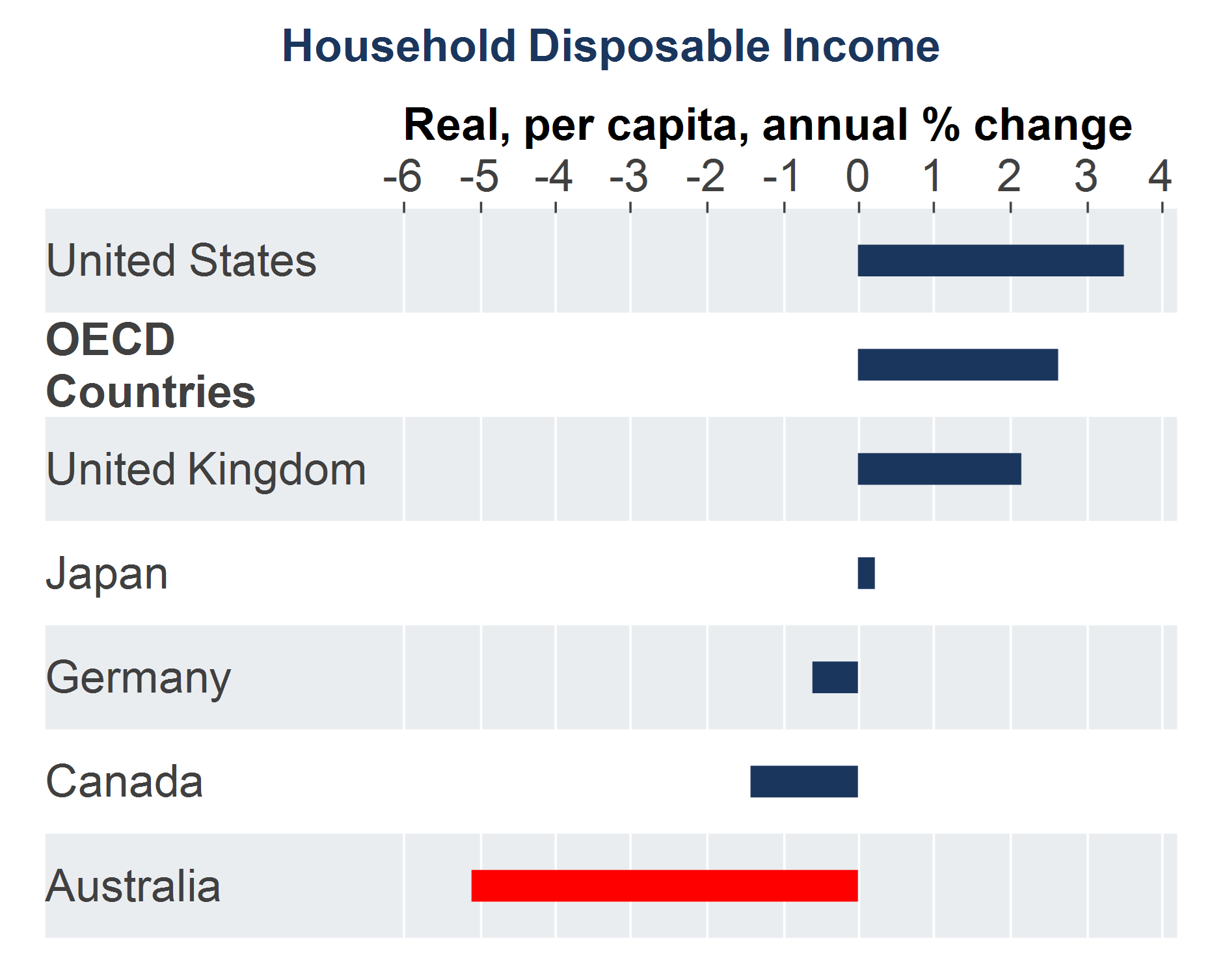
- Australia ranked as having one of the lowest rates of disposable income growth per capita amongst OECD countries in mid 2023.
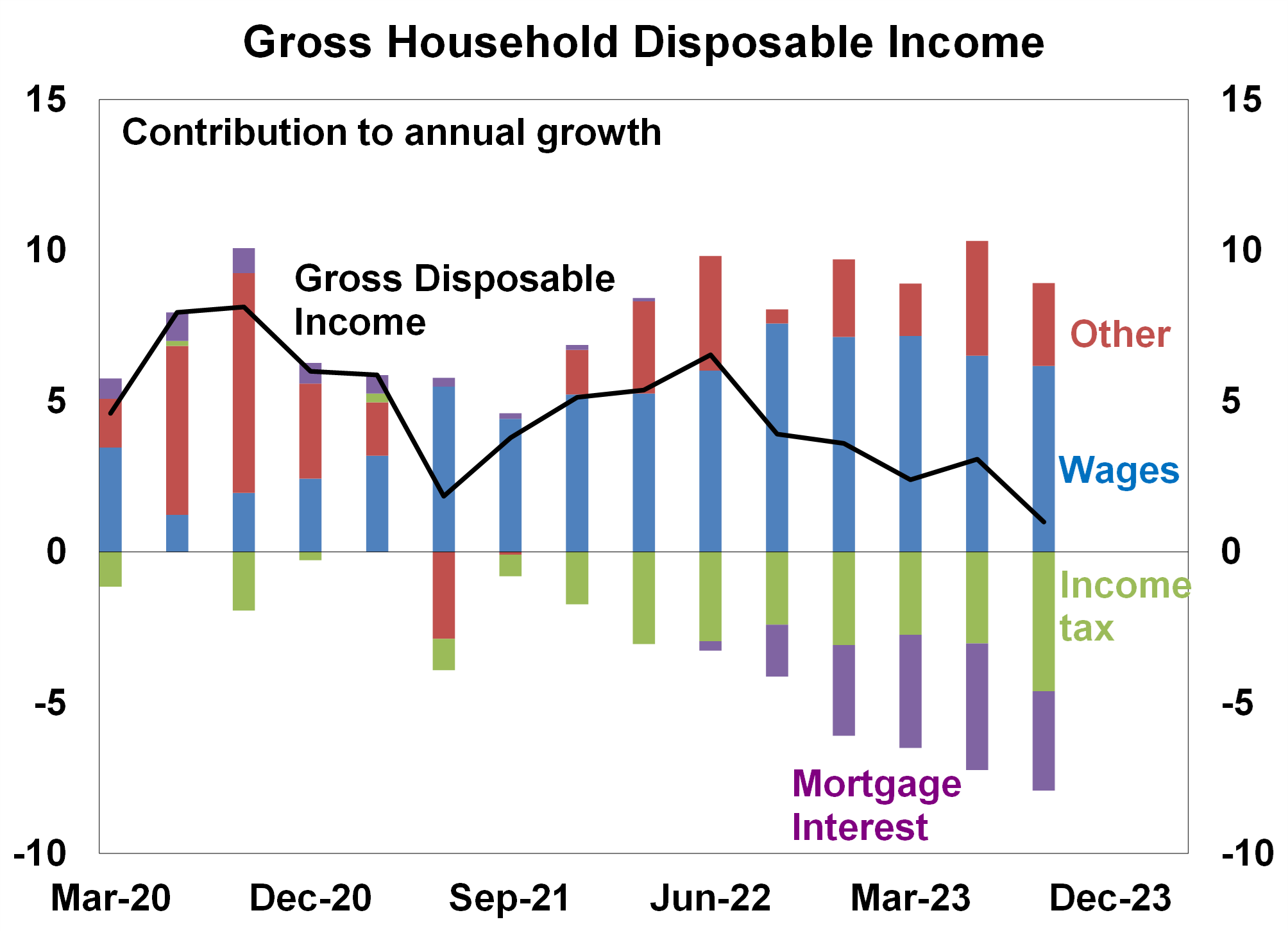
- An increasing income tax burden and mortgage repayments have weighed on income growth, despite solid wages and salaries.
- But, household balance sheets in Australia look stronger compared to incomes. Household wealth increased in 2023, as home prices rose.
- However, growth in household wealth will decline in 2024 as home prices are expected to fall. Household incomes will also be under pressure as earnings growth slows from a softening labour market.
- As a result, high household wealth holdings will not be enough to offset a challenging environment for households in 2024, despite some easing in cost of living challenges.
Introduction
Household income data from the OECD showed that Australia had one of the lowest rates of annual real household disposable income per person compared to its OECD peers (see the chart below). Over the year to June 2023, Australia’s real per capita household disposable income was down by 5.1%, compared to a 2.6% rise across OECD countries.
Source: AMP, Macrobond
This occurred despite very healthy labour market conditions in Australia which saw employment growth running above 3.0% per annum all year, the unemployment rate remaining below 3.9% and underemployment continuing to be low, all of which boosted wages growth. Despite this positive earnings backdrop, the income tax burden increased in 2023 as households have been moving into higher income tax brackets (otherwise known as “bracket creep”), as well as the end of income tax concessions. Mortgage interest repayments are also an increasing drag on incomes (see the chart below) as the cash rate has been increased by 425 basis points since May 2022. Australia’s very high population growth in 2023 (running at 2.4% over the year to June 2023) also masked a fall in household disposable income growth per person, relative to other OECD countries.
Source: ABS, AMP
Just looking at household income accounts does not show everything about the position of households. In a country like Australia where home ownership rates are high (66% of Australian households own their home, with or without a mortgage), looking at household wealth is also important.
Household wealth in Australia
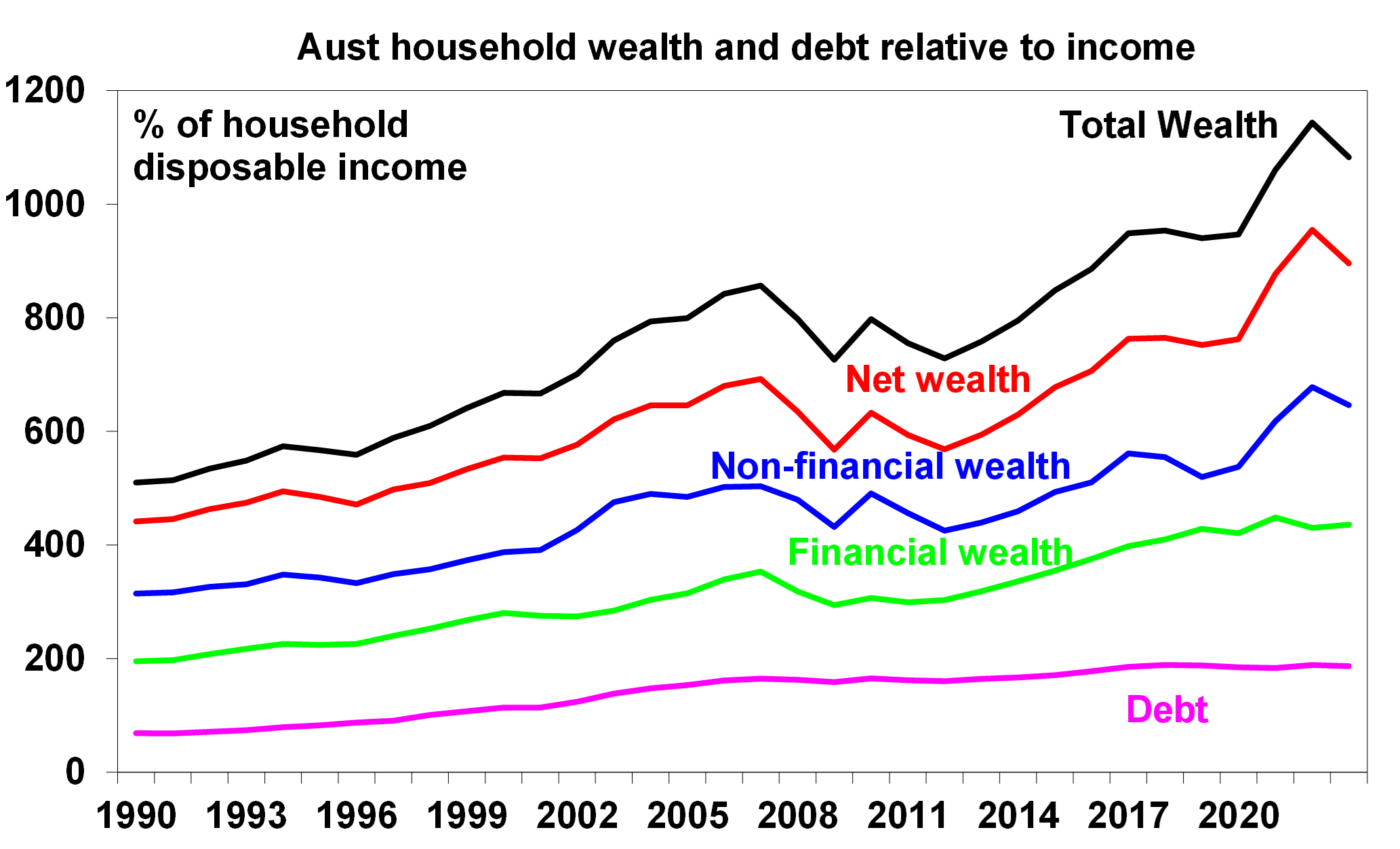
The Australian Bureau of Statistics estimates the value of a household’s assets, liabilities and therefore wealth. Net worth or wealth is calculated as a household’s total assets minus its liabilities. Total wealth is close to 11 times the size of household disposable income (or 1083%) and net wealth is 896% of income. The latest data for the year to June 2023 showed a slight fall in wealth as a share of income, after it reached a record high in 2022 – see the chart below. Non financial wealth is worth 647% of income, larger than financial wealth at 436% and well surpassing household debt, which is 187% of income.
Source: RBA, AMP
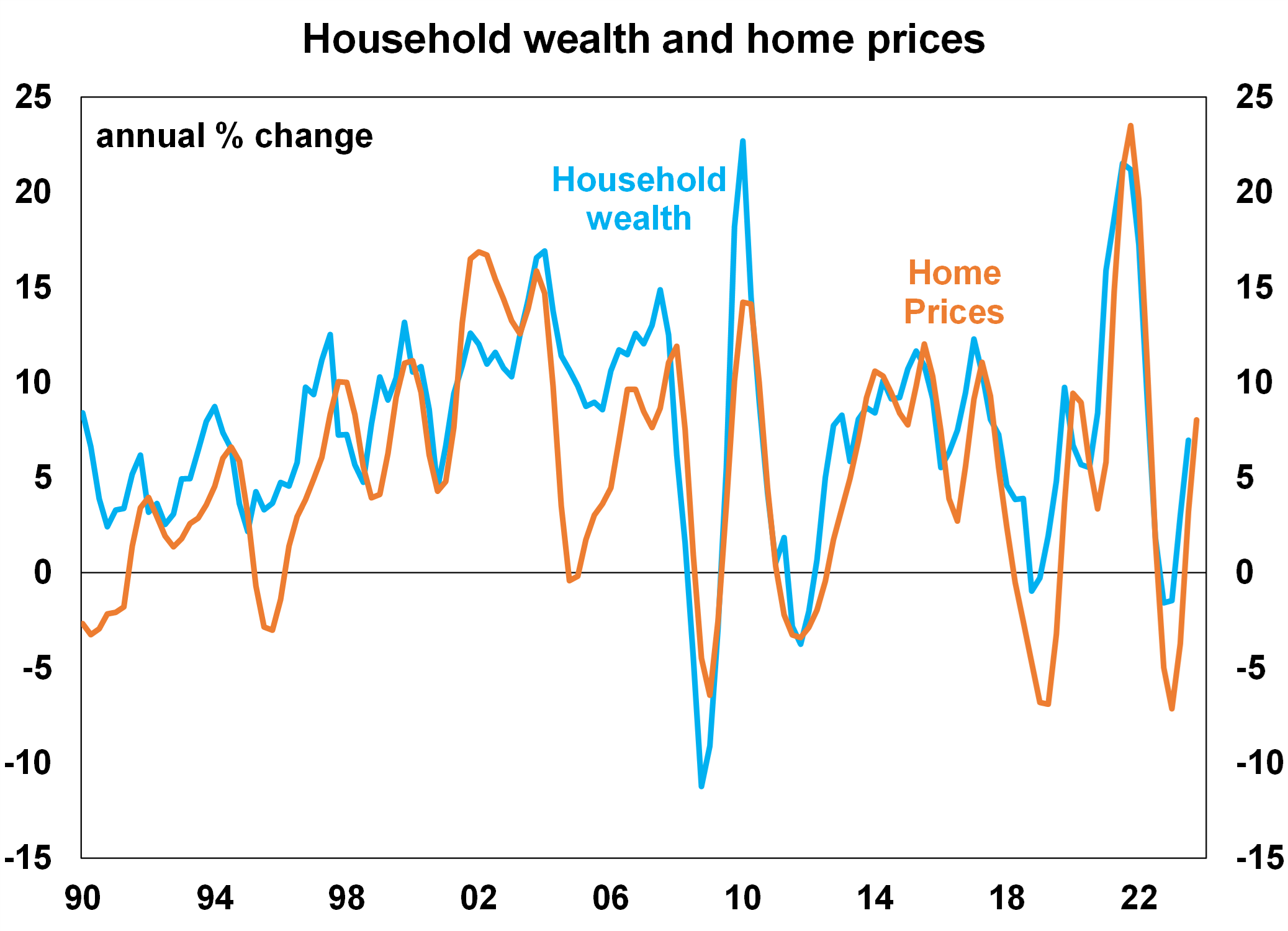
Around 70% of Australian household wealth is tied to the value of homes (which is made up of land and dwellings) and moves closely in line with home prices (see the chart below). Household wealth rose throughout 2023, in line with solid growth in home prices.
Source: ABS, AMP
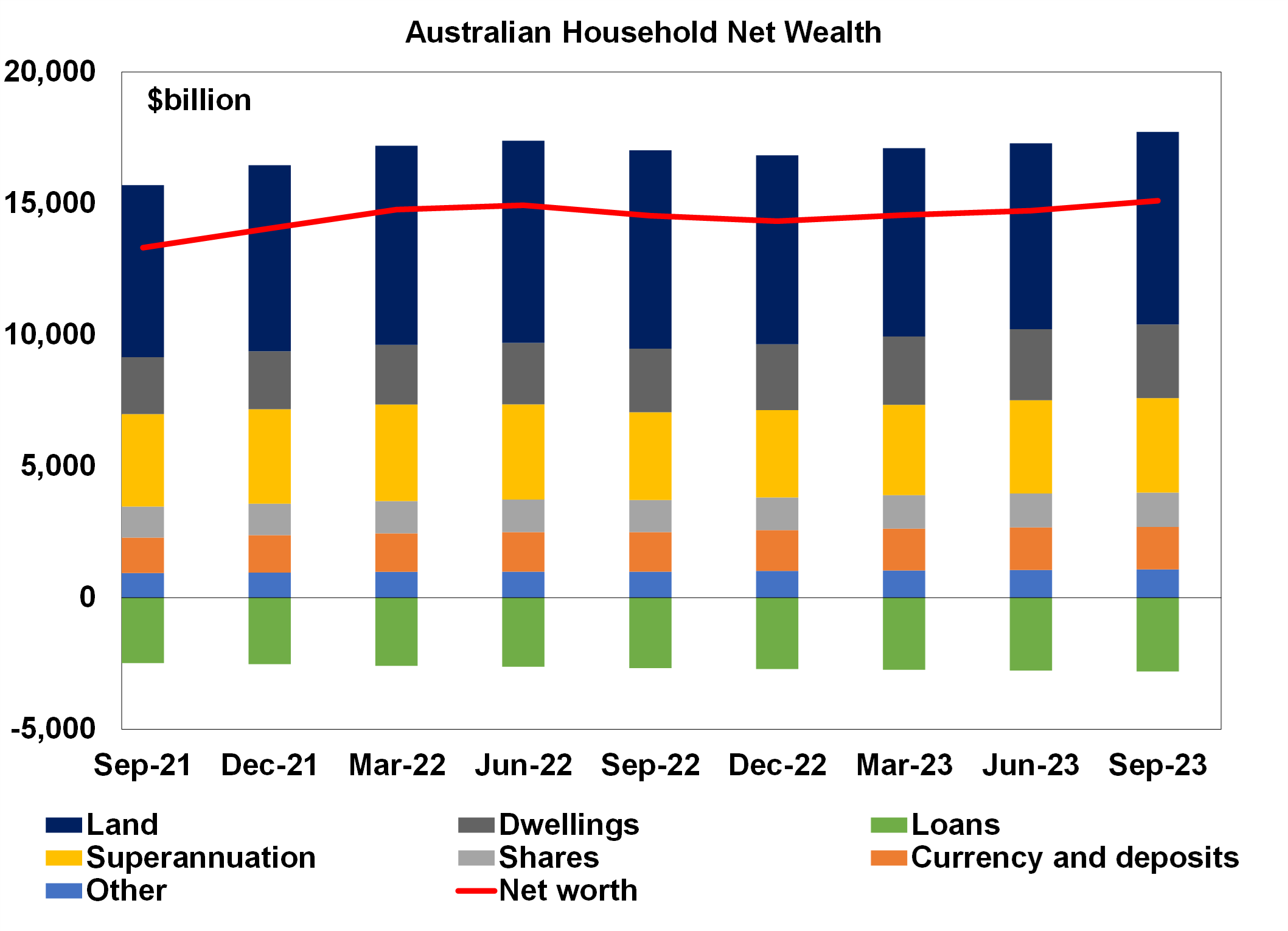
Other components of household wealth are shown in the chart below. Assets include superannuation, shares and currency and deposits. Loans which are mostly for housing are the source of household liabilities.
Source: ABS, AMP
How does household wealth compare around the world?
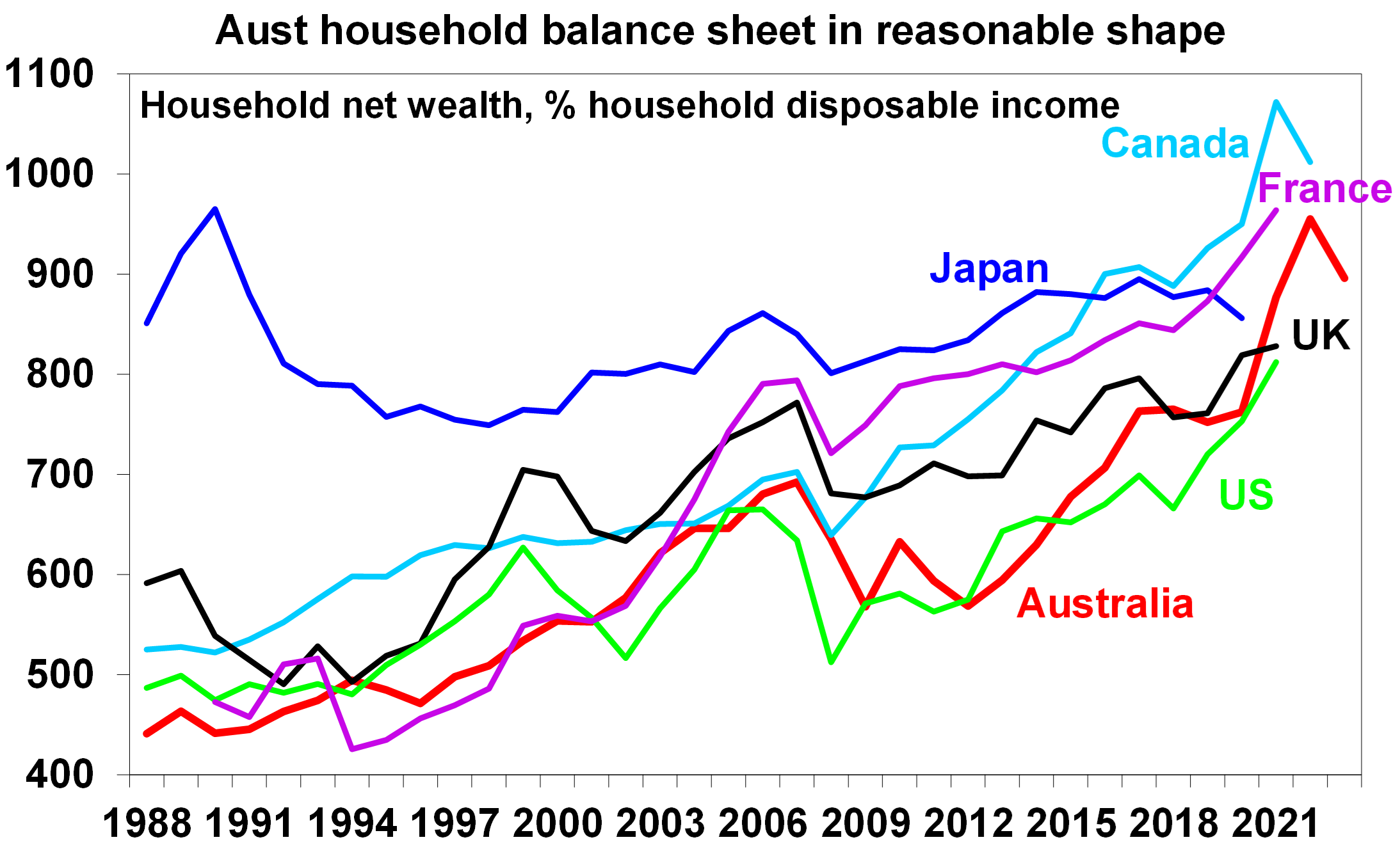
Australian household wealth, as a share of household disposable income, is at the top end of its OECD peers (see the chart below).
Source: OECD, AMP
High holdings of wealth could be considered a source of support for households, especially against record levels of household debt in Australia. This is a concept known as the “wealth effect”. When household wealth increases, households feel more secure with their financial position and household savings tend to decrease which lifts consumer spending. When wealth decreases, households feel less secure which leads to an increase in savings and decline in spending. However, this relationship does not always work. Most recently in the pandemic, household wealth rose in 2021/22 alongside the lift in home prices but the savings ratio also surged thanks to government driven stimulus cheques. Since then, the household savings ratio has been falling but growth in total consumer spending has been low. We expect that the household savings rate will continue to fall in 2024 as it normalises after the pandemic but growth in consumer spending will still be low.
Implications for investors
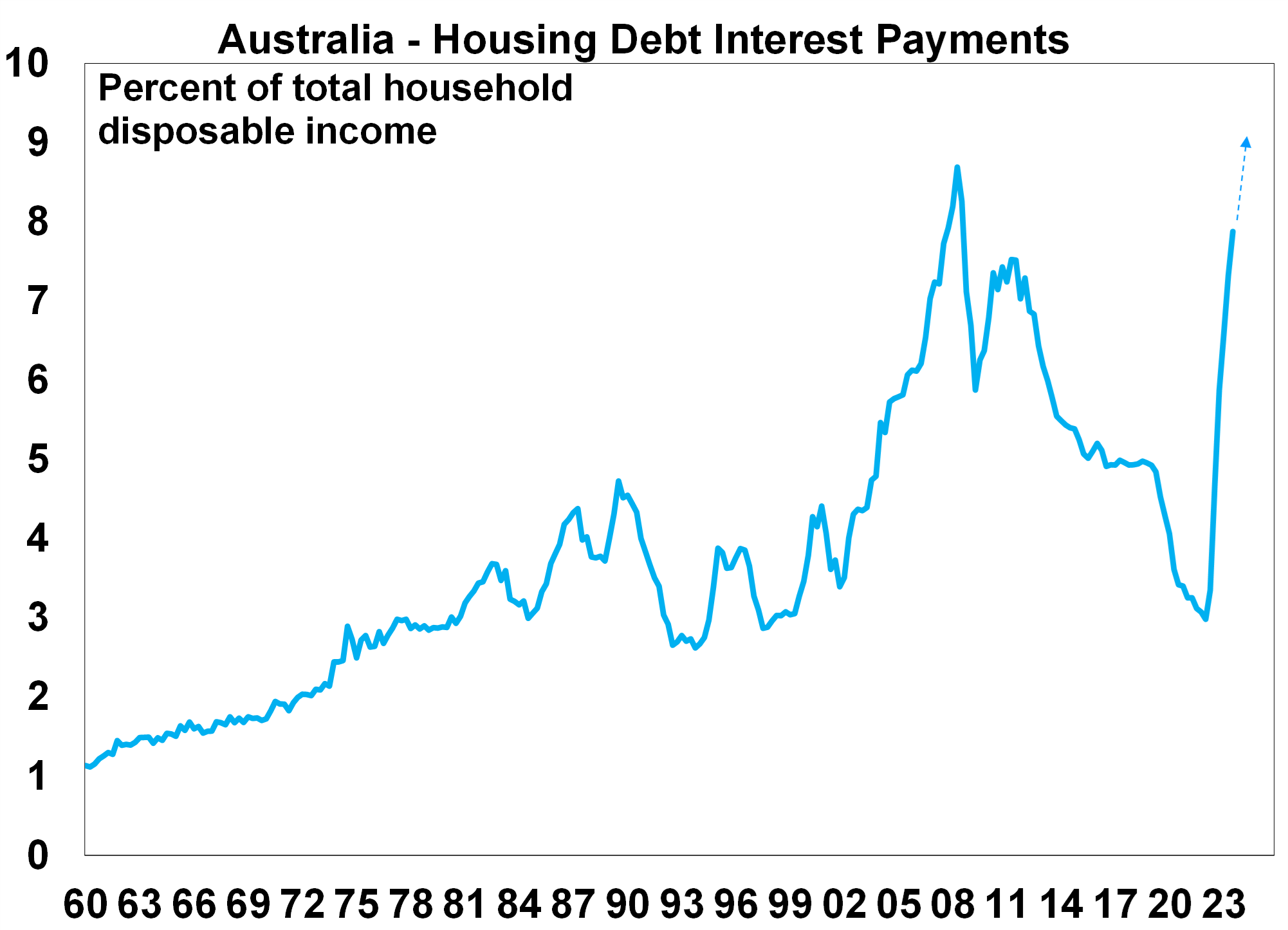
Households dealt with a cost of living challenge in 2023 because of high inflation and rising interest rates. Inflation is expected to slow in 2024 and we expect the RBA to start cutting interest rates by mid year which should ease the repayment burden for households with a mortgage, as mortgage interest repayments as a share of income are rising to a record high (see the chart below).
Source: ABS, AMP
So, while cost of living issues should improve for consumers, household wealth will come under pressure in 2024 as we expect home prices will decline by 3.0% to 5%. This is likely to occur alongside a slowing in household incomes as the labour market weakens and the unemployment rate increases. This environment is expected to be negative for consumer spending and GDP growth. We see GDP growth rising by 1.2% over the year to June 2024, below the RBA’s forecast of 1.8% and anticipate the unemployment rate to increase to 4.5% by mid year. This should see the RBA cutting interest rates by June and we expect a total of 3 rate cuts in 2024.
Wealth inequality between households is also an issue in Australia. The top 20% of households (by income quintile) owned 63% of total household wealth in 2019-20 but the bottom income quintile (the bottom 20%) owned less than 1.0% of all household wealth. In Australia, there is also increasing generational wealth gap, with wealth across older households increasing significantly over recent decades but this has not been the case for younger Australians. There are numerous government policies that could address these issues of wealth inequality, including improving the housing affordability issue (through lifting housing supply and/or looking at the favourable treatment of housing investment) and doing a tax review (looking at broadening the GST and examining the merits of a wealth or death tax), which could help the wealth inequality issue.
Source: AMP
Demand for financial advice doubles in five years
By Robert Wright /November 23,2021/

If your car engine sounds dodgy, you see a mechanic. If you’re unwell, you see a doctor. If you’ve got a tooth ache, you see a dentist. But what about when you’re looking to better manage your finances?
According to 2020 figures from research group Investment Trends, 2.6 million Aussies said they intended to seek help from a financial adviser over the next two years, up from 2.1 million in 2019 and double the levels seen in 2015.
Findings also revealed that COVID-19 had prompted greater engagement between Aussies and financial advisers where a relationship already existed.
Demand for advice is on the rise
Talking about the report findings, Investment Trends Senior Analyst King Loong Choi said, against a backdrop of economic uncertainty and volatile markets, a record number of non-advised Australians realise they need assistance from a professional.
“Among these potential advised clients, the pandemic has been a major catalyst, with 44% saying the COVID-19 situation had increased their likelihood of seeking advice,” he said.
Greater engagement between advisers and clients
The research also showed three in four financial advice clients had been in contact with their adviser to discuss the impact of the COVID-19 pandemic.
“Most financial planners have proactively engaged with their clients during this period of volatile markets, and clients themselves acknowledge these efforts,” Choi said.
The topics Aussies want advice on
There might be particular goals, events or circumstances that prompt financial advice, including unexpected situations like redundancy, death or divorce.
According to a survey by ASIC, the most common topics that participants had received advice on, or were interested in receiving advice on, were:
- investments (eg shares and managed funds) – 45%
- retirement income planning – 37%
- growing superannuation – 31%
- budgeting or cash flow management – 22%
- aged care planning – 18%
Other topics also included risk protection, self managed super funds, debt management, switching or consolidating super, and estate planning.
What’s involved when you see an adviser
You may opt to receive simple advice on a particular issue, broader financial advice, or ongoing financial advice.
After you’ve discussed your goals, objectives and attitude to risk, your adviser can then provide you with recommendations and a product disclosure statement for any product they’ve recommended.
As part of this process, it’s important to understand how you will be charged and you’ll also need to assess whether the advice provided is right for you. After all, it is your money.
Source: AMP
11 things everyone should know about their super
By Robert Wright /October 25,2021/

Super is there to provide you with an income when you stop working and it may provide a tax-effective way to save for your retirement over the long-term.
What’s probably more interesting, is in time, your super may become one of your largest assets. We don’t often think about that, but it’s a good reason why you may want to pay closer attention to it.
Here are some things worth knowing or which may even interest you to investigate further.
1. Who pays your super
Generally, your super savings will build up over the course of your working life, as money you earn is put into super by yourself, or by your employer under the super guarantee, if you’re eligible.
You can make additional voluntary contributions to your super to boost your retirement savings if you choose to. However, there are limits on the amount you can contribute each year and there are separate caps, depending on the types of contributions you’re making.
2. Where your money’s invested
Any time money is deposited into your super, it’s invested on your behalf by the trustee of your super fund.
Investments can be made into property, shares, cash deposits and other assets depending on your default investment profile, or if you’ve made your own investment selections.
Most funds will allow you to choose from a range or mix of investment options and asset classes and choosing the most suitable option will typically come down to your attitude to risk and the time you have available to invest.
3. How to see what your employer’s paying you
Super guarantee (or SG) contributions made by your employer, if you’re eligible, should be at least 10% of your ordinary (not overtime) earnings if you’re making $450 or more each month. Note, others may also be eligible.
Meanwhile, as these contributions may be the foundation of your future savings, it’s important to check they’re being paid correctly. You can do this by reviewing your payslips, checking your super statements, calling your super fund or logging into your online account to see what’s been put in.
Keep in mind, employer super contributions also only have to be paid into your fund four times a year (at a minimum), on dates set by the ATO, which means your super may be paid at different times to your employment income.
4. Where to go if something doesn’t look right
If your employer hasn’t paid your super, speak to the person who handles the payroll at your work. If you’re not satisfied with what they tell you, you can lodge an unpaid super enquiry with the ATO.
5. How your current super balance stacks up
In many cases you can check out your super balance online via your super fund’s website or the statements they send you.
Meanwhile, if you’re interested to know how your balance fares and what you might need each year in retirement, the Association of Superannuation Funds of Australia puts out a report each quarter.
If you’re curious to know how your super balance shapes up against others your age, check out the average super balances for employed people of different age groups across Australia.
6. How to find your lost or unclaimed super
At last count, there was more than $13 billion in lost and unclaimed super waiting to be claimed across Australia.
That can happen when you set up a new super fund and forget to roll over what you accumulated in a previous one, or if you forget to update your details with your providers when you change them.
You can search for lost or unclaimed super by doing a super search with your current super fund or by logging into your MyGov account to find your super funds.
7. What to look out for if you roll two funds into one
If you have more than one super account, there may be advantages to rolling your accounts into one, such as paying one set of fees and less paperwork.
If you do decide to consolidate, make sure you don’t risk losing features and benefits including life and other insurance that may be attached to the account you’re considering closing
8. How to check your insurance if you have it
Most super funds let you pay for personal insurance out of the money in your super fund, but there are pros and cons worth weighing up.
For instance, insurance through super can often be cheaper than personal insurance bought outside super, but you may not get the same level of cover.
9. How to make sure the right people get your money if you pass away
If you don’t nominate a beneficiary with your super fund, your super fund may decide who receives your super money when you pass away, regardless of what you have in your will.
There are generally two types of beneficiary nominations you can make, binding and non-binding.
If you make a binding nomination, your super fund is required to pay your benefit to the person or people you’ve nominated, as long as the nomination is valid when you pass away. Keep in mind, some binding nominations are lapsing and may only remain valid for three years.
If you make a non-binding nomination, your super fund will have the final say as to who receives your super benefits, but they will attempt to find all potential beneficiaries and decide who’s the most appropriate.
10. What age you can withdraw your super
The government sets general rules around when you can access your super, which typically won’t be until you reach your preservation age (which will be between 55 and 60, depending on when you were born) and meet a condition of release, such as retirement.
At this time, you may choose to take the money as a lump sum, income stream, or even a bit of both.
Meanwhile, there may be some special circumstances where you may be able to withdraw your super early.
11. When can you no longer contribute to super
Once you turn 75, generally you can no longer make voluntary contributions to your super, with some exceptions, which may include if you’re selling your home and making a downsizer contribution. Compulsory SG contributions made by your employer, if you’re still working, can still be paid.
Many people think of their super as an investment that takes care of itself, but the choices you make about your super today, could make a big difference to your quality of life later on.
Source: AMP