

Tag Archives: Financial Health Check
How much super should I have at my age?
By Robert Wright /February 18,2021/

A healthy super balance is a key ingredient to living comfortably in retirement. But for many people, retirement is a long way off, and it can be hard to know if your super is on track. If you’ve ever been curious about how your super savings match up, read on to find out.
How much super do I need?
The amount of super you need to live comfortably in retirement depends on a range of factors, such as your cost of living, any outstanding debts you owe including a home loan, and whether or not you have other income streams such as investment returns.
The Association of Superannuation Funds of Australia (ASFA) retirement standard estimates if you own a home outright, singles will need retirement savings of $545,000 for a comfortable retirement, while couples will need combined retirement savings of $640,000.
How does your super compare?
Curious to know how your super account balance shapes up against others your age? The table below shows the average super balances for employed Australian men and women of different ages (excluding those with no super):
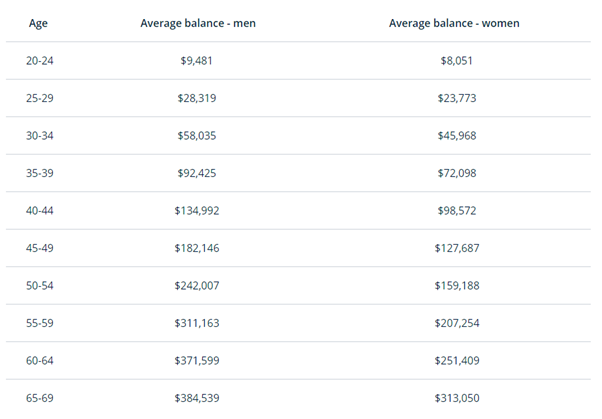
If your balance looks low, there could be several reasons why your super is lagging behind your peers – taking time out of the workforce to study, travel or care for older relatives, or perhaps being out of work, working part-time or earning a lower wage than others your age.
As the figures show, women are more likely to have lower super balances than their male counterparts – likely due to factors impacting their financial situation, such as taking time off work to raise children.
What to do if your super balance needs a boost?
If you check your super every 6-12 months and notice your balance isn’t as high as you’d like it to be, start with these quick and easy steps to give it a potential boost:
- Search for lost super. Money belonging to you might be sitting in an account you’ve forgotten about.
- If you have accounts with multiple super funds, think about consolidating it into one account. You could save on fees and charges that may be eating into your balance. However, you’ll need to check for exit or termination fees and ensure your insurance cover isn’t affected.
- Consider how your super is invested. Depending on how far you are from retirement you might think about switching it into a more growth-focused investment option. But bear in mind that returns aren’t guaranteed, and that higher risk accompanies the opportunity for higher returns. There’s also a risk you may lock in losses, so seek financial advice or contact your super fund.
Here are some ways to boost your balance over the long term by making additional contributions:
- Salary sacrificing: You can contribute extra cash into your super from your before-tax salary. The amount contributed will only be taxed at 15% if you earn under $250,000 a year or 30% if you earn $250,000 or more a year, rather than at your usual marginal tax rate. However, make sure your total concessional super contributions (including any your employer makes on your behalf) don’t exceed $25,000 per year. You’ll need to speak to your payroll department to set up a salary sacrifice arrangement.
- Personal tax-deductible contributions: If your employer doesn’t offer salary sacrifice, you’re unemployed, self-employed or you don’t want to salary sacrifice, you can make a personal tax-deductible contribution to your super. The amount you contribute is taxed at 15% if you earn under $250,000 a year, 30% if you earn $250,000 or more a year, and subject to the $25,000 per year limit.
- After-tax contributions (also known as non-concessional contributions): There’s a $100,000 limit per financial year on the amount of after-tax contributions you can make. If you are under age 65 at 1 July of the year the contribution is made, you can also ‘bring forward’ up to two years’ worth of after-tax contributions and make up to $300,000 contribution in a financial year.
- Spouse contributions: If your partner is out of work, a stay-at-home parent, working part-time or earning less than $40,000, adding to their super could benefit you both financially.
- Government contributions: If you’re a low or middle-income earner, you may be eligible for a co-contribution from the government when you add after-tax money to your super.
Need more help with your super?
To help make sure your retirement income will give you a comfortable life after work, speak to your financial adviser.
Source: AMP
How to start saving for your future in your 30s
By Robert Wright /February 04,2021/

Some big life changes – and big expenses – can occur in your 30s. The key to maximising your retirement savings now is making savvy, forward-thinking financial decisions.
This becomes even more relevant when you’re surrounded by the current economic uncertainty. Short-term needs and expenses are front-of-mind and you might prioritise saving more money for a rainy day. Even so, it’s still possible to balance this with preparing for retirement while in your 30s to help make sure you eventually leave the workforce with sufficient financial freedom.
Set a budget – and stick to it
Your budget shouldn’t be static, and it’s a good idea to reassess it at different stages of your life. This is particularly important from age 30, when you’re potentially faced with a lot of large expenses, both expected and unexpected.
Start saving as much as you can
You’re no longer new to the workforce and, with a decade of experience under your belt, you may be in a position to receive a promotion or pay rise.
But just because you’re earning more doesn’t mean you should spend more. In fact, as your income grows, so too should your financial and savings goals. If you developed strong savings habits in your 20s – now’s a good time to save and invest to set aside even more for your future.
Boost your super
It’s time to get serious about super, so your retirement savings are maximised – like consolidating funds where appropriate, choosing a fund that’s in line with your values and understanding where and how your money is generating an investment return, then it’s time to think about these tasks.
Next, if you were one of the thousands of Australians who withdrew their superannuation under the Federal Government’s early super access scheme, start thinking about how you might be able to replenish your super balance. You could do this by making a personal super contribution – you could then try claim this amount as a tax deduction in your tax return or potentially receive a government bonus to your super in the form of a co-contribution.
If you’re an employee, on top of the compulsory superannuation guarantee (SG) from your employer (currently 9.5%) you might also consider salary sacrificing, which is where your employer makes additional voluntary contributions to your super account. You choose the amount your comfortable salary sacrificing, and it’s paid directly from your before-tax income.
Whatever strategy you choose, by setting up payments as an automatic contribution, you’re less likely to even notice them coming out. Plus, putting these tactics in place now means you’re taking a small but vital step toward ensuring your financial wellbeing and a comfortable retirement.
Identify additional income streams
Help save for retirement in your 30s through a side hustle or by regularly getting rid of the stuff you no longer use. It’s also potentially a fun way to meet new people and spend more time doing the things you love. Consider putting whatever you earn from these side projects directly into your retirement account – you’ll be building funds for your future, while decluttering or getting your creative juices flowing.
Assess your insurance needs
With more responsibilities, and possibly debts, it’s probably a good time to make sure your financial future is protected with insurance. You might consider taking out private health insurance before you turn 31, to avoid paying a lifetime health cover loading on top of your premium.
While it may not seem like something you need just yet, income protection and life insurance are not just for oldies. They’re relevant for Aussies at all life stages, especially those of working age with ambitions for the future. Imagine if you couldn’t work because of illness or an accident – taking out insurance can protect you from having to dip into your savings to pay for unforeseen expenses whilst you’re off work.
Save and invest wisely
This is the decade where you might consider investing more aggressively for your future, however it’s important to make considered decisions with advice from those in the know.
If you’re a newbie investor, there are a lot of factors to take into consideration, including what level of risk you’re comfortable with and how diversified you’d like your portfolio to be. Start small, set clear goals and continually re-evaluate your progress.
Get personal finance advice
Whether you talk to your partner, use savvy friends as a sounding board, or get advice from your parents, it’s good to have honest conversations about personal finance. But it’s also important to understand the value of qualified professional advice. Consider making an appointment to see a financial adviser to help you better understand your financial situation, so you can set and reach your retirement goals.
Source: AMP
How to start saving for your future in your 20s
By Robert Wright /December 04,2020/

If you’re in your 20s, chances are that life could feel like a bit of a rollercoaster right now. The economic fallout of the coronavirus (COVID-19) may have knocked your personal finances for six and at the same time, you could be juggling new expenses and experiences for the first time, such as moving out of home and starting your first full-time job. Learning to juggle competing financial priorities and save for the future is essential.
While these lessons may be confronting at the moment, they can also teach valuable skills that your future self will thank you for. If you do things right in your 20s, you can lay the foundations for a solid financial future and set yourself up for life. Here’s how to put some sound plans in place to give yourself more choices about how you live your life in the years ahead.
Get budgeting
It might seem obvious but getting in the habit of budgeting when you’re young is one of the best ways to boost your future financial wellbeing.
Start by tracking what money you have coming in (your income) and going out (your expenses). It’s important to understand where your money is going and what proportion you’re spending on essentials, like rent, food and utilities, and non-essentials, like entertainment and clothes.
Practise mindful spending
No matter what your financial situation is at the moment, this is an ideal time to learn savvy spending techniques. Practising mindful spending is an easy way to ‘trick yourself’ into saving money. And when you do need to buy a big-ticket item, do your research, shop around and where possible, look out for seasonal sales to help stretch your hard-earned dollars further.
Compound your interest
When you’re in your 20s, your budget is usually pretty tight and there are plenty of other demands on your income. But if you can spare a few dollars from your pay, it can make a big difference later on.
By starting to save in your 20s, you have a great opportunity to maximise the growth potential of compound interest. This means that you not only earn interest on whatever funds you deposit into your savings account, but you also earn interest on that interest. It’s extra money – without the extra effort.
For example, if you begin with $100 in an account earning 2% interest a month, and deposit just $10 into the account every month, in 10 years you’ll have $1,449 in the account – $149 of that pure interest. If you keep doing that for your entire career, say 50 years, when you retire, you’ll have $10,568. Of that, $4,468 – almost half – is pure interest.
Watch your super grow
Once you earn over $450 a month, superannuation is compulsory in Australia for most employees, which typically means you’re in the fortunate position of being able to start planning for your retirement as soon as you get your first job – whether full-time, part-time or casual.
So, rather than thinking of super as a burden, think of it as an easy way to save for retirement in your 20s. It can be tax effective and harnesses the benefits of compound savings.
If you withdrew your super early
If you’ve been affected financially by the coronavirus (COVID-19), you may have withdrawn some of your super early, under the government’s early super access scheme.
While it might have helped in the short term, it’s important to consider the long-term implications of withdrawing any money from your super. Just as compound interest works to grow your retirement savings over time, the reverse is also true, and any money that was withdrawn this year could be worth much more by the time you’re ready to retire.
If you did withdraw some of your super early, think about whether you can commit to a plan for paying it back, once you’re back on your feet. You can do this by making personal contributions to your super.
Ditch personal loans and credit card debt
Falling into credit card debt at an early age can quickly spiral into an unhealthy financial future. If you do have any spare cash at the moment, it may be a good idea to prioritise debt repayments.
Write down all the money you owe, then rank each debt in terms of the interest rate on the amount. Payday loans and credit cards generally have higher interest rates, so you should prioritise paying them off first.
Learn to invest wisely
While you’re in your 20s, retirement isn’t just around the corner, which means you have more flexibility with your finances than someone in their 60s who may be planning to leave the workforce in a few years.
With fewer financial responsibilities, you may be in a position to take a few more risks with your investments – the thinking being that if things don’t work out, you have time to fix them.
Start early and consider talking to a financial adviser about choosing a mix of investments that will bring you gains you feel comfortable with, given your financial investment style.
Source: AMP
The right times for financial advice
By Robert Wright /December 04,2020/

COVID-19 has created uncertainty everywhere and impacted not just our health but our wealth too. From millennials to retirees, we’ve had to review our finances and adapt to the changing environment.
We’ve seen volatile share markets, slashed dividends on bank stocks, record-low interest rates and sectors like airlines, tourism and traditional retail struggling to survive. On the other hand, online shopping and e-commerce have surged, and more people are saving now than before the pandemic.
During this uncertainty, many people have found their financial adviser to be a critical source of guidance and a valuable sounding board. In many cases, the adviser-client relationship has been a long-term connection. It’s built over many years and based on trust and confidence that the adviser has the client’s best interest at the centre of every decision.
Demand for advice doubles
The financial advice industry is full of examples of clients reaching out to their advisers in recent months, leveraging these long-term relationships at a time of worry and crisis.
Recent research from the Investment Trends 2020 Financial Advice Report showed three in four financial advice clients had been in contact with their adviser to discuss the impact of the COVID-19 pandemic.
Advisers are also fielding an unprecedented number of calls from potential clients who are confused by the current markets and understand they need help.
The instability of recent times has undermined the confidence of those who are retired or are about to retire, with many wondering if they’ll be left with enough superannuation savings for a comfortable retirement. But those who have a long-term relationship with their adviser can rely on the fact their adviser knows them well, understands their unique circumstances and life goals, and can deliver advice tailored to them.
Advice for different life stages
Financial advice can be helpful at a range of life stages, not just when thinking about retirement. Some common things advisers can help navigate financially are:
- saving for and preparing to buy your first home
- getting married or starting a family
- budgeting and money management
- growing wealth
- estate planning
- planning for retirement
- retirement and aged care.
Advisers can help with practical advice in all these scenarios. But more importantly, they can help you focus on your financial priorities and goals and create a plan to achieve them.
Life’s journey has many twists and turns and points at which priorities change. For many people, it’s a journey best navigated not only with partners, family and friends but with a trusted financial adviser by their side.
Source: AMP