

Tag Archives: Financial Planning
Spouse super contributions – what are the benefits?
By Robert Wright /May 23,2025/

If your partner is earning a low income, working part-time, or currently unemployed, boosting their super could be a smart financial move for both of you.
When your partner isn’t earning much, or is out of work, their super might not be growing enough to support them in retirement. By contributing to their super, you may not only help them but also enjoy some tax benefits yourself.
We’ll explore how the spouse contributions tax offset works and how it differs from contribution splitting.
The spouse contributions tax offset
Are you eligible?
To be entitled to the spouse contributions tax offset:
- You need to make a non-concessional contribution to your spouse’s super. This means you add money from your after-tax income and don’t claim a tax deduction for it.
- You must be married or in a de facto relationship together and are not living apart or separately.
- You must both be Australian residents.
- Your spouse’s income should be $37,000 or less for the full tax offset, and under $40,000 for a partial tax offset.
- Your spouse is under 75 years of age, and their total superannuation balance is less than the general transfer balance cap ($1,900,000 for 2024-25) as at 30 June of the prior year.
What are the financial benefits?
If eligible, you can generally make a contribution to your spouse’s super fund and claim an 18% tax offset on up to $3,000 through your tax return.
To be eligible for the maximum tax offset, which works out to be $540, you need to contribute a minimum of $3,000 and your partner’s annual income needs to be $37,000 or less. If their income exceeds $37,000, you’re still eligible for a partial offset. However, once their income reaches $40,000, you’ll no longer be eligible for any offset, but can still make contributions on their behalf.
Are there limits to what can be contributed?
You can’t contribute more than your partner’s non-concessional contributions cap, which is $120,000 per year for everyone, noting any non-concessional contributions your partner may have already made.
However, if your partner is under 75 and eligible, they (or you) may be able to make up to three years of non-concessional contributions in a single income year, under bring-forward rules, which would allow a maximum contribution of up to $360,000.
Another thing to be aware of is that non-concessional contributions can’t be made once someone’s super balance reaches $1.9 million or above as at 30 June 2024. So you won’t be able to make a spouse contribution if your partner’s balance reaches that amount. There are also restrictions on the ability to trigger bring-forward rules for certain people with large super balances (more than $1.66 million in 2024-25).
There are also different super balance limits in place if you want to take advantage of the bring-forward rules.
How contributions splitting differs
Another way to increase your partner’s super is by splitting up to 85% of your concessional super contributions with them, which you either made or received in the previous financial year. Concessional super contributions can include employer and or salary-sacrifice contributions, as well as voluntary contributions you may have claimed a tax deduction for.
What rules apply for contribution splitting?
To be eligible for contributions splitting, your partner must be between age 60 (preservation age) and 65 (and not retired).
Are there limits to how much can be contributed?
Amounts you split from your super into your partner’s super will count toward your concessional contributions cap, which is $30,000 per year for everyone.
On top of this, unused cap amounts accrued in the last 5 years can also be contributed, if they’re eligible. Note, this broadly applies to people whose total super balance was less than $500,000 on 30 June of the previous financial year.
Do all super funds allow for this type of arrangement?
You’ll need to talk to your super fund to find out whether it offers contributions splitting, and it’s also worth asking whether there are any fees.
What else you and your partner should know
- If either of you exceeds super contribution caps, additional tax and penalties may apply.
- The value of your partner’s investment in super, like yours, can go up and down, so before making contributions, make sure you both understand any potential risks.
- The government sets rules about when you can access your super. Generally, you can access it when you’ve reached age 60 (preservation age) and retire.
- While you can’t personally make further non-concessional contributions into your super once you have a total super balance of $1.9 million or above (as at 30 June of the previous financial year), it’s still possible to make contributions to your partner’s super (noting the caps).
Where to go for more information
Your circumstances will play a big part in what you both decide to do. And, as the rules around spouse contributions and contributions splitting can be complex, it’s a good idea to chat to your financial adviser to make sure the approach you and your partner take is the right one.
Source: AMP
Using the bucket strategy to make your money last longer
By Robert Wright /February 28,2025/

How do you find the sweet spot between using your retirement savings to enjoy a comfortable standard of living, and investing so you won’t run out of money in the future? It’s a big question for many retirees.
Two in three retirees (69%) are concerned about running out of money in retirement, according to new research from Colonial First State (CFS)*.
A total of 41% said they sometimes felt so concerned about running out of money that it affected how they used their retirement savings and their current standard of living. A further 28% said this fear affected them significantly. Just one in three said they never worried about it.
With that in mind, it’s worth understanding what’s known as the ‘bucket strategy’ for how to manage your savings in retirement.
This strategy was conceived as a way for retirees to balance spending with the need to preserve capital and invest to grow your future retirement savings to last the distance.
How much you put into each bucket, and how you invest those buckets will depend on your level of retirement savings, the lifestyle you want in retirement, your risk appetite and any other income you may have. It’s worth getting financial advice to ensure this approach is right for you.
What is the bucket strategy?
Simply put, the bucket strategy involves keeping your money in different investment types designed to deliver short term, medium term and long term returns.
- Short term bucket: This is money you think you’ll need to access in the next one to three years. Consider keeping it in cash, such as high yield savings accounts or term deposits with staggered maturity dates.
This is money to live on and perhaps an emergency fund for those unexpected expenses, such as when your washing machine stops working or your car conks out.
There should be enough to get you through a market downturn if needed, so you don’t need to cash in higher growth investments and turn paper losses into real ones or sell units in your pension investment option when they may have experienced a short term drop in value.
Factor in any other income, such as the Age Pension if you receive it, or any work income, and set aside money to cover the rest.
- Medium term bucket: Consider holding money you may need in the next four to six years in income producing, relatively ‘safe’ assets like high quality bonds, fixed income investments, low risk, dividend paying stocks or a balanced pension investment option.
This bucket is designed to help your retirement savings keep pace with inflation. If you hold too much in cash, your retirement savings won’t grow very quickly.
- Long term bucket: This is the money you want to invest to grow over the long term. It can be kept in higher growth investment types that are often seen as higher risk, such as a growth pension investment option or growth shares.
This should be money you won’t need to touch for seven to 10 years, which gives it time to grow irrespective of any short term market volatility that may occur.
More than half your retirement savings may be generated from earnings on your pension investment option after you have retired^, so it’s worth quarantining a good amount in your long term bucket.
How does it work?
The bucket strategy is intended to balance the need to preserve your capital in retirement by putting some of your savings into low risk cash options.
This enables retirees to access income when you need it without dipping into higher growth investments that will grow your retirement savings over the long term and can therefore provide peace of mind about spending while also helping your retirement savings last longer.
It can be particularly beneficial in times of market volatility, such as if there is a market downturn, to prevent you having to sell higher risk investments at an inopportune time.
Keeping all your retirement savings in conservative investment options or cash that may not keep pace with inflation may be low risk but it won’t provide you with the best retirement outcomes over the long term.
As the funds in bucket 1 are used, consider topping it up from bucket 2, or even bucket 3, depending on market conditions, what you’re invested in, and how your investments are performing.
As mentioned, how much you put into each bucket, and how you invest those buckets will differ depending on your individual situation. It’s worth getting financial advice to ensure this approach is right for you.
And this strategy may require more active management of your retirement savings than some people may be comfortable with.
But the bucket strategy offers built in diversification by incorporating different investment types and time frames and can be useful for helping you decide how much to spend and how much to invest for the long term.
* Financial literacy and retirement study conducted between July and September 2024. Respondents included 834 retiree respondents.
^ Calculations by CFS. Projection starts at age 25 (with salary of $100,000), retirement at age 65 and super lasts until age 92. Superannuation earnings, tax on earnings, investment and administration fees, and yearly indexation of contributions and income stream payments, are based on the default assumptions used in ASIC’s Moneysmart calculator, available at moneysmart.gov.au as at August 2024.
Source: CFS
What assets can you have before losing your Age Pension?
By Robert Wright /February 28,2025/

There are many benefits to receiving an Age Pension or even a part pension, but there are limits to what level of income or assets you can have, to be eligible.
Regarding assets, the key limits as at 20 September 2024 are as follows:
To receive a full pension, assets (excluding the value of the primary residence) must be less than:
| Homeowner | Non-homeowner | |
| Single | $314,000 | $566,000 |
| Couple, combined | $470,000 | $722,000 |
- Indexed every 20 March, 1 July and 20 September. Source: Australian Government Services Australia.
To receive at least a part pension, assets must be less than:
| Homeowner | Non-homeowner | |
| Single | $695,500 | $947,500 |
| Couple | $1,045,500 | $1,297,500 |
| Couple – separated by illness | $1,233,000 | $1,485,000 |
- Indexed every 20 March, 1 July and 20 September. Recipients of Rent Assistance will have higher thresholds. Source: Australian Government Services Australia.
It’s important to note that if you get Rent Assistance, your cut off point will be higher. Use the Payment and Service Finder to find out your cut off point.
Asset reduction strategies
There are a number of strategies that may be used to reduce asset levels, which may result in qualifying for a part pension or increasing the current pension amount received.
However, before reducing your assets it is important to bear in mind whether your remaining savings can support any shortfall in your retirement income needs, as any increased pension amount may still be inadequate. Personal circumstances can also change and increase the reliance on your reduced savings. For example, future health issues may require a move into aged care, which can bring increased expenses.
With that in mind, here are six possible asset reduction strategies to help boost your pension:
- Gift within limits, for more than 5 years before qualifying age
If there is a desire to provide financial assistance to family or friends, gifting can reduce your assessable assets. The allowable amounts a single person or a couple combined may gift is $10,000 in a financial year or $30,000 over a rolling five financial year period. Any excess amounts will continue to count under the asset test (and deemed under the income test) for five years from the date of the gift. This is called deprivation.
If you are more than five financial years away from reaching your age pension age or from receiving any other Centrelink payments, you can gift any amount without affecting its eventual assessment once you reach age pension age.
- Homeowners can renovate
Your home is an exempt asset and any money spent to repair or improve it will form part of its value and will also be exempt from the assets test.
- Repay debt secured against exempt assets
Debts secured against exempt assets do not reduce your total assessable assets. An example is a mortgage against the family home, regardless of what the borrowed funds have been used to purchase. However, using assessable assets to repay these debts can reduce the overall assessed asset amount. Crucially, you must make actual repayments towards the debt; depositing or retaining cash in an offset account will not achieve this outcome.
- Funeral bonds within limits or prepaying funeral expenses
If you wish to set aside funds or pay for your funeral costs now, there are a couple of ways to do this which may reduce your assessable assets.
A person can invest up to $15,500 (as at 1 July 2024) in a funeral bond and this amount is exempt from the assets test. Members of a couple can have their own individual bond up to the same limit each. By contrast, if a couple invests jointly into a funeral bond, this must not exceed $15,500 i.e. it is not double the individual limit2.
In comparison, there is no limit to the amount that can be spent on prepaid funeral expenses. For the expenses to qualify, there must be a contract setting out the services paid for, state that it is fully paid, and must not be refundable. Importantly, both methods of paying for funeral costs are designed purely for this purpose and preventing assets from being accessed for any other reason.
- Contribute to younger spouse’s super and hold in accumulation phase
If you have a younger spouse who has not yet reached their Age Pension age and is eligible to contribute to super, contributing an amount into their super account may reduce your assessable assets. The elder spouse can even withdraw from their own super, generally as a tax free lump sum, to fund the contribution.
Investments held in the accumulation phase of super are not included in a person’s assessable assets if the account holder is below Age Pension age. Before using this strategy, any additional costs incurred should first be considered. Holding multiple super accounts may duplicate fees. Shifting funds into an accumulation account may increase the tax on the earnings on these investments to as much as 15%. Alternatively, earnings on the funds are tax free if invested in an account-based pension or potentially even personally.
Additionally, contributing to a younger spouse who is under Age Pension age, and still working, will ‘preserve’ these funds. They should also ensure they do not exceed their contribution caps3.
- Purchase a lifetime income stream
Lifetime income streams such as an annuity purchased after 1 July 2019 may be favourably assessed, according to the Social Services and Other Legislation Amendment (Supporting Retirement Incomes) Bill 20184. Where eligible, only 60% of the purchase price is assessed. This drops to 30% once the latter of age 84 (based on current life expectancy factors) or five years occurs.
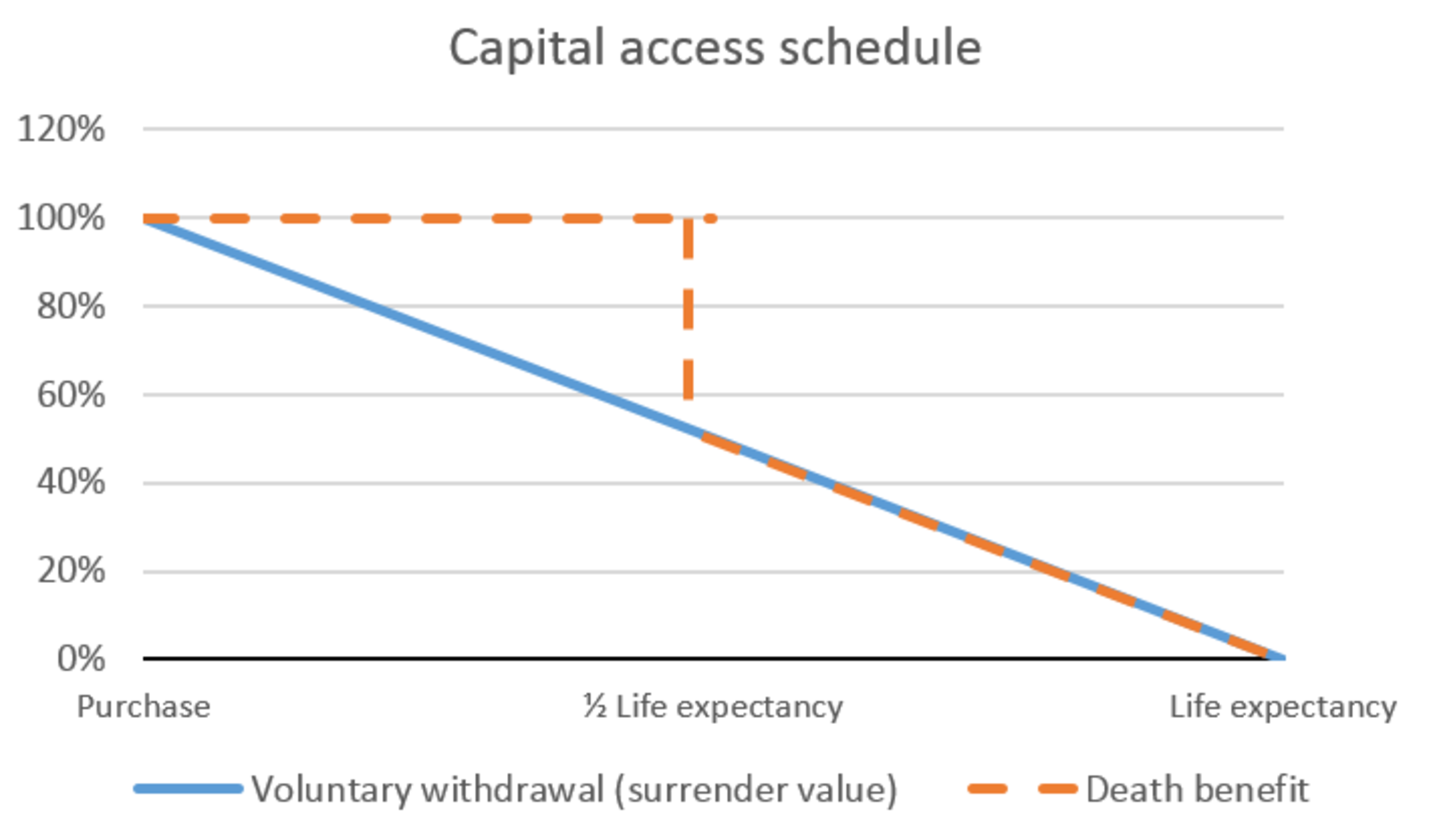
To receive concessional treatment, the lifetime annuity must satisfy a ‘capital access schedule’ which limits the amount that can be commuted voluntarily or on death4. This is illustrated below:
- Source: Parliament of Australia.
Voluntary commutations must follow a ‘straight line’ declining value, falling to nil at life expectancy. The death benefit can be up to 100% until the investor reaches half of their life expectancy, at which point it will follow the voluntary withdrawal value4.
Conclusion
Reducing your assessable assets within the relevant assets test threshold can provide many benefits such as increasing your existing pension or allowing you to qualify for a part pension, if you are currently above the upper asset test threshold.
While it is tempting to intentionally reduce your asset levels to gain these benefits, it is important to remember the Age Pension payment rate is determined by applying both an income and assets test. The test that results in a lower entitlement determines the amount receivable. If the income test is the harsher test, reducing your assessable assets may provide little or no benefit.
If the assets test is harsher, you should not lose sight of the fact that any reduction in your assets means there are fewer assets for you to call upon if required.
References:
1. https://www.servicesaustralia.gov.au/assets-test-for-age-pension?context=22526
2. https://www.servicesaustralia.gov.au/funeral-bonds-and-prepaid-funerals?context=22526
3. https://www.ato.gov.au/super/self-managed-super-funds/contributions-and-rollovers/contribution-caps/ and https://www.ato.gov.au/individuals-and-families/super-for-individuals-and-families/self-managed-super-funds-smsf/contributions-and-rollovers/contribution-caps
4. https://parlinfo.aph.gov.au/parlInfo/search/display/display.w3p;query=Id%3A%22legislation%2Fems%2Fr6224_ems_58c16ce0-95fa-4ef6-afe4-668b3e41fb62%22
Source: BT
Nine bad habits of ineffective investors: common mistakes investors make
By Robert Wright /November 20,2024/

Introduction
In the confusing and often seemingly illogical world of investing, investors often make various mistakes that keep them from reaching their financial goals. This note takes a look at the nine most common mistakes.
Mistake #1 Crowd support indicates a sure thing
“I will tell you how to become rich…Be fearful when others are greedy. Be greedy when others are fearful”. Warren Buffett, Investor and CEO
It’s normal to feel safer investing in an asset when your friends and neighbours are doing the same and media commentary is reinforcing the message that it’s the place to be. But “safety in numbers” is often doomed to failure. The trouble is that when everyone is bullish and has bought into an investment with general euphoria about it, it gets to a point where there is no one left to buy in the face of more positive supporting news but instead there are lots of people who can sell if the news turns sour. Of course, the opposite applies when everyone is pessimistic and bearish and have sold – it only takes a bit of good news to turn the value of the asset back up. So, the point of maximum opportunity is when the crowd is pessimistic (or fearful) and the point of maximum risk is when the crowd is euphoric (and greedy).
Mistake #2 Current returns are a guide to the future
“Past performance is not a reliable indicator of future performance”. Standard disclaimer
Faced with lots of information, investors often use simplifying assumptions, or rules, in order to process it. A common one of these is that “recent returns or the current state of the economy and investment markets are a guide to the future”. So tough economic conditions and recent poor returns are expected to continue and vice versa for good returns and good economic conditions. The problem with this is that when it’s combined with the “safety in numbers” mistake, it results in investors getting in at the wrong time (e.g. after an asset has already had strong gains) or getting out at the wrong time (e.g. when it is bottoming). In other words, buying high and selling low.
This is pertinent now with shares providing strong gains over the last two years – with US shares up 56%, global shares up 49% and Australian shares up 25% – despite lots of worries about interest rates, recession, commercial property and US banks, wars, elections, etc. This has brought with it a temptation to conclude we are in a “new era” where macro problems don’t matter and that even if they do central banks will protect us by slashing rates and pumping money in (the so-called “central bank put” which morphed from the “Greenspan put” many years ago) and governments will do the same with government spending.
Unfortunately, we have heard the “this time is different” argument many times before only to find out that it’s not – usually when we are most complacent! The reality is that shares have done well over the last two years because they came off a big cyclical fall in 2022 and the threats have not proved that serious economically. For instance, the much feared recession has failed to appear and the war in the Middle East has not disrupted global oil supplies (so far). And the “central bank put” did not prevent the tech wreck and the GFC (both saw US shares fall around 50%) and various other share market plunges. Just because shares have had strong returns over the last two years, despite lots of worries, doesn’t mean that the cycle has been abolished and that there is nothing at all to worry about.
Mistake #3 “Experts” will tell you what will happen
“Economists put decimal points in their forecasts to show that they have a sense of humour”. William Gillmore Simms, Novelist and Politician
The reality is that no one has a perfect crystal ball. It’s well known that forecasts as to where the share market, property market and currencies will be at a particular time have a dismal track record, so they need to be treated with care. Usually the grander the forecast, calls for “new eras of permanent prosperity” or for “great crashes ahead”, the greater the need for scepticism as either they get the timing wrong or it’s dead wrong.
Market prognosticators suffer from the same psychological biases as everyone else. And sometimes forecasts themselves can set in motion policy changes that make sure they don’t happen – such as rate cuts heading off sharp house price falls in the pandemic in 2020. The key value of investment experts is to provide an understanding of the issues around an investment and to put things in context. This can provide valuable information in terms of understanding the potential for an investment. But if forecasting was so easy, the forecasters would be rich and so would have retired!
Mistake #4 Shares can’t go up in a recession…
“It’s so good it’s bad, it’s so bad it’s good”. Anon
A common lament around in second half 2020, after share markets rebounded from their late March 2020 pandemic low, was that, “the share market is crazy as the economy is in deep recession and earnings are collapsing!” Of course, shares kept rising into 2022, economies recovered, and earnings rebounded. The reality is that share markets are forward looking, so when economic data and profits are really weak, the market has already factored it in.
History tells us that the best gains in stocks are usually made when the economic news is still poor, as stocks rebound from being undervalued and unloved, helped by falling interest rates. In other words, things are so bad they are actually good for investors! Of course, the opposite applies at market tops after a sustained economic recovery has left the economy overheated with no spare capacity and rising inflation and so the share market frets about rising rates. Hence things are so good they become bad! This seemingly perverse logic often trips up many investors.
Mistake #5 Letting a strongly held view get in the way
“The aim is to make money, not to be right”. Ned Davis, Investment Analyst
Many let their blind faith in a strongly held, often bearish view – “there is too much debt”, “aging populations will destroy returns”, “a house price crash is imminent”, “a Trump victory will see shares crash”, etc. – drive their investment decisions. This is easy to do as the human brain is wired to focus on the downside more than the upside, so we are easily attracted to doomsayers. They could be right one day but lose a lot of money in the interim. Giving too much attention to pessimists doesn’t pay for investors.
Mistake #6 Looking at your investments too much
“Investing should be like watching paint dry or watching grass grow. If you want excitement…go to Las Vegas”. Paul Samuelson, Economist
Checking up on how your investments are doing is a good thing, surely? But the danger is that the more investors are exposed to news around their investments, the more they may see them falling. Whereas share markets have historically generated positive returns more than 60% of the time on a monthly basis and more than 70% of the time on a calendar year basis, day to day it’s close to 50/50 as to whether the share market will be up or down.

Daily & monthly data from 1995, data for years and decades from 1900. Source: Bloomberg, AMP
Being exposed to this very short term “noise” and the chatter around it can cause investors to have a greater exposure to lower returning but safer investments that won’t grow wealth. The trick is to turn down the noise and have patience. Evidence shows that patient people make better investors because they can look beyond short-term noise and are less inclined to jump into one investment after another after they have already had their run.
Mistake #7 Making investing too complex
“There seems to be a perverse human characteristic that makes easy things difficult”. Warren Buffett
With the increasing ease of access to investment options, ways to put them together and information and processes to assess them, investing is getting more complex. But when you overcomplicate your investments, it can mean that you can’t see the wood for the trees. You can spend so much time focusing on this stock or ETF versus that stock or ETF or this fund manager versus that fund manager, that you ignore the key driver of your portfolio’s risk and return which is how much you have in shares, bonds, real assets, cash, onshore versus offshore, etc. Or that you end up in things you don’t understand. Instead, it’s best to avoid the clutter, don’t fret the small stuff, keep it simple and don’t invest in things you don’t understand.
Mistake #8 Too conservative early in life
“Compound interest is the eighth wonder of the world. He who understands it, earns it, he who doesn’t, pays it”. Albert Einstein, Theoretical Physicist
Cash and bank deposits are low risk and fine for near term spending requirements and emergency funds, but they won’t build wealth over time. The following chart shows the value of $1 invested in various Australian assets since 1900 allowing for the reinvestment of interest and dividends along the way. That $1 would have grown to $955,656 if invested in shares but only to $263 if invested in cash. Despite periodic setbacks, shown with arrows (such as WWI, the Great Depression, WWII, stagflation in the 1970s, the 1987 share crash and the GFC), shares and other growth assets grow to much higher values over time thanks to their higher returns over the long term than cash and bonds and thanks to the magic of compound interest where higher returns build on higher returns through time.

Source: ASX. Bloomberg, RBA, AMP
Not having enough in growth assets early in their career can be a problem for investors as it can make it harder to adequately fund retirement later in life as they miss out on the magic of compounding higher returns on higher returns through time in growth assets like shares and property. Fortunately, compulsory superannuation in Australia helps manage this, although early super withdrawal for various purposes (through the pandemic, for medical needs and as proposed for housing) may set this back for some. For example, a 30 year old who withdraws $20,000 from their super could have around $184,000 (or $74,000 in today’s dollars) less when they retire at age 67 based on assumptions in the ASIC MoneySmart Super Calculator.
Mistake #9 Trying to time the market
“Far more money has been lost by investors in preparing for corrections, or anticipating corrections, than has been lost in the corrections themselves”. Peter Lynch, Fund Manager
In the absence of a tried and tested process, trying to time the market, i.e. selling before falls and buying ahead of gains is very difficult. Many of the mistakes referred to above kick in and it can be a sure way to destroy wealth. Perhaps the best example of this is a comparison of returns if the investor is fully invested in shares versus missing out on the best days. Of course, if you can avoid the worst days during a given period you will boost your returns. But this is very hard and many investors only get out after the bad returns occur, just in time to miss out on some of the best days and so hurt their returns. If you were fully invested in Australian shares from January 1995, you would have returned 9.5% p.a. (including dividends but not allowing for franking credits). But if by trying to time the market you miss the 10 best days the return falls to 7.5% p.a. If you miss the 40 best days, it drops to just 3.5% p.a. Hence, it’s time in the market that’s the key, not timing the market. The last two years provide a classic example of how hard it is to time markets – there has been a long worry list, so it’s been easy to be gloomy but timing markets on the back of this has been a loser as shares put in strong gains.
Concluding comment
I know it sounds kind of boring and like a cliché, but the easiest way to overcome many of these mistakes is to have a long-term investment plan that allows for your goals and risk tolerance and then stick to it.
Source: AMP