

Tag Archives: Investment Strategy
Navigating market volatility
By Robert Wright /May 23,2025/

Financial markets have been erratic lately, understandably causing some concern for those of us with super and investments. While dips and major market events are a common feature of investing, markets generally trend upwards over time.
Most super funds invest in sharemarkets to help your money grow over in the long term. So when markets see-saw, so do super and investment balances and returns.
While this can be worrying, it’s important to remember that although the value of investments may go up and down at different times, markets tend to recover and grow over the long term. So it’s important to keep your long-term investment goals in mind.
What’s happened recently?
On 3 April, President Donald Trump announced the US would place tariffs on goods imported into the US from countries around the world. This included a 10% tariff on goods from Australia, which was the minimum rate announced on the day.
Major global economies and markets had been preparing for the announcements, but the tariffs imposed on some countries were bigger than expected. Other countries have also responded by putting similar tariffs on US goods coming into their markets.
As a result, share markets in the US and elsewhere fell sharply in the days afterwards, including the Australian Stock Exchange.
What is a tariff?
A tariff is a tax added to the cost of goods imported from a particular country or countries. It is paid to the government where the goods are being imported.
Tariffs are often used to protect domestic industries by increasing the price of foreign-made competitor products, or to raise revenue.
The cost of those items to the public will generally increase by a similar amount to the tariff.
What does this mean for markets and investments?
The US tariffs are expected to slow global trade and push up the price of some things, which could cause inflation to rise.
This could result in the Reserve Bank of Australia cutting the interest rate several times this year to prevent the economy from slowing down too much.
In the short term, you may see a negative effect on the performance of investments.
Short term volatility in response to political announcements and other geopolitical events is a common feature of investment markets.
While difficult to forecast, history shows us that markets do recover from disruptive influences – for example, from the Global Financial Crisis and the COVID-19 pandemic.
What led to this?
Since Trump’s second presidency began, uncertainty has emerged about US policy in the areas of tariffs, defence and other critical areas of government spending.
In recent months, shares have been quite weak, particularly US technology stocks. This group of stocks was optimistically priced after two years of strong growth, and therefore most at risk of uncertainty in the US market.
This has unsettled businesses amid concerns the US economy could slow. It has also fed into uncertainty in global investment markets, including the Australian sharemarket.
What does this mean for me?
As global financial markets move up and down, the value and returns of your super and investments may also change in the short term.
While this can be concerning, history shows that markets rise over time. So it’s important to keep your long-term savings and investment goals in mind and carefully consider before making any changes to your investment strategy.
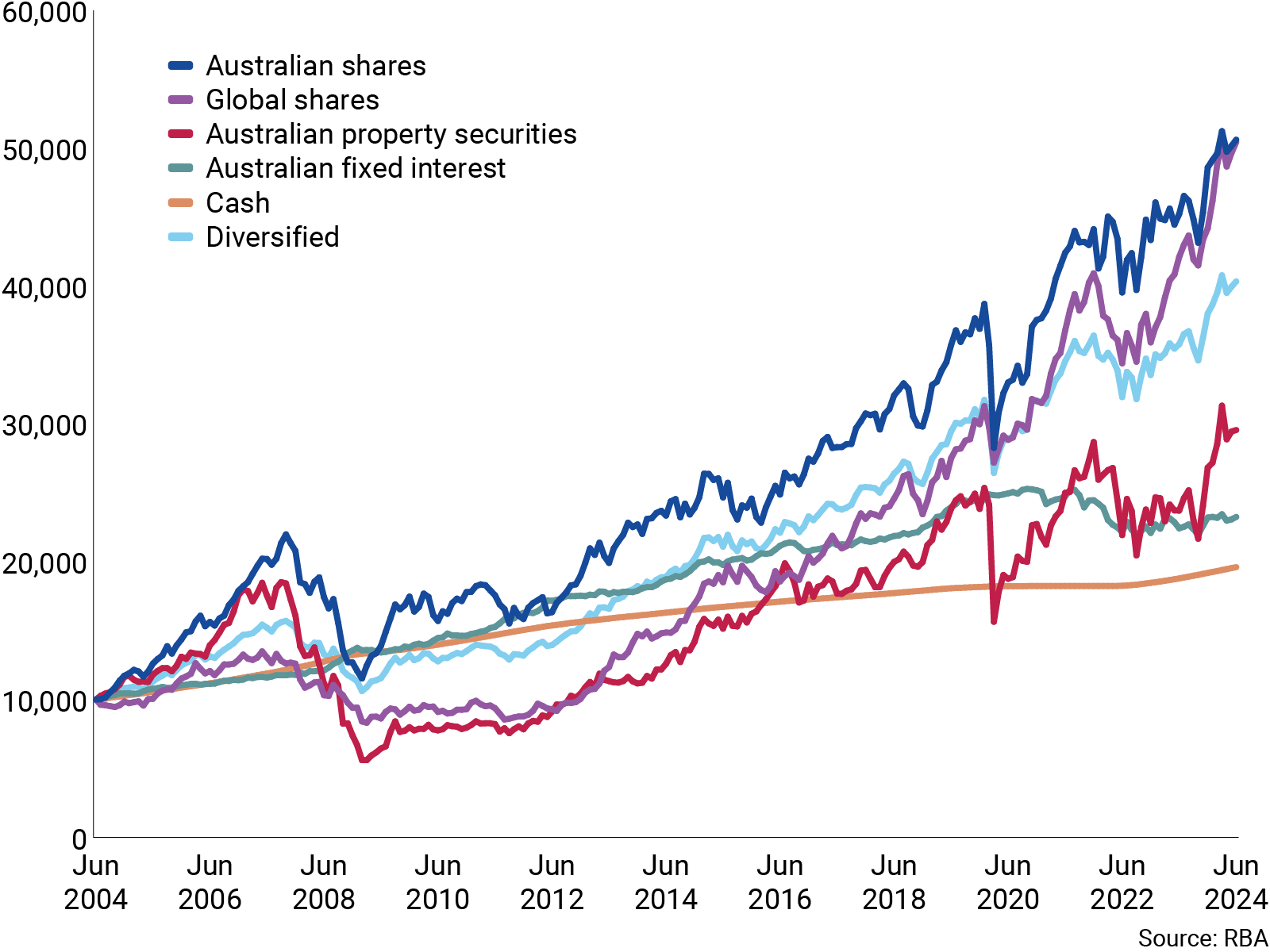
It’s understandable at times like these that some members think about changing how their money is invested. As this chart shows, the long-term trend across major investment types is positive, with shares experiencing more volatility but generating higher returns than more conservative options such as cash.
While past performance is not a guarantee of future performance, historically more time invested in the sharemarket has meant a higher return on investment.
How different investment types have performed over 20 years
It’s also worth noting that investment performance has generally been strong over the past two years, meaning the value of your investments or super may have been relatively high.
Do I need to do anything?
As with any significant market event, it’s best to avoid impulse reactions, but to take a long-term view.
Source: CFS
The ins and outs of geared share funds
By Robert Wright /February 28,2025/

Geared share funds are high risk and high reward. When share markets are doing well, the returns can be very high, but the opposite is also true. We look at the pros and cons, and the role of geared share funds in a diversified investment strategy.
Geared share funds can be a great way for investors to invest in shares – and share in the rewards – when the share market performs well over long periods of time.
Geared share funds magnify both positive and negative returns, so they’re considered high risk, high return investment options.
But exactly what is a geared share fund, and are they for everyone?
Let’s take a look at the ins and outs of this unique investment option.
What is a geared share fund?
Geared share funds accept money from investors and borrow money to invest alongside investors’ capital. The fund uses the pool of investors’ money and borrowed money to buy shares.
They amplify both positive returns and negative returns on the shares in which the fund invests.
On the upside, geared share funds generate higher returns than overall share market returns when markets are rising. Conversely, the value of your investment will drop further than equivalent investment options without internal gearing.
They are best explored as part of a long term, diversified investment strategy.
How do geared share funds work?
When you invest money in a geared share fund, the fund will borrow money to invest on your behalf, alongside your investment.
For example, for every $1,000 you invest in the fund, the geared share fund may borrow another $1,000. That would give you $2,000 of exposure to the shares in which the fund invests. So in addition to the returns generated from your capital, you also receive all the returns from the borrowed funds (less the cost of borrowing).
The fund’s gearing, or borrowing, effectively magnifies the returns of the underlying investments, whether they are gains or losses.
Geared share funds generally perform well when the share market is growing at a higher rate than the interest charged on borrowed money.
Geared share funds borrow at institutional interest rates, which are generally lower than those offered to individual investors.
Pros of geared share funds
- The gearing, or borrowing, is done within the fund: unlike a margin loan, the fund, rather than the investor, is responsible for repaying its loans. This model allows investors to keep a long term view on their investments, rather than worry about day to day performance of their investments.
- Investor exposure is limited to their invested capital: while the fund borrows on behalf of its investors to buy shares, if the share market falls, and the fund’s loans need to be repaid, individual investors will never lose more than their invested capital.
- Gains are magnified by gearing: when the shares in which the fund invests go up, the return to the investor may be much higher than if they had simply purchased an equivalent fund without gearing.
- Franking credits are magnified by gearing: when a geared fund invests in Australian shares, the gearing will also magnify the level of franking credits payable as part of income distributions.
- Long term gains magnify long term share performance: investors seeking to invest for a decade or more, and who are willing to ride out short term market falls, can do very well with geared share funds. The compounding effect of the additional returns from gearing is very powerful over the long term.
Cons of geared share funds
- Fees are relatively high: fees are charged not just on the $1,000 you invest, but also on the $1,000 that the fund borrows on your behalf. Fees reduce your return.
- Losses are magnified by gearing: when the shares in which the fund invests go down, losses will be much higher than if you simply purchased the same shares with the same initial investment.
- Short term share market falls can lead to big investment losses: investors who need to take out their capital at a particular point in time, or who are not prepared to wait for markets to recover, can suffer big losses if this coincides with a fall in markets.
When to consider geared share funds
Geared funds can play an important role within a diversified portfolio for investors looking for above average investment performance over the long term by accelerating their Australian and/or global share allocations.
Investors who can ride out short term market volatility and do not need to take out their money in the short term, may benefit from the long term returns that geared share funds can offer. Geared funds should therefore be particularly attractive to superannuation investors who cannot access their capital until retirement.
Investors who are risk averse and who may need to cash in their investment in the short term, may not find geared share funds a suitable investment.
Investors should always seek financial advice to ensure investments are suitable for their objectives, investment horizon, and personal circumstances.
Source: CFS
Nine bad habits of ineffective investors: common mistakes investors make
By Robert Wright /November 20,2024/

Introduction
In the confusing and often seemingly illogical world of investing, investors often make various mistakes that keep them from reaching their financial goals. This note takes a look at the nine most common mistakes.
Mistake #1 Crowd support indicates a sure thing
“I will tell you how to become rich…Be fearful when others are greedy. Be greedy when others are fearful”. Warren Buffett, Investor and CEO
It’s normal to feel safer investing in an asset when your friends and neighbours are doing the same and media commentary is reinforcing the message that it’s the place to be. But “safety in numbers” is often doomed to failure. The trouble is that when everyone is bullish and has bought into an investment with general euphoria about it, it gets to a point where there is no one left to buy in the face of more positive supporting news but instead there are lots of people who can sell if the news turns sour. Of course, the opposite applies when everyone is pessimistic and bearish and have sold – it only takes a bit of good news to turn the value of the asset back up. So, the point of maximum opportunity is when the crowd is pessimistic (or fearful) and the point of maximum risk is when the crowd is euphoric (and greedy).
Mistake #2 Current returns are a guide to the future
“Past performance is not a reliable indicator of future performance”. Standard disclaimer
Faced with lots of information, investors often use simplifying assumptions, or rules, in order to process it. A common one of these is that “recent returns or the current state of the economy and investment markets are a guide to the future”. So tough economic conditions and recent poor returns are expected to continue and vice versa for good returns and good economic conditions. The problem with this is that when it’s combined with the “safety in numbers” mistake, it results in investors getting in at the wrong time (e.g. after an asset has already had strong gains) or getting out at the wrong time (e.g. when it is bottoming). In other words, buying high and selling low.
This is pertinent now with shares providing strong gains over the last two years – with US shares up 56%, global shares up 49% and Australian shares up 25% – despite lots of worries about interest rates, recession, commercial property and US banks, wars, elections, etc. This has brought with it a temptation to conclude we are in a “new era” where macro problems don’t matter and that even if they do central banks will protect us by slashing rates and pumping money in (the so-called “central bank put” which morphed from the “Greenspan put” many years ago) and governments will do the same with government spending.
Unfortunately, we have heard the “this time is different” argument many times before only to find out that it’s not – usually when we are most complacent! The reality is that shares have done well over the last two years because they came off a big cyclical fall in 2022 and the threats have not proved that serious economically. For instance, the much feared recession has failed to appear and the war in the Middle East has not disrupted global oil supplies (so far). And the “central bank put” did not prevent the tech wreck and the GFC (both saw US shares fall around 50%) and various other share market plunges. Just because shares have had strong returns over the last two years, despite lots of worries, doesn’t mean that the cycle has been abolished and that there is nothing at all to worry about.
Mistake #3 “Experts” will tell you what will happen
“Economists put decimal points in their forecasts to show that they have a sense of humour”. William Gillmore Simms, Novelist and Politician
The reality is that no one has a perfect crystal ball. It’s well known that forecasts as to where the share market, property market and currencies will be at a particular time have a dismal track record, so they need to be treated with care. Usually the grander the forecast, calls for “new eras of permanent prosperity” or for “great crashes ahead”, the greater the need for scepticism as either they get the timing wrong or it’s dead wrong.
Market prognosticators suffer from the same psychological biases as everyone else. And sometimes forecasts themselves can set in motion policy changes that make sure they don’t happen – such as rate cuts heading off sharp house price falls in the pandemic in 2020. The key value of investment experts is to provide an understanding of the issues around an investment and to put things in context. This can provide valuable information in terms of understanding the potential for an investment. But if forecasting was so easy, the forecasters would be rich and so would have retired!
Mistake #4 Shares can’t go up in a recession…
“It’s so good it’s bad, it’s so bad it’s good”. Anon
A common lament around in second half 2020, after share markets rebounded from their late March 2020 pandemic low, was that, “the share market is crazy as the economy is in deep recession and earnings are collapsing!” Of course, shares kept rising into 2022, economies recovered, and earnings rebounded. The reality is that share markets are forward looking, so when economic data and profits are really weak, the market has already factored it in.
History tells us that the best gains in stocks are usually made when the economic news is still poor, as stocks rebound from being undervalued and unloved, helped by falling interest rates. In other words, things are so bad they are actually good for investors! Of course, the opposite applies at market tops after a sustained economic recovery has left the economy overheated with no spare capacity and rising inflation and so the share market frets about rising rates. Hence things are so good they become bad! This seemingly perverse logic often trips up many investors.
Mistake #5 Letting a strongly held view get in the way
“The aim is to make money, not to be right”. Ned Davis, Investment Analyst
Many let their blind faith in a strongly held, often bearish view – “there is too much debt”, “aging populations will destroy returns”, “a house price crash is imminent”, “a Trump victory will see shares crash”, etc. – drive their investment decisions. This is easy to do as the human brain is wired to focus on the downside more than the upside, so we are easily attracted to doomsayers. They could be right one day but lose a lot of money in the interim. Giving too much attention to pessimists doesn’t pay for investors.
Mistake #6 Looking at your investments too much
“Investing should be like watching paint dry or watching grass grow. If you want excitement…go to Las Vegas”. Paul Samuelson, Economist
Checking up on how your investments are doing is a good thing, surely? But the danger is that the more investors are exposed to news around their investments, the more they may see them falling. Whereas share markets have historically generated positive returns more than 60% of the time on a monthly basis and more than 70% of the time on a calendar year basis, day to day it’s close to 50/50 as to whether the share market will be up or down.

Daily & monthly data from 1995, data for years and decades from 1900. Source: Bloomberg, AMP
Being exposed to this very short term “noise” and the chatter around it can cause investors to have a greater exposure to lower returning but safer investments that won’t grow wealth. The trick is to turn down the noise and have patience. Evidence shows that patient people make better investors because they can look beyond short-term noise and are less inclined to jump into one investment after another after they have already had their run.
Mistake #7 Making investing too complex
“There seems to be a perverse human characteristic that makes easy things difficult”. Warren Buffett
With the increasing ease of access to investment options, ways to put them together and information and processes to assess them, investing is getting more complex. But when you overcomplicate your investments, it can mean that you can’t see the wood for the trees. You can spend so much time focusing on this stock or ETF versus that stock or ETF or this fund manager versus that fund manager, that you ignore the key driver of your portfolio’s risk and return which is how much you have in shares, bonds, real assets, cash, onshore versus offshore, etc. Or that you end up in things you don’t understand. Instead, it’s best to avoid the clutter, don’t fret the small stuff, keep it simple and don’t invest in things you don’t understand.
Mistake #8 Too conservative early in life
“Compound interest is the eighth wonder of the world. He who understands it, earns it, he who doesn’t, pays it”. Albert Einstein, Theoretical Physicist
Cash and bank deposits are low risk and fine for near term spending requirements and emergency funds, but they won’t build wealth over time. The following chart shows the value of $1 invested in various Australian assets since 1900 allowing for the reinvestment of interest and dividends along the way. That $1 would have grown to $955,656 if invested in shares but only to $263 if invested in cash. Despite periodic setbacks, shown with arrows (such as WWI, the Great Depression, WWII, stagflation in the 1970s, the 1987 share crash and the GFC), shares and other growth assets grow to much higher values over time thanks to their higher returns over the long term than cash and bonds and thanks to the magic of compound interest where higher returns build on higher returns through time.

Source: ASX. Bloomberg, RBA, AMP
Not having enough in growth assets early in their career can be a problem for investors as it can make it harder to adequately fund retirement later in life as they miss out on the magic of compounding higher returns on higher returns through time in growth assets like shares and property. Fortunately, compulsory superannuation in Australia helps manage this, although early super withdrawal for various purposes (through the pandemic, for medical needs and as proposed for housing) may set this back for some. For example, a 30 year old who withdraws $20,000 from their super could have around $184,000 (or $74,000 in today’s dollars) less when they retire at age 67 based on assumptions in the ASIC MoneySmart Super Calculator.
Mistake #9 Trying to time the market
“Far more money has been lost by investors in preparing for corrections, or anticipating corrections, than has been lost in the corrections themselves”. Peter Lynch, Fund Manager
In the absence of a tried and tested process, trying to time the market, i.e. selling before falls and buying ahead of gains is very difficult. Many of the mistakes referred to above kick in and it can be a sure way to destroy wealth. Perhaps the best example of this is a comparison of returns if the investor is fully invested in shares versus missing out on the best days. Of course, if you can avoid the worst days during a given period you will boost your returns. But this is very hard and many investors only get out after the bad returns occur, just in time to miss out on some of the best days and so hurt their returns. If you were fully invested in Australian shares from January 1995, you would have returned 9.5% p.a. (including dividends but not allowing for franking credits). But if by trying to time the market you miss the 10 best days the return falls to 7.5% p.a. If you miss the 40 best days, it drops to just 3.5% p.a. Hence, it’s time in the market that’s the key, not timing the market. The last two years provide a classic example of how hard it is to time markets – there has been a long worry list, so it’s been easy to be gloomy but timing markets on the back of this has been a loser as shares put in strong gains.
Concluding comment
I know it sounds kind of boring and like a cliché, but the easiest way to overcome many of these mistakes is to have a long-term investment plan that allows for your goals and risk tolerance and then stick to it.
Source: AMP
Decoding cognitive biases: what every investor needs to be aware of
By Robert Wright /August 23,2024/

Common human biases that investors should understand when it comes to investing is extremely important. These biases are ingrained in human nature, leading to tendencies to oversimplify, rely on quick thinking or exhibit excessive confidence in judgments, which may lead to investment mistakes. By gaining insight into these biases, investors may be able to make better decisions to help reduce risk and improve their investment outcomes in the long-term.
Numerous cognitive biases can affect how decisions are made. The key to mitigating these biases lies in recognising their presence, identifying when they might arise and then either making appropriate adjustments or obtaining help to moderate their impact.
Seven cognitive biases that might arise at various stages of an investor’s investing journey.
- Herding: The tendency to follow and mimic the actions of a larger group.
- Confirmation bias: The preference for information that confirms one’s existing beliefs or hypotheses.
- Overconfidence effect: Excessive confidence in one’s own investment decisions and abilities.
- Loss aversion: When the fear of loss is felt more intensely than the elation of gains.
- Endowment effect: Overvaluing assets because they are owned.
- Neglect of probability: Disregarding the actual likelihood of events and often overemphasising rare occurrences at the expense of more probable outcomes.
- Anchoring bias: The tendency to rely too heavily on a past reference or a single piece of information when making decisions.
Herding
The herd mentality occurs when people find reassurance and comfort in a concept that is widely adopted or believed by many others. In recent times, we have seen the herd mentality with the events that surrounded the GameStop stock event. Where many people saw the rise in stock prices and without proper investment research followed the trend of many others and invested.
This impacted a lot of investors who bought the stock due to the fear of missing out and the hype it created. We believe, to be a successful investor, you must be able to analyse and think independently. Speculative bubbles are typically the result of herd mentality. Herd mentality in investing can overshadow rational decision making and could increase the risk of financial losses.
Investors need to recognise the feeling of pressure to conform to popular opinion or follow the crowd and instead consider conducting research and analysis before making decisions, as well as seeking alternative views to challenge the consensus.
Confirmation bias
Confirmation bias is the tendency to favour information that corroborates pre-existing beliefs or theories. In our view, confirmation bias can lead to significant errors in investing. Investors may develop an inflated sense of certainty when they encounter consistent evidence supporting their choices. This overconfidence can create an illusion of infallibility, with an expectation that nothing can go wrong.
Overconfidence bias
Overconfidence bias in investing is where investors overestimate their knowledge, intuition and predictive capabilities, often leading to poor financial decisions. This bias can present itself through various ways such as excessive trading, under-diversification and the general disregard for potential risks.
Investors with overconfidence bias tend to believe they can time the market or have the ability to pick the winning stocks better than most, which in turn may also result in overtrading and increased transaction costs. Overconfidence can also lead to a lack of proper risk assessment and analysis, as investors might underestimate the likelihood of negative events or industry dynamics affecting their investments.
An example of overconfidence bias occurred during the dot-com bubble of the late 1990s and early 2000s. Many investors were overly optimistic about the growth potential of internet related companies. This led to inflated stock prices as more and more people invested in these companies without proper evaluation of their actual worth.
Loss aversion
Loss aversion is where a real or potential loss is perceived as much more severe than an equivalent gain. The pain of losing is often far greater than the joy in gaining the same amount.
This overwhelming fear of loss can cause investors to behave irrationally and make bad decisions, such as holding onto a stock for too long or too little time. For example, an investor whose stock begins to tumble, despite clear signs that recovery is unlikely, may be unable to bring themselves to sell due to the fear of loss in the portfolio. On the flip side, when a stock in the portfolio surges, they may quickly cash out, not wanting to see the possibility of those profits disappearing.
When an investor clings onto failing stocks, departs with successful stocks too quicky and fear governs their investment decision, it’s known as the disposition effect. It’s a direct consequence of loss aversion, leading investors to make overly cautious choices that ultimately undermine their financial goals.
So, understanding this bias may help investors make rational decisions to grow their portfolios while managing risk effectively.
Endowment effect
Closely related to the concept of loss aversion is the endowment effect. This effect arises when individuals place a greater value to items because they own them, as opposed to identical items that they do not own. It’s a cognitive bias where ownership elevates the perceived value of an item beyond its objective market value.
For example, an investor may develop a strong attachment to a particular stock. It could be the very first stock they ever invested in, or they may favour the company for a particular personal reason such as aligning with their values. If this stock begins to fall and financial experts are advising to sell, because of the value bias this investor has they may be unwilling to sell. The investor perceives the stock’s value as greater than what the market dictates, purely because of ownership. It is a delicate balance that is needed to be able to determine between attachment and sound financial decision making and can be challenging for some investors.
To help mitigate the endowment effect, investors should regularly review their portfolios and consider the help of a financial adviser. Establish clear, predefined criteria for selling assets, aligned with financial goals. Develop a detailed investment plan with specific financial goals, a well defined investment strategy is crucial to prevent emotional decision making. Understanding and focusing on long-term investment goals can also help in maintaining objectivity.
Neglect of probability
Humans often overlook or misjudge probabilities when making decisions, including investment decisions. Instead of considering a range of possible outcomes, many people tend to simplify and focus on a single estimate. However, the reality is that any outcome an investor anticipates may just be their best guess or most likely scenario. Around this expected outcome, there’s a range of potential results, represented by a distribution curve.
This curve can vary widely depending on the specific characteristics of the business involved. For instance, companies which are well established and have strong competitive positions, tend to have a narrower range of potential outcomes compared to less mature or more volatile companies, which are more susceptible to economic cycles or competitive pressures.
Another error investors may make is to overestimate or misprice the risk of very low probability events. That does not mean that ‘black swan’ events cannot happen but that overcompensating for very low probability events can be costly for investors.
Anchoring bias
Anchoring bias is the inclination to excessively rely on a previous reference or a single piece of information when making decisions. Numerous academic studies have explored the impact of anchoring on decision making. Typically, these studies prompt individuals to fixate on a completely random number (such as their birth year or age) before asking them to assign a value to something. The findings consistently demonstrate that people’s responses are influenced by the random number they focused on prior to being asked the question.
Looking at a recent share price is a common way investors may anchor their decisions. Some people even use a method called technical analysis, which looks at past price movements to predict future ones. However, just because a stock’s price was high or low in the past doesn’t tell us if it’s a good deal now.
Source: Magellan