

Tag Archives: Retirement Planning
How to save for retirement in your 50s
By Robert Wright /April 16,2021/

For many people, your 50s are your golden years, a time when you may be at the pinnacle of your career and some of the big expenses you needed in your 20s, 30s and 40s have levelled out. But, while it may be easy to slip into a comfortable pattern of splurging on yourself and your children, this is the final stretch towards reaching your financial goals – a time when you should be maximising your financial know-how.
Shift your mindset to your saving goals
You might have a regular income now (in fact, statistics say you’re likely to be earning your highest income between the ages 45 and 51). But how will your life change when you retire, and your finances are potentially reduced or more sporadic? What happens when you need to prioritise saving overspending?
An important tip for saving for your retirement in your 50s is to change your mindset early and focus on what’s essential, rather than nice. Now is the time to prioritise your needs over your wants so you can reach your savings goals. The first step is to use a retirement calculator to help get an idea of how much you’re likely to need.
Hold your nerve
If you’re like many Aussies, your retirement savings and other investments might have been hit by the effects of the coronavirus pandemic.
You may, however, need to re-evaluate some of your retirement plans and consider pushing back your retirement by a few years if you can.
Transition to retirement
Still keen to exit the workforce sooner rather than later? Another option to consider is transition to retirement, a stepped pathway into full retirement that lets you access some of your super funds while you’re still working.
This scheme is open to those aged between 55 and 60 who are still working and comes with a range of options that could help you leave full-time employment behind.
Aim to be debt-free
Your focus for the next decade should be on how you can enter retirement with as little debt as possible. The average mortgage in Australia is $384,7003, according to the Australian Bureau of Statistics.
Imagine if you were able to retire without having to make monthly repayments on sizable amounts like this? There are numerous strategies for shrinking your mortgage fast, from setting up offset accounts to making lump-sum repayments.
Don’t forget other, smaller debts as well. While your home loan likely comes with an interest rate of between 2.5% and 5%, credit cards and personal loans often have much higher interest rates attached to them. The sooner you get rid of this debt, the sooner you can channel money into your retirement finances to help you build a comfortable retirement income.
Teach your kids to be independent
A recent report found that more than five million Australians provide support to their adult children, and now is certainly a time that many parents will be thinking about it. If your children were among the 3.1 million people who withdrew money under the early super access scheme and you’re in a position to be able to help, consider working out a way that you can help them to repay the money over the coming months.
Source: AMP
How to save for retirement in your 40s
By Robert Wright /March 10,2021/

Let’s start with the good news: studies show that your income peaks between the ages of 45 and 54. You’ll potentially have more money than ever – but you may also have unexpected or unwelcome expenses, like divorce. At this age you might also put retirement planning on the backburner in favour of more pressing financial commitments, such as your mortgage and kids’ school fees. Use these potential life changes as the impetus to re-evaluate your assets and income, and look at how you can maximise savings for your retirement.
In your 40s, retirement age is still some 20 years away and, while that seems like plenty of time, your decisions now can help secure your financial future. Read on to find out how to save for retirement in your 40s.
Calculate how much you’ll need for retirement
According to the Association of Superannuation Funds of Australia, by the time you reach 49 you’ll have between around $87,500 and $145,000 in your super account. The same group estimates singles will need retirement savings of $545,000 for a comfortable retirement, while couples will need combined retirement savings of $640,000. Are you on track to getting there in the next couple of decades?
Set realistic financial goals
While your financial goals in your 20s and 30s may have been idealistic, as you get closer to retirement, they should become realistic. It’s time to develop a clear plan for your savings, with achievable short, mid and long-term targets in working towards your overall retirement goal.
Live within your means
Your 40s are typically peak earning years, but with Australia in the grip of a recession, many things aren’t typical right now. One thing that’s changed is where we do our work. At the start of the coronavirus epidemic, more than 10.5 million Aussies swiftly transitioned to working from home, and many people are yet to go back to the workplace. While there might have been some initial expenses to set up a suitable home workspace, there’s also a reduction in day-to-day costs like commuting. Consider funnelling any of this cash into your savings instead, to actively save for your retirement in your 40s
Become more mindful around spending on big-ticket items as well – before a splurge, try taking a day (or a week) to give yourself time to think about how much you really need the item. You’ll be surprised at how often you decide it’s not essential to your life, and the money you save can be added to your retirement savings instead.
Review your investments
Your super might be ticking along, but what about other investments? It’s not too late to start saving and investing. Work out what style of investor you are so you have a better understanding of how comfortable you are with risk. Then talk to a financial adviser about creating a portfolio that suits you, which might include property, shares and other investment classes.
Aim to be debt free
Entering retirement with debt means juggling repayments with a high interest rate, which will eat into your retirement income.
To enter retirement debt free, look at paying off your home loan before you retire. Preparing for retirement in your 40s might mean getting a better deal on interest rates or creating a budget that allows you to make extra contributions to your mortgage, above your minimum monthly repayments.
Make sure you pay off your credit card balance in full each month so you don’t accumulate interest. Be cautious about borrowing money that you won’t be able to pay off in a short period of time.
Update your insurance
For many people, COVID-19 has been a strong reminder of how much we value good health and wellbeing – and how quickly things can change. Having the right kind of insurance can help create peace of mind when you need it.
Review your private health insurance to make sure it’s still right for your needs, particularly if your circumstances have changed or you have a growing family. Income protection and life insurance help to protect you and your family if you can’t work due to injury or illness, so you can continue to pay the bills without dipping into your savings.
Plan for your kids’ futures
Your kids mean the world to you – we get it. But their education doesn’t have to come at the expense of your retirement. As part of your retirement planning, consider setting up a separate savings account to fund things like your kids’ school and university fees, so you don’t have to dip into your retirement fund for their education.
Show your children how and why you’re cutting back on discretionary spending (meals out, trips to the movies) to make their long-term goals (like getting a job) a priority. You’re never too young to develop a healthy understanding of finances and budgeting.
Source: AMP
How much super should I have at my age?
By Robert Wright /February 18,2021/

A healthy super balance is a key ingredient to living comfortably in retirement. But for many people, retirement is a long way off, and it can be hard to know if your super is on track. If you’ve ever been curious about how your super savings match up, read on to find out.
How much super do I need?
The amount of super you need to live comfortably in retirement depends on a range of factors, such as your cost of living, any outstanding debts you owe including a home loan, and whether or not you have other income streams such as investment returns.
The Association of Superannuation Funds of Australia (ASFA) retirement standard estimates if you own a home outright, singles will need retirement savings of $545,000 for a comfortable retirement, while couples will need combined retirement savings of $640,000.
How does your super compare?
Curious to know how your super account balance shapes up against others your age? The table below shows the average super balances for employed Australian men and women of different ages (excluding those with no super):
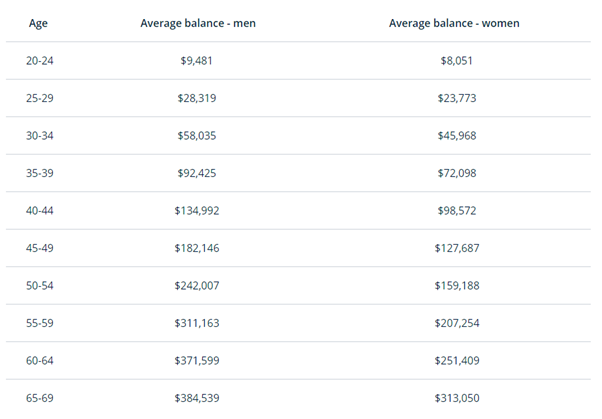
If your balance looks low, there could be several reasons why your super is lagging behind your peers – taking time out of the workforce to study, travel or care for older relatives, or perhaps being out of work, working part-time or earning a lower wage than others your age.
As the figures show, women are more likely to have lower super balances than their male counterparts – likely due to factors impacting their financial situation, such as taking time off work to raise children.
What to do if your super balance needs a boost?
If you check your super every 6-12 months and notice your balance isn’t as high as you’d like it to be, start with these quick and easy steps to give it a potential boost:
- Search for lost super. Money belonging to you might be sitting in an account you’ve forgotten about.
- If you have accounts with multiple super funds, think about consolidating it into one account. You could save on fees and charges that may be eating into your balance. However, you’ll need to check for exit or termination fees and ensure your insurance cover isn’t affected.
- Consider how your super is invested. Depending on how far you are from retirement you might think about switching it into a more growth-focused investment option. But bear in mind that returns aren’t guaranteed, and that higher risk accompanies the opportunity for higher returns. There’s also a risk you may lock in losses, so seek financial advice or contact your super fund.
Here are some ways to boost your balance over the long term by making additional contributions:
- Salary sacrificing: You can contribute extra cash into your super from your before-tax salary. The amount contributed will only be taxed at 15% if you earn under $250,000 a year or 30% if you earn $250,000 or more a year, rather than at your usual marginal tax rate. However, make sure your total concessional super contributions (including any your employer makes on your behalf) don’t exceed $25,000 per year. You’ll need to speak to your payroll department to set up a salary sacrifice arrangement.
- Personal tax-deductible contributions: If your employer doesn’t offer salary sacrifice, you’re unemployed, self-employed or you don’t want to salary sacrifice, you can make a personal tax-deductible contribution to your super. The amount you contribute is taxed at 15% if you earn under $250,000 a year, 30% if you earn $250,000 or more a year, and subject to the $25,000 per year limit.
- After-tax contributions (also known as non-concessional contributions): There’s a $100,000 limit per financial year on the amount of after-tax contributions you can make. If you are under age 65 at 1 July of the year the contribution is made, you can also ‘bring forward’ up to two years’ worth of after-tax contributions and make up to $300,000 contribution in a financial year.
- Spouse contributions: If your partner is out of work, a stay-at-home parent, working part-time or earning less than $40,000, adding to their super could benefit you both financially.
- Government contributions: If you’re a low or middle-income earner, you may be eligible for a co-contribution from the government when you add after-tax money to your super.
Need more help with your super?
To help make sure your retirement income will give you a comfortable life after work, speak to your financial adviser.
Source: AMP
The A-Z of Inheritance
By Robert Wright /February 18,2021/

Inheritance is an emotional subject on every level. The people leaving an inheritance generally do it with pride and love. The people receiving an inheritance often receive it with gratitude – and sorrow. But while emotional, it’s also a financial transfer that comes with a whole range of legal, financial planning and admin issues attached.
For many people inheritance is painful and protracted. It can lead to family disputes and disappointment. In this article, we look at both the financial and emotional aspects of inheritance and at how some forethought can make the process easier for everyone.
The Process: Leaving a Paper Trail
Moving wealth from one generation to the next does not happen quickly. Let’s think about why that is and why some intelligent forward planning is required.
Consider your own finances – all the bank and investment accounts, loans, credit cards, tax, super and insurances that make up your financial life. Think of all the documents, passwords, websites and email chains they create. Then hand them to someone who isn’t financially trained and hasn’t dealt with them every day like you have. Hand them to someone who’s emotionally drained by your passing – and then has to deal with the whole series of complex legal processes we outline below.
Get a grip on assets and liabilities
Before any inheritance gets distributed, the executor (the person you’ve appointed in your will to administer your estate) needs a deep and documented understanding of your financial position; what you own and what you owe. It’s complex and detailed work, but it needs to be done so a Statement of Assets and Liabilities can be submitted to the Supreme Court.
Probate – all about a valid will
After the assets and liabilities have been accounted for, the executor of your will needs to apply for Probate. The word tells its own story – it comes from the Latin probare: “to prove”.
It means a Court must certify that the will they’re working with is the valid one. Usually, the executor needs to advertise their intention to apply for probate in a newspaper or via the court website. They also need to give creditors time to lodge a claim against the estate.
Death and Taxes
Once Probate has been granted your executor must make sure outstanding taxes are paid and a date of death tax return and other tax returns are lodged. They also need to work through any other tax complexities, including family trusts, to ensure assets are passed on in compliance with tax law.
This is one area where a financial adviser or accountant – or both – can be invaluable. If you’re preparing your estate plan, their help can make sure you pass on assets to those you care about in the most-tax-effective fashion.
And if you’re receiving an inheritance, expert financial advice can help you manage the tax decisions more effectively.
Tax management is important. Australia doesn’t have death duties and most assets you inherit don’t get captured by Capital Gain Tax (CGT) when they transfer into your ownership. But CGT does apply when you sell those assets or, potentially, if you inherit residential property that has been used for investment purposes. Expert advice can help you manage these complexities.
Rings passed down for generations
Unless a claim is lodged against the estate (and it can’t be paid or negotiated away) the next step is for cash legacies, bequests and personal items – including jewellery – to be distributed. Individuals often use their will to make bequests to charitable organisations – these are identified and treated separately to the rest of the estate.
Distributing the estate
Once all legacies and bequests have been managed correctly, the balance of the estate (typically large assets like property, equity in businesses and investment holdings like shares) are distributed in accordance with the will or subsequent directions from a court. Sometimes this is not a final process – particularly if there are minor children involved. In these situations, the administration of the estate can be ongoing (which adds to complexity and costs).
As you can see, taking an inheritance from the reading of the will to the distribution of assets has already involved accounting, advertising and two layers of Court documentation. This all takes time – and that’s assuming there are no family disputes or arguments with the tax man or the deceased’s creditors.
The Emotions
We mentioned managing the process. Now we need to talk about managing your emotions. If all parties do that – the person leaving the inheritance and the person receiving it – the result can be better for all concerned. So, let’s look at the emotions involved in leaving an inheritance and the paths they can take us down.
Grief
In the aftermath of a loved one’s death, it can be hard to manage complex tasks, particularly if those tasks stir more emotion – like family disputes. Preparing for that challenge – perhaps by ensuring the executor has some financial skills, or is trusted by all parties, or is independent – can reduce the stresses placed on a grieving family.
Impatience
A simple look at the list above explains why patience is required in an inheritance situation. Understanding the probable time frame – which can vary depending on the complexity of the estate, but can often be a minimum of 12 months before an estate is settled – can make all the difference.
As we saw earlier, good advice can be crucial to setting up an estate plan that provides the maximum benefit for those you leave behind. It can be just as useful for the inheritors of an estate.
Reticence
According to research by Perpetual, some 53% of parents have not discussed their will and legacy with their children. More striking still, 80% of Australians who believe they will inherit something haven’t discussed that inheritance with their parents.
That lack of communication is at the heart of many fraught inheritance experiences. But to ensure that the transfer of wealth from one generation to the next happens with the minimum of complexity, cost and angst, all those involved need to be clear about their intentions – and their feelings.
Source: Perpetual