

Tag Archives: Retirement
What assets can you have before losing your Age Pension?
By Robert Wright /February 28,2025/

There are many benefits to receiving an Age Pension or even a part pension, but there are limits to what level of income or assets you can have, to be eligible.
Regarding assets, the key limits as at 20 September 2024 are as follows:
To receive a full pension, assets (excluding the value of the primary residence) must be less than:
| Homeowner | Non-homeowner | |
| Single | $314,000 | $566,000 |
| Couple, combined | $470,000 | $722,000 |
- Indexed every 20 March, 1 July and 20 September. Source: Australian Government Services Australia.
To receive at least a part pension, assets must be less than:
| Homeowner | Non-homeowner | |
| Single | $695,500 | $947,500 |
| Couple | $1,045,500 | $1,297,500 |
| Couple – separated by illness | $1,233,000 | $1,485,000 |
- Indexed every 20 March, 1 July and 20 September. Recipients of Rent Assistance will have higher thresholds. Source: Australian Government Services Australia.
It’s important to note that if you get Rent Assistance, your cut off point will be higher. Use the Payment and Service Finder to find out your cut off point.
Asset reduction strategies
There are a number of strategies that may be used to reduce asset levels, which may result in qualifying for a part pension or increasing the current pension amount received.
However, before reducing your assets it is important to bear in mind whether your remaining savings can support any shortfall in your retirement income needs, as any increased pension amount may still be inadequate. Personal circumstances can also change and increase the reliance on your reduced savings. For example, future health issues may require a move into aged care, which can bring increased expenses.
With that in mind, here are six possible asset reduction strategies to help boost your pension:
- Gift within limits, for more than 5 years before qualifying age
If there is a desire to provide financial assistance to family or friends, gifting can reduce your assessable assets. The allowable amounts a single person or a couple combined may gift is $10,000 in a financial year or $30,000 over a rolling five financial year period. Any excess amounts will continue to count under the asset test (and deemed under the income test) for five years from the date of the gift. This is called deprivation.
If you are more than five financial years away from reaching your age pension age or from receiving any other Centrelink payments, you can gift any amount without affecting its eventual assessment once you reach age pension age.
- Homeowners can renovate
Your home is an exempt asset and any money spent to repair or improve it will form part of its value and will also be exempt from the assets test.
- Repay debt secured against exempt assets
Debts secured against exempt assets do not reduce your total assessable assets. An example is a mortgage against the family home, regardless of what the borrowed funds have been used to purchase. However, using assessable assets to repay these debts can reduce the overall assessed asset amount. Crucially, you must make actual repayments towards the debt; depositing or retaining cash in an offset account will not achieve this outcome.
- Funeral bonds within limits or prepaying funeral expenses
If you wish to set aside funds or pay for your funeral costs now, there are a couple of ways to do this which may reduce your assessable assets.
A person can invest up to $15,500 (as at 1 July 2024) in a funeral bond and this amount is exempt from the assets test. Members of a couple can have their own individual bond up to the same limit each. By contrast, if a couple invests jointly into a funeral bond, this must not exceed $15,500 i.e. it is not double the individual limit2.
In comparison, there is no limit to the amount that can be spent on prepaid funeral expenses. For the expenses to qualify, there must be a contract setting out the services paid for, state that it is fully paid, and must not be refundable. Importantly, both methods of paying for funeral costs are designed purely for this purpose and preventing assets from being accessed for any other reason.
- Contribute to younger spouse’s super and hold in accumulation phase
If you have a younger spouse who has not yet reached their Age Pension age and is eligible to contribute to super, contributing an amount into their super account may reduce your assessable assets. The elder spouse can even withdraw from their own super, generally as a tax free lump sum, to fund the contribution.
Investments held in the accumulation phase of super are not included in a person’s assessable assets if the account holder is below Age Pension age. Before using this strategy, any additional costs incurred should first be considered. Holding multiple super accounts may duplicate fees. Shifting funds into an accumulation account may increase the tax on the earnings on these investments to as much as 15%. Alternatively, earnings on the funds are tax free if invested in an account-based pension or potentially even personally.
Additionally, contributing to a younger spouse who is under Age Pension age, and still working, will ‘preserve’ these funds. They should also ensure they do not exceed their contribution caps3.
- Purchase a lifetime income stream
Lifetime income streams such as an annuity purchased after 1 July 2019 may be favourably assessed, according to the Social Services and Other Legislation Amendment (Supporting Retirement Incomes) Bill 20184. Where eligible, only 60% of the purchase price is assessed. This drops to 30% once the latter of age 84 (based on current life expectancy factors) or five years occurs.
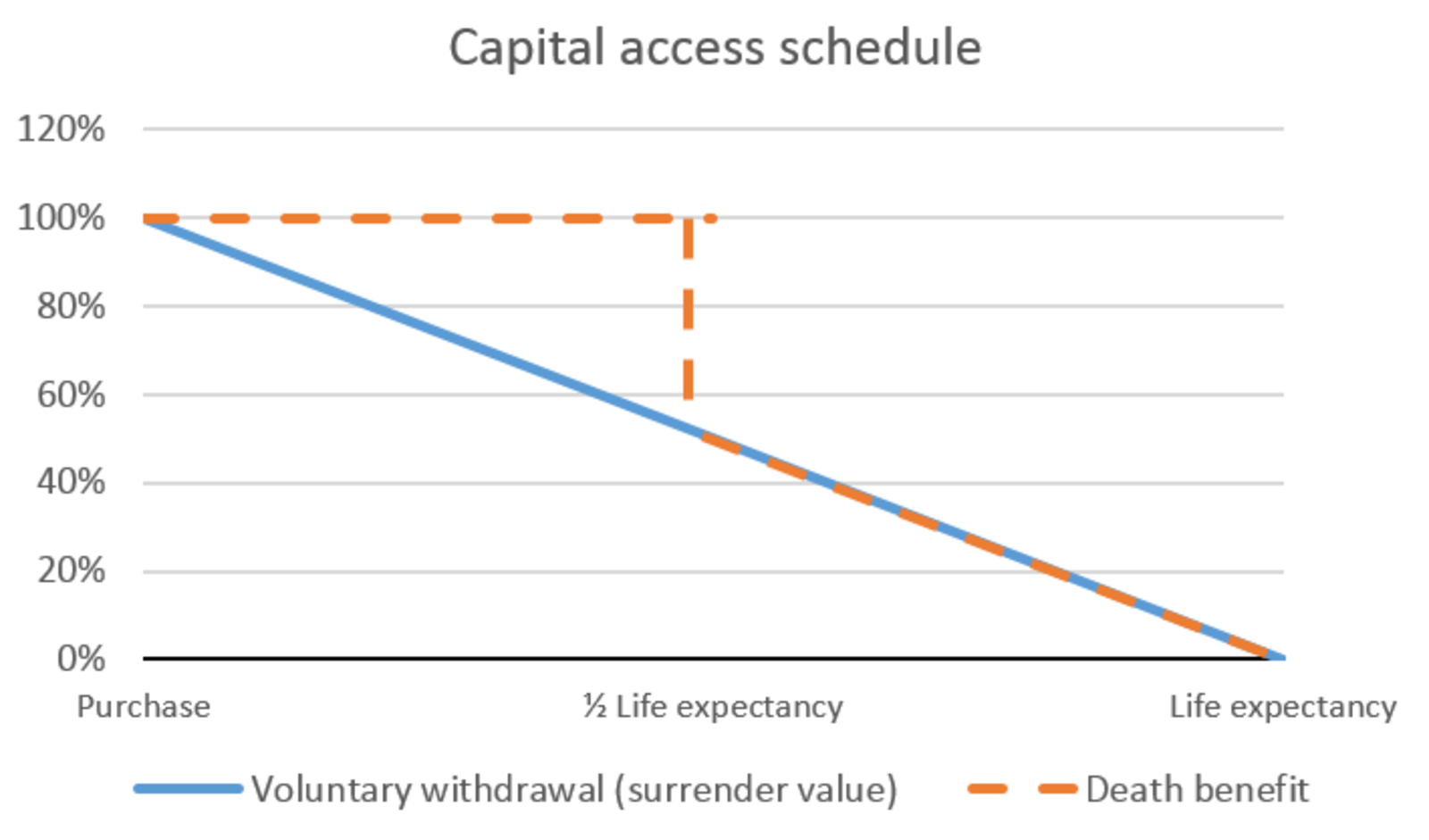
To receive concessional treatment, the lifetime annuity must satisfy a ‘capital access schedule’ which limits the amount that can be commuted voluntarily or on death4. This is illustrated below:
- Source: Parliament of Australia.
Voluntary commutations must follow a ‘straight line’ declining value, falling to nil at life expectancy. The death benefit can be up to 100% until the investor reaches half of their life expectancy, at which point it will follow the voluntary withdrawal value4.
Conclusion
Reducing your assessable assets within the relevant assets test threshold can provide many benefits such as increasing your existing pension or allowing you to qualify for a part pension, if you are currently above the upper asset test threshold.
While it is tempting to intentionally reduce your asset levels to gain these benefits, it is important to remember the Age Pension payment rate is determined by applying both an income and assets test. The test that results in a lower entitlement determines the amount receivable. If the income test is the harsher test, reducing your assessable assets may provide little or no benefit.
If the assets test is harsher, you should not lose sight of the fact that any reduction in your assets means there are fewer assets for you to call upon if required.
References:
1. https://www.servicesaustralia.gov.au/assets-test-for-age-pension?context=22526
2. https://www.servicesaustralia.gov.au/funeral-bonds-and-prepaid-funerals?context=22526
3. https://www.ato.gov.au/super/self-managed-super-funds/contributions-and-rollovers/contribution-caps/ and https://www.ato.gov.au/individuals-and-families/super-for-individuals-and-families/self-managed-super-funds-smsf/contributions-and-rollovers/contribution-caps
4. https://parlinfo.aph.gov.au/parlInfo/search/display/display.w3p;query=Id%3A%22legislation%2Fems%2Fr6224_ems_58c16ce0-95fa-4ef6-afe4-668b3e41fb62%22
Source: BT
Pros and cons of Self Managed Super Funds (SMSFs)
By Robert Wright /November 20,2024/

While self managed super funds are not for everyone, they do offer significant benefits. Running an SMSF successfully requires investment, legal, super and admin skills – or the ability to get help from people who have those skills.
Having control over how your retirement savings are invested is one of the many benefits of SMSFs.
On the flip side, the responsibilities and management skills required to run an SMSF are significant. This is because you’re accountable for your SMSFs regulatory compliance, not your accountant, financial adviser or solicitor.
What is an SMSF?
An SMSF is a private super fund you manage yourself, giving you more control over how your retirement savings are invested.
SMSF members must be trustees (or directors of the self managed super fund corporate trustee) and are beneficiaries of their SMSF. This means SMSF members are responsible for managing the fund’s investments and compliance with super and tax laws. This hands on approach sets SMSFs apart from public super funds, which are managed by financial institutions.
Benefits of SMSFs
- Access to more investment options
Having an SMSF provides more choice and freedom to access investment options that would otherwise be unavailable through a public super fund. This includes assets like real property, art and collectibles (such as stamps and coins), as well as physical gold.
Unlike investing with an industry, bank or retail super fund, your SMSF can borrow to invest in property, using a Limited Recourse Borrowing Arrangement (LRBA).
This strategy is a good option to help expand your investment portfolio. However, there are restrictions and compliance requirements. The Australian Taxation Office (ATO) has warned investors of the dangers of over investing (and over borrowing) into property within SMSFs.
- Control
If you’re a member of an SMSF, you have greater control over how your super’s invested while working, and how it’s paid when you retire.
This means you can invest in many of the products available to public super funds, as well as some products that aren’t. For example, SMSFs can invest directly in real estate, rather than being restricted to property trusts as many public funds are.
- Tax benefits
You’re entitled to the same reduced tax rates that are available through super so your investment return is taxed at a maximum of 15% (provided that your SMSF is a complying fund) rather than your personal income tax rate which could be as high as 45%. In addition, any payments received after the age of 60 are tax free.
These tax benefits are common to all super funds, not just SMSFs. However, SMSFs have more flexibility to use tax strategies around capital gains, taxable income or franking credits.
- More scale to access opportunities
Generally speaking, an SMSF can have up to six members. Bringing six investors’ money together, offers greater scale to access investment opportunities that may not be available to you as an individual investor.
Having scale may also help to keep fees down. This is because you can pool your assets and share expenses, leading to potential cost savings, which means you may have more funds available for investment growth.
- Estate planning
One often overlooked advantage of an SMSF is that they can provide greater flexibility or control with estate planning, if a member was to pass away.
An SMSF trust deed may also provide how and to whom death benefits will be distributed as long as these align with super law. The deed may also allow for cascading death benefit nominations or the exclusion of certain beneficiaries. Benefits could also be distributed to beneficiaries in a tax effective way.
Considerations to be aware of with SMSFs
- Responsibility
Managing an SMSF is not easy. As the trustee, you need to ensure the fund complies with all relevant regulations otherwise you could face severe consequences for getting it wrong.
If the fund is deemed to have breached its compliance responsibilities, penalties can include fines and civil or criminal proceedings. Depending on the offense, tax penalties could be increased, including fund returns being taxed at the top marginal tax rate as opposed to the concessional super rate of 15%.
- Expertise
What investors often overlook is the financial and investment expertise required to run, or be involved in running an SMSF.
As a trustee, you’ll be responsible for creating and implementing your own investment strategy – one that will need to deliver enough returns to adequately fund your retirement.
This means you need to:
- Understand how investment markets work, including share markets.
- Record your investments and transactions.
- Ensure your fund is adequately diversified to help manage risk.
You’ll also need to remain up to date on any changes to legislation that affect SMSFs as these may have compliance requirements.
An understanding of how to manage legal documents, such as a trust deed, is also beneficial. However, a legal professional could help you with this.
- Time
The administration and management of an SMSF is time intensive so if time is something you’re short of, an SMSF may not be a good option. On the other hand, many SMSF investors enjoy the sense of involvement and purpose that running their own fund brings.
- Higher insurance costs
Public super funds can generally provide cheaper insurance to their members than SMSFs. This is because they have large memberships and can negotiate discounted bulk premiums with insurance providers.
- Outsourcing your SMSF to professionals
If you find you don’t have the time or investment knowledge to manage your SMSF, you can outsource this to investment managers, financial advisers or other experts. This will come at an additional cost though.
- Minimum amount required for SMSFs
There is a lot of controversy around what should be a reasonable amount to set up an SMSF.
There’s no minimum amount required to set up an SMSF but depending on the fund’s complexity and structure, set up costs, administration, reporting and legal fees, it can become expensive. It’s generally more cost effective if your SMSF has a higher balance.
Source: MLC
Millions to get more Age Pension starting from 20 March 2024
By Robert Wright /May 28,2024/

Government Age Pension payments increased on 20 March, so if you’re one of the millions of eligible Australians, you’ll have a little more to spend.
The increases are designed to help address inflation and cost of living increases. Here’s what happened.
Age Pension payments increase in March 2024 due to indexation
Here are the maximum Age Pension payment rates that came into effect from 20 March, which are paid fortnightly, along with their respective annual equivalents. Single payments rose by $19.60 per fortnight, while combined payments for couples increased by $29.40.
Maximum Age Pension payments from 20 March 2024
| Fortnightly* | Annually* | |
| Single | $1,116.30 | $29,023.80 |
| Previous payment | $1,096.70 | $28,514.20 |
| Couple (each) | $841.40 | $21,876.40 |
| Previous payment | $826.70 | $21,494.20 |
| Couple (combined) | $1,682.80 | $43,752.80 |
| Previous payment | $1,653.40 | $42,988.40 |
*Includes basic rate plus maximum pension and energy supplements
The payment rate increased 1.8%, indexed to inflation. Payments last increased in September 2023 and are likely to change again when they are next assessed this coming September.
Tip: Depending on how much super you have, you may be eligible to receive Age Pension payments in addition to income from your super savings.
Income and assets test thresholds increase for the Age Pension
The government reviews the Age Pension income and assets test thresholds in July each year. The upper thresholds also increase in March and September each year in line with Age Pension payment increases.
Whether you are eligible for the Age Pension depends on your age, residency and your income and assets.
If your income and assets are below certain limits (also known as thresholds), you may be eligible.
When determining how much you’re entitled to receive under the income and assets tests, the test that results in the lower amount of Age Pension applies.
Here are the income and assets test thresholds that apply as at 20 March, compared with previous thresholds.
Assets test thresholds comparison
The lower assets test threshold determines the point where the full Age Pension starts to reduce, while the upper assets test thresholds determine what the cutoff points are for the part Age Pension.
If the value of your assets falls between the lower and upper assets test thresholds, your entitlement will reduce.
The higher your assessable assets, the lower the amount of Age Pension you are eligible to receive.
Your family home is exempt from the assets test but, your investments, household contents and motor vehicles may be included.
Asset test thresholds from 20 March 2024
| Full Age Pension limit | Part Age Pension cutoff | |
| Single – Homeowner | $301,750 (unchanged) | $674,000 |
| Previous threshold | $301,750 | $667,500 |
| Single – Non-homeowner | $543,750 (unchanged) | $916,000 |
| Previous threshold | $543,750 | $909,500 |
| Couple (combined) – Homeowner | $451,500 (unchanged) | $1,012,500 |
| Previous threshold | $451,500 | $1,003,000 |
| Couple (combined) – Non-homeowner | $693,500 (unchanged) | $1,254,500 |
| Previous threshold | $693,500 | $1,245,000 |
Income test thresholds comparison
The lower income test threshold determines the point where the full Age Pension starts to reduce, while the upper income test threshold determines what the cutoff point is for the part Age Pension.
Income includes things like payment for employment or self-employment activities, rental income, and a deemed rate of income from financial investments such as managed funds, super (if you are over the Age Pension age) or account-based pensions commenced after 1 January 2015.
Income doesn’t include things like emergency relief payments.
Income test thresholds from 20 March 2024
| Full Age Pension limit | Part Age Pension cutoff | |
| Single | $204 per fortnight (unchanged) | $2,436.60 per fortnight |
| Previous threshold | $204 per fortnight | $2,397.40 per fortnight |
| Couple (combined) | $360 per fortnight (unchanged) | $3,725.60 per fortnight |
| Previous threshold | $360 per fortnight | $3,666.80 per fortnight |
If you have income between the lower and upper income test thresholds, your entitlement will reduce as your level of income rises.
For example, the Age Pension payment for a single person earning more than $204 per fortnight will reduce by 50 cents for each dollar earned over $204.
For a couple earning more than $360 per fortnight combined, the Age Pension payment for each person will reduce by 25 cents for each dollar earned over $360.
Tip: The Work Bonus may allow you to receive more income from working, without reducing your Age Pension.
The maximum Work Bonus balance that you can accrue is $11,800.
Source: Colonial First State
Why investing for retirement is different
By Robert Wright /March 07,2023/

When you’re still employed and earning a salary, there’s money coming in you can rely on. In retirement, in the absence of a regular salary you’ll need to find a new way to secure enough income to cover your living costs.
Investing your money is one way to make the most of your savings and provide an income in retirement but if you’re expecting savings and investment earnings to help cover your expenses, it’s important to get your strategy right.
Why timing matters
When accumulating super for retirement, you can afford to be patient. With years ahead to top up your super, you can stay invested during falls in the share market and wait for markets and your assets to bounce back. For the few years just before and after retirement, it’s a different story. This period, known as the ‘retirement risk zone’, is the time when you have most to lose from a fall in the value of investments. Your super has likely reached its peak in value and you want to make the most of these savings for your future retirement income.
In order to protect your savings and provide you with income throughout your retirement, it’s important to be aware of three key risks:
1. Living longer
Australians are living longer than ever before. Life expectancy has grown by more than 30 years in the last century1. Living off retirement savings for 20-30 years or more introduces the very real risk of running out of money. So it’s no wonder more than half of Australians aged 50+ are worried about outliving their savings according to a 2019 National Seniors Australia survey.
We’re lucky that we live in a country that if your retirement savings run out; the Age Pension is there as a safety net but these regular payments may not be enough to maintain the lifestyle you’ve been enjoying in retirement. You could also be left with limited funds and options for aged care, if you should need it. That’s why it’s so important to make a financial plan early in your retirement so that you can help to protect your income now and in the future.
2. Inflation
Inflation measures the change in the cost of living over time and represents an important and often underestimated risk to your financial security in retirement. Given your retirement could last 20 plus years, there’s a good chance your savings and income will be affected by inflation. At an average annual inflation rate of 2.5%2, a dollar today is worth roughly half what it was 25 years ago. Even this modest year on year rise in the price of goods and services can put you at risk of having an income that no longer covers your living expenses from year to year.
3. Share market performance
Share market performance is a risk for investors with exposure to investments such as shares, bonds and commodities. If you’re worried about market collapses similar to the Global Financial Crisis (GFC) in 2008, you’re not alone. A 2018 National Seniors Australia survey found that 7 out of 10 older Australians share your concerns.
Falls in the value of investments are impossible to predict and can make a big difference to income and financial security throughout your retirement. When investments earn negative returns, your retirement savings are falling in value. Crucially, if you also need to make regular withdrawals to pay for living expenses, it’s a twofold blow for your overall financial position in retirement. Less savings now means more potential for outliving those savings later in life.
Protecting your income and future in retirement
Diversifying your investments – balancing growth and defensive assets for example can limit the impact of market risks and inflation on your retirement savings. However, even with a well diversified portfolio, your super and Age Pension may not provide you enough income for your entire retirement. If you’d like the peace of mind that comes with a regular income for life, a lifetime annuity might be right for you.
Using a portion of your savings or super, you can invest in a lifetime annuity and receive regular income payments for life. It can act as a safety net ensuring that you will receive income for life, regardless of how long you live.
Talk to an adviser about the benefits of a lifetime annuity and whether it might be right for you.
[1] Australian Bureau of Statistics, Life Expectancy improvements in Australia over the last 125 years, 18 October 2017.
[2] Australian Bureau of Statistics, 70 years of inflation in Australia, Andrew Glasscock, 2017. Fig 2.
Source: Challenger