

Tag Archives: Superannuation
How to save for retirement in your 60s
By Robert Wright /June 11,2021/

Your 60s are the time in which you’re most likely to retire – according to the Australian Bureau of Statistics, of the Aussies who are planning their retirement, the average age they intend to retire is 65.5 years. But just because you’re getting close to retirement age, doesn’t mean you can afford to stop being proactive about building your nest egg.
Alternatively, you might decide to follow through with your plans, and accept that your retirement income might be smaller. No matter which approach you choose, keeping an open mind and a flexible approach can make it easier to adapt to the current global economic situation.
Have a financial plan for your dream retirement
Many people love what they do and may not be looking forward to the prospect of walking away from full-time work. Others might be counting down the minutes until they can leave the office behind or be keen to scale back to part-time hours. Regardless of which category you fall into, as you start planning for retirement more seriously, now is the time to start picturing what your dream retirement will look like.
You can also use this time to turn your skills and hobbies – such as consulting or mentoring others – into additional retirement income. Whether you’re looking for part-time work or a hobby that brings in a little extra, why not get creative, keep busy, make new friends, and earn extra cash on the side, all at the same time?
Learn to live more frugally
Just because retirement is in your sights doesn’t mean you no longer need a retirement budget – in fact, retirement planning becomes essential in your final years in the workforce. To make sure your retirement savings are sufficiently healthy to support you through the rest of your life, it’s a good idea to revisit your budget and look at all the extra ways you can cut back on spending to give your finances a final boost.
Switching to online banking and shopping can be a sound way to keep track of your income and expenses so you have a better idea of where every dollar is being spent.
Now that you’re less likely to have dependants living with you, consider downsizing into an apartment or a smaller home – you’ll save money (reduced utility bills) and time (less space to clean). Think about selling furniture and other objects that you no longer need, including big-ticket items like a second car. Tightening your belt on the big things means you’ll still be able to afford the luxuries you’ve been counting on enjoying in retirement.
Fine-tune your passive income in retirement
Having a passive income stream – that is, income you earn from an investment, such as property or shares, rather than income you earn by working – is a great way to maintain your finances when you’re no longer in full-time employment.
Start by working out what style of investor you are, and then consider the type of portfolio that will best match your risk tolerance and the number of years you have left in the workforce. Talk to a financial adviser if you need more guidance on how to structure your investments.
Set up an emergency fund
Unexpected costs arise at all stages of life, whether related to your property or your health. In fact, recent research estimates that an Australian couple will spend between $4,700 and $9,500 a year on healthcare in retirement.
When you no longer have a steady income stream, dealing with these potentially hefty expenses can mean dipping into your savings. To avoid this, set up an emergency fund to cover any unplanned bills. Based on the average healthcare amounts mentioned above, you should be budgeting around $25 a day for an individual or, for a couple, $780 a month. Here’s how you can plan for unexpected healthcare costs in retirement.
Stay insured when you stop working
More than 70% of Australians with life insurance hold it through their superannuation. But in most cases, this ends when you turn 65. If you haven’t taken out separate life insurance, you may want to do it before you stop working.
The purpose of this type of insurance is to provide you and your family with financial security if you were to die or become terminally ill. Your premiums will be higher in your 60s, but you’ll have financial peace of mind knowing that things like living expenses will be taken care of if there’s an emergency.
Source: AMP
Transfer balance cap set to increase to $1.7 million
By Robert Wright /June 11,2021/

The amount of super savings that can be transferred into a retirement pension (whether you have one or more than one) will increase from $1.6 million to $1.7 million on 1 July this year, but not for everyone.
Currently you can transfer a maximum of $1.6 million from your super savings into a retirement pension (or pensions) to generate an income after you’ve finished working.
However, from 1 July 2021, this limit (known as the transfer balance cap) will increase to $1.7 million. While this is good news for some, the higher cap won’t apply to everyone, and other caps and limits will also be affected.
What is the transfer balance cap?
One of the main benefits of transferring super savings into a retirement pension is that the investment earnings within your retirement pension account are tax-free, and from age 60 onwards, so are any pension payments you receive.
The transfer balance cap is a limit on how much can be transferred from your super savings into a retirement pension, regardless of how many retirement pensions you hold. Note, these are not to be confused with the government’s Age Pension, or a transition to retirement pension.
Also, once you’ve transferred the maximum amount into a retirement pension (according to your personal transfer balance cap), you typically won’t be able to top up your retirement pension a second time, even if your balance reduces over time. If you transfer more than your relevant transfer balance cap into a retirement pension, tax penalties may apply.
Why is the transfer balance cap changing?
The reason the transfer balance cap is increasing by $100,000 to $1.7 million in the 2021-22 financial year is because changes to the cap are dependent on the cost of living, as measured by the Consumer Price Index, which recently went up.
Who does the new $1.7 million transfer balance cap apply to?
While the general transfer balance cap is changing, your personal transfer balance cap could remain at $1.6 million, could increase to $1.7 million, or it could be somewhere in between.
What that will come down to is whether you move, or have already moved, money from your super account into a retirement pension before 1 July 2021. How much you’ve moved will also have an impact.
What this means is, if you’ve never moved money from super into a retirement pension, and do this for the first time after 1 July 2021, the new transfer balance cap of $1.7 million will apply to you.
However, if you move, or have already moved, money from super into a retirement pension before 1 July 2021, this will not be the case. Instead, your personal transfer balance cap will be determined by how much you’ve already transferred into retirement pensions.
If you transfer (or have transferred) less than $1.6 million, your personal transfer balance cap will be anywhere between $1.6 million and $1.7 million.
If, by 1 July 2021 you fully use, or exceed, the transfer balance cap of $1.6 million, your personal cap will remain at $1.6 million.
These changes could affect what you do before and after 1 July 2021, so please contact us to discuss whether you may be affected.
Source: AMP
Good news – Super contribution caps to rise
By Robert Wright /June 11,2021/

On 1 July 2021, both the concessional and non-concessional superannuation contribution limits, also known as ‘super contribution caps’, will rise.
This is good news because this is the first time these limits have changed since 1 July 2017, when the concessional contributions cap was reduced to $25,000 pa for the 2017/2018 financial year and onwards.
Since that time, the non-concessional contribution cap hasn’t changed either, currently $100,000 pa.
What are Concessional contributions?
These are super contributions made by your employer, from your pre-tax income (salary sacrifice contribution) or contributions for which you claim a tax deduction. They are generally taxed at only 15 per cent instead of your marginal tax rate.
What are Non-concessional contributions?
These are super contributions made from your after-tax income. Since you’ve already paid income tax on these contributions, they are tax-free going into your super.
Due to indexation of Australians’ average weekly ordinary time earnings (AWOTE), the concessional cap will increase to $27,500 from 1 July 2021.
What are the current and new contribution caps?
| Current concessional contributions cap | New concessional contribution cap |
| $25,000 | $27,500 |
| Current non-concessional contributions cap | New non-concessional contribution cap |
| $100,000 | $110,000 |
What does this increase mean for you?
Any increase in the super contribution caps means you may increase how much you can contribute to super. The tax benefits plus the compounding of returns can make a substantial difference to your final super benefit.
Additional concessional contributions to super can be made by ‘salary sacrificing’ through your employer or via ‘personal deductible contributions’.
You should consider whether to make non-concessional contributions or maximise your concessional contributions.
Concessional contributions
Additional concessional contributions can reduce your taxable income and your end-of-year tax liability. Concessional contributions are subject to just 15% tax on entry to your super fund compared to your upper marginal tax rate which could be as high as 37% or 45% (plus 2% Medicare levy) if you’re in one of the highest tax brackets.
Note: an additional 15% tax may apply to concessional contributions if your income is over $250,000.
How to make concessional contributions
Additional concessional contributions to super can be made by ‘salary sacrificing’ through your employer or via ‘personal deductible contributions’. Both methods have the same tax benefit so the method you choose comes down to what suits you:
Salary sacrificing comes out of your pre-tax salary and reduces your net taxable income meaning you may pay less tax on your personal income.
Personal deductible contributions are paid by you, and you can then claim a tax deduction when completing your tax return. If you choose this method, you need to submit a form to your super fund by a certain time advising your ‘intent to claim a deduction’ on your super contribution.
Making the most of ‘catch up’ contributions
‘Catch up’ contributions may allow you to use up to five previous financial years’ unused contribution caps in the current financial year if you meet certain requirements. The 2018/19 financial year was the first financial year you could accumulate unused concessional contributions. Unused carried forward concessional cap amounts expire after five years.
Non-concessional contributions
Non-concessional contributions do not entitle you to a tax deduction, but you won’t pay any additional tax as you’ve already paid tax via your personal income tax liability. Earnings on the contributions are taxed at only 15% and are tax-free once you access them as either a lump sum or a pension after age 60, when you satisfy a condition of release such as retirement.
Making non-concessional contributions to super might benefit you if you are seeking to contribute larger lump sum contributions.
Making the most of the ‘bring forward rule’
If you were age 64 or less at 1 July 2020 you may be eligible to use the ‘bring forward rule’, ie bring forward and use up to two future years’ worth of your non-concessional contribution caps.
Depending on your total superannuation balance this may allow you to contribute up to $300,000 (3 x $100,000) into super this financial year. However, if you wait and the cap increases from $100,000 to $110,000, the bring forward amount will increase to $330,000 next financial year.
You generally need to meet a ‘work test’ if you are 67 to 74 years old at the time of contribution.
Legislation is pending to increase the age at which you can trigger the bring forward rule from age 64 or younger as at 1 July of the relevant financial year to age 66 or younger.
With increases in the contributions caps on the horizon, 2021 may be a good year to revisit how much you are contributing to super and make a super plan for the future.
Source: IOOF
How much super should I have at my age?
By Robert Wright /February 18,2021/

A healthy super balance is a key ingredient to living comfortably in retirement. But for many people, retirement is a long way off, and it can be hard to know if your super is on track. If you’ve ever been curious about how your super savings match up, read on to find out.
How much super do I need?
The amount of super you need to live comfortably in retirement depends on a range of factors, such as your cost of living, any outstanding debts you owe including a home loan, and whether or not you have other income streams such as investment returns.
The Association of Superannuation Funds of Australia (ASFA) retirement standard estimates if you own a home outright, singles will need retirement savings of $545,000 for a comfortable retirement, while couples will need combined retirement savings of $640,000.
How does your super compare?
Curious to know how your super account balance shapes up against others your age? The table below shows the average super balances for employed Australian men and women of different ages (excluding those with no super):
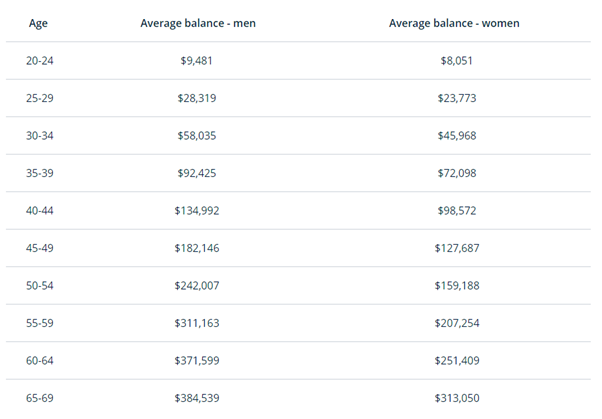
If your balance looks low, there could be several reasons why your super is lagging behind your peers – taking time out of the workforce to study, travel or care for older relatives, or perhaps being out of work, working part-time or earning a lower wage than others your age.
As the figures show, women are more likely to have lower super balances than their male counterparts – likely due to factors impacting their financial situation, such as taking time off work to raise children.
What to do if your super balance needs a boost?
If you check your super every 6-12 months and notice your balance isn’t as high as you’d like it to be, start with these quick and easy steps to give it a potential boost:
- Search for lost super. Money belonging to you might be sitting in an account you’ve forgotten about.
- If you have accounts with multiple super funds, think about consolidating it into one account. You could save on fees and charges that may be eating into your balance. However, you’ll need to check for exit or termination fees and ensure your insurance cover isn’t affected.
- Consider how your super is invested. Depending on how far you are from retirement you might think about switching it into a more growth-focused investment option. But bear in mind that returns aren’t guaranteed, and that higher risk accompanies the opportunity for higher returns. There’s also a risk you may lock in losses, so seek financial advice or contact your super fund.
Here are some ways to boost your balance over the long term by making additional contributions:
- Salary sacrificing: You can contribute extra cash into your super from your before-tax salary. The amount contributed will only be taxed at 15% if you earn under $250,000 a year or 30% if you earn $250,000 or more a year, rather than at your usual marginal tax rate. However, make sure your total concessional super contributions (including any your employer makes on your behalf) don’t exceed $25,000 per year. You’ll need to speak to your payroll department to set up a salary sacrifice arrangement.
- Personal tax-deductible contributions: If your employer doesn’t offer salary sacrifice, you’re unemployed, self-employed or you don’t want to salary sacrifice, you can make a personal tax-deductible contribution to your super. The amount you contribute is taxed at 15% if you earn under $250,000 a year, 30% if you earn $250,000 or more a year, and subject to the $25,000 per year limit.
- After-tax contributions (also known as non-concessional contributions): There’s a $100,000 limit per financial year on the amount of after-tax contributions you can make. If you are under age 65 at 1 July of the year the contribution is made, you can also ‘bring forward’ up to two years’ worth of after-tax contributions and make up to $300,000 contribution in a financial year.
- Spouse contributions: If your partner is out of work, a stay-at-home parent, working part-time or earning less than $40,000, adding to their super could benefit you both financially.
- Government contributions: If you’re a low or middle-income earner, you may be eligible for a co-contribution from the government when you add after-tax money to your super.
Need more help with your super?
To help make sure your retirement income will give you a comfortable life after work, speak to your financial adviser.
Source: AMP