

Tag Archives: Wealth Accumulation
Navigating market volatility
By Robert Wright /May 23,2025/

Financial markets have been erratic lately, understandably causing some concern for those of us with super and investments. While dips and major market events are a common feature of investing, markets generally trend upwards over time.
Most super funds invest in sharemarkets to help your money grow over in the long term. So when markets see-saw, so do super and investment balances and returns.
While this can be worrying, it’s important to remember that although the value of investments may go up and down at different times, markets tend to recover and grow over the long term. So it’s important to keep your long-term investment goals in mind.
What’s happened recently?
On 3 April, President Donald Trump announced the US would place tariffs on goods imported into the US from countries around the world. This included a 10% tariff on goods from Australia, which was the minimum rate announced on the day.
Major global economies and markets had been preparing for the announcements, but the tariffs imposed on some countries were bigger than expected. Other countries have also responded by putting similar tariffs on US goods coming into their markets.
As a result, share markets in the US and elsewhere fell sharply in the days afterwards, including the Australian Stock Exchange.
What is a tariff?
A tariff is a tax added to the cost of goods imported from a particular country or countries. It is paid to the government where the goods are being imported.
Tariffs are often used to protect domestic industries by increasing the price of foreign-made competitor products, or to raise revenue.
The cost of those items to the public will generally increase by a similar amount to the tariff.
What does this mean for markets and investments?
The US tariffs are expected to slow global trade and push up the price of some things, which could cause inflation to rise.
This could result in the Reserve Bank of Australia cutting the interest rate several times this year to prevent the economy from slowing down too much.
In the short term, you may see a negative effect on the performance of investments.
Short term volatility in response to political announcements and other geopolitical events is a common feature of investment markets.
While difficult to forecast, history shows us that markets do recover from disruptive influences – for example, from the Global Financial Crisis and the COVID-19 pandemic.
What led to this?
Since Trump’s second presidency began, uncertainty has emerged about US policy in the areas of tariffs, defence and other critical areas of government spending.
In recent months, shares have been quite weak, particularly US technology stocks. This group of stocks was optimistically priced after two years of strong growth, and therefore most at risk of uncertainty in the US market.
This has unsettled businesses amid concerns the US economy could slow. It has also fed into uncertainty in global investment markets, including the Australian sharemarket.
What does this mean for me?
As global financial markets move up and down, the value and returns of your super and investments may also change in the short term.
While this can be concerning, history shows that markets rise over time. So it’s important to keep your long-term savings and investment goals in mind and carefully consider before making any changes to your investment strategy.
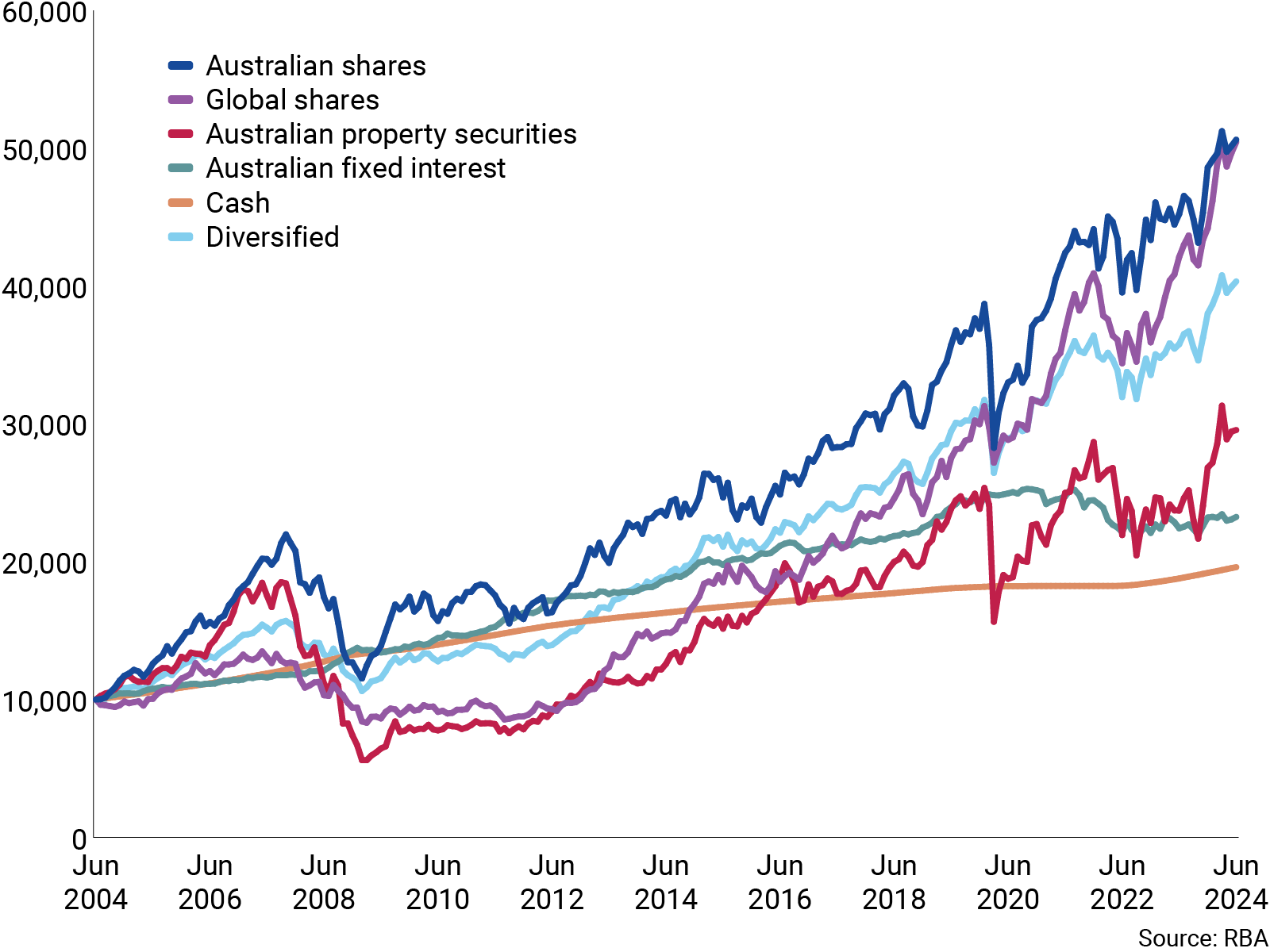
It’s understandable at times like these that some members think about changing how their money is invested. As this chart shows, the long-term trend across major investment types is positive, with shares experiencing more volatility but generating higher returns than more conservative options such as cash.
While past performance is not a guarantee of future performance, historically more time invested in the sharemarket has meant a higher return on investment.
How different investment types have performed over 20 years
It’s also worth noting that investment performance has generally been strong over the past two years, meaning the value of your investments or super may have been relatively high.
Do I need to do anything?
As with any significant market event, it’s best to avoid impulse reactions, but to take a long-term view.
Source: CFS
Spouse super contributions – what are the benefits?
By Robert Wright /May 23,2025/

If your partner is earning a low income, working part-time, or currently unemployed, boosting their super could be a smart financial move for both of you.
When your partner isn’t earning much, or is out of work, their super might not be growing enough to support them in retirement. By contributing to their super, you may not only help them but also enjoy some tax benefits yourself.
We’ll explore how the spouse contributions tax offset works and how it differs from contribution splitting.
The spouse contributions tax offset
Are you eligible?
To be entitled to the spouse contributions tax offset:
- You need to make a non-concessional contribution to your spouse’s super. This means you add money from your after-tax income and don’t claim a tax deduction for it.
- You must be married or in a de facto relationship together and are not living apart or separately.
- You must both be Australian residents.
- Your spouse’s income should be $37,000 or less for the full tax offset, and under $40,000 for a partial tax offset.
- Your spouse is under 75 years of age, and their total superannuation balance is less than the general transfer balance cap ($1,900,000 for 2024-25) as at 30 June of the prior year.
What are the financial benefits?
If eligible, you can generally make a contribution to your spouse’s super fund and claim an 18% tax offset on up to $3,000 through your tax return.
To be eligible for the maximum tax offset, which works out to be $540, you need to contribute a minimum of $3,000 and your partner’s annual income needs to be $37,000 or less. If their income exceeds $37,000, you’re still eligible for a partial offset. However, once their income reaches $40,000, you’ll no longer be eligible for any offset, but can still make contributions on their behalf.
Are there limits to what can be contributed?
You can’t contribute more than your partner’s non-concessional contributions cap, which is $120,000 per year for everyone, noting any non-concessional contributions your partner may have already made.
However, if your partner is under 75 and eligible, they (or you) may be able to make up to three years of non-concessional contributions in a single income year, under bring-forward rules, which would allow a maximum contribution of up to $360,000.
Another thing to be aware of is that non-concessional contributions can’t be made once someone’s super balance reaches $1.9 million or above as at 30 June 2024. So you won’t be able to make a spouse contribution if your partner’s balance reaches that amount. There are also restrictions on the ability to trigger bring-forward rules for certain people with large super balances (more than $1.66 million in 2024-25).
There are also different super balance limits in place if you want to take advantage of the bring-forward rules.
How contributions splitting differs
Another way to increase your partner’s super is by splitting up to 85% of your concessional super contributions with them, which you either made or received in the previous financial year. Concessional super contributions can include employer and or salary-sacrifice contributions, as well as voluntary contributions you may have claimed a tax deduction for.
What rules apply for contribution splitting?
To be eligible for contributions splitting, your partner must be between age 60 (preservation age) and 65 (and not retired).
Are there limits to how much can be contributed?
Amounts you split from your super into your partner’s super will count toward your concessional contributions cap, which is $30,000 per year for everyone.
On top of this, unused cap amounts accrued in the last 5 years can also be contributed, if they’re eligible. Note, this broadly applies to people whose total super balance was less than $500,000 on 30 June of the previous financial year.
Do all super funds allow for this type of arrangement?
You’ll need to talk to your super fund to find out whether it offers contributions splitting, and it’s also worth asking whether there are any fees.
What else you and your partner should know
- If either of you exceeds super contribution caps, additional tax and penalties may apply.
- The value of your partner’s investment in super, like yours, can go up and down, so before making contributions, make sure you both understand any potential risks.
- The government sets rules about when you can access your super. Generally, you can access it when you’ve reached age 60 (preservation age) and retire.
- While you can’t personally make further non-concessional contributions into your super once you have a total super balance of $1.9 million or above (as at 30 June of the previous financial year), it’s still possible to make contributions to your partner’s super (noting the caps).
Where to go for more information
Your circumstances will play a big part in what you both decide to do. And, as the rules around spouse contributions and contributions splitting can be complex, it’s a good idea to chat to your financial adviser to make sure the approach you and your partner take is the right one.
Source: AMP
The ins and outs of geared share funds
By Robert Wright /February 28,2025/

Geared share funds are high risk and high reward. When share markets are doing well, the returns can be very high, but the opposite is also true. We look at the pros and cons, and the role of geared share funds in a diversified investment strategy.
Geared share funds can be a great way for investors to invest in shares – and share in the rewards – when the share market performs well over long periods of time.
Geared share funds magnify both positive and negative returns, so they’re considered high risk, high return investment options.
But exactly what is a geared share fund, and are they for everyone?
Let’s take a look at the ins and outs of this unique investment option.
What is a geared share fund?
Geared share funds accept money from investors and borrow money to invest alongside investors’ capital. The fund uses the pool of investors’ money and borrowed money to buy shares.
They amplify both positive returns and negative returns on the shares in which the fund invests.
On the upside, geared share funds generate higher returns than overall share market returns when markets are rising. Conversely, the value of your investment will drop further than equivalent investment options without internal gearing.
They are best explored as part of a long term, diversified investment strategy.
How do geared share funds work?
When you invest money in a geared share fund, the fund will borrow money to invest on your behalf, alongside your investment.
For example, for every $1,000 you invest in the fund, the geared share fund may borrow another $1,000. That would give you $2,000 of exposure to the shares in which the fund invests. So in addition to the returns generated from your capital, you also receive all the returns from the borrowed funds (less the cost of borrowing).
The fund’s gearing, or borrowing, effectively magnifies the returns of the underlying investments, whether they are gains or losses.
Geared share funds generally perform well when the share market is growing at a higher rate than the interest charged on borrowed money.
Geared share funds borrow at institutional interest rates, which are generally lower than those offered to individual investors.
Pros of geared share funds
- The gearing, or borrowing, is done within the fund: unlike a margin loan, the fund, rather than the investor, is responsible for repaying its loans. This model allows investors to keep a long term view on their investments, rather than worry about day to day performance of their investments.
- Investor exposure is limited to their invested capital: while the fund borrows on behalf of its investors to buy shares, if the share market falls, and the fund’s loans need to be repaid, individual investors will never lose more than their invested capital.
- Gains are magnified by gearing: when the shares in which the fund invests go up, the return to the investor may be much higher than if they had simply purchased an equivalent fund without gearing.
- Franking credits are magnified by gearing: when a geared fund invests in Australian shares, the gearing will also magnify the level of franking credits payable as part of income distributions.
- Long term gains magnify long term share performance: investors seeking to invest for a decade or more, and who are willing to ride out short term market falls, can do very well with geared share funds. The compounding effect of the additional returns from gearing is very powerful over the long term.
Cons of geared share funds
- Fees are relatively high: fees are charged not just on the $1,000 you invest, but also on the $1,000 that the fund borrows on your behalf. Fees reduce your return.
- Losses are magnified by gearing: when the shares in which the fund invests go down, losses will be much higher than if you simply purchased the same shares with the same initial investment.
- Short term share market falls can lead to big investment losses: investors who need to take out their capital at a particular point in time, or who are not prepared to wait for markets to recover, can suffer big losses if this coincides with a fall in markets.
When to consider geared share funds
Geared funds can play an important role within a diversified portfolio for investors looking for above average investment performance over the long term by accelerating their Australian and/or global share allocations.
Investors who can ride out short term market volatility and do not need to take out their money in the short term, may benefit from the long term returns that geared share funds can offer. Geared funds should therefore be particularly attractive to superannuation investors who cannot access their capital until retirement.
Investors who are risk averse and who may need to cash in their investment in the short term, may not find geared share funds a suitable investment.
Investors should always seek financial advice to ensure investments are suitable for their objectives, investment horizon, and personal circumstances.
Source: CFS
Mortgage vs super: where should I put my extra money?
By Robert Wright /February 16,2024/

It’s a dilemma many of us face – are we better off directing extra money to our mortgage or super? As with most financial decisions, it’s not a one size fits all approach and here are some factors to consider in deciding what’s right for you.
Key takeaways:
- There may be tax advantages when you contribute to super, especially if you salary sacrifice or you’re eligible to claim a tax deduction for personal super contributions.
- The power of compounding returns could mean that even small contributions to your super over many years could make the world of difference.
- By making extra mortgage repayments, coupled with any potential increase in the value of your property, you will build equity in your property at a faster rate than if you were to make just the minimum repayments.
Building the case for super over mortgage
You might think your super is already being taken care of – after all, that’s what your employer’s compulsory Superannuation Guarantee contributions are all about. But these contributions alone often aren’t enough to ensure you achieve the retirement lifestyle you want to live.
Making extra contributions to your super is a great way to boost your retirement savings. As an investment vehicle, super is a very tax effective way to save for the future.
The power of compounding returns
Super is a long term investment, at least until you retire, and potentially much longer if you leave your money in super and draw a pension after you retire.
This long investment term, coupled with the rate of tax on your super investment (generally 15%), means your money can add up and generate further investment returns on those returns. This is known as compound returns, or compounding.
The expenses of daily life can be considerable. Thinking about directing money to super might not seem like a priority when we feel overwhelmed by the effort to save a deposit for a home, paying down debt, and the costs of raising a family.
However, the benefit of compounding returns means that even small, frequent contributions can make a big difference down the track. It’s about striking a balance that is right for you today and remember, nothing has to be forever. As your life changes, you can simply adjust your contributions strategy to suit your needs.
Building super early
To maximise your retirement savings while allowing compounding returns to do the heavy lifting, the best approach is to start early. The longer compounding continues, the bigger your savings could be. Entering retirement debt free is an attractive prospect. It can be easy to think that you need to repay your debt before you can start thinking about saving for retirement. However, it doesn’t have to be one or the other.
You can see the difference small, regular contributions could make to your final retirement income using the MoneySmart retirement planner calculator.
Tax benefits of super
From a tax point of view, super can be incredibly beneficial. Salary sacrificing some of your before-tax salary or making a voluntary after-tax contribution for which you can claim a tax deduction, can be effective ways to not only grow your retirement savings but also reduce your taxable income.
One great benefit of investing in super is that concessional (before tax) contributions are taxed at a maximum rate of 15%. This can be higher though if you earn over $250,000.
Mortgage repayments are usually made from your take home pay after you’ve paid tax at your marginal tax rate. Your marginal tax rate could be as high as 47%. So, depending on your circumstances, making a voluntary deductible contribution to super or salary sacrificing may result in an overall tax saving of up to 32%.
There is a limit on the amount you can contribute into super every year. These are referred to as contribution caps. Currently, the annual concessional contributions cap is $27,500. If you’re eligible to use the catch-up concessional contributions rules, you may be able to carry forward any unused concessional contributions for up to 5 years. If you exceed these caps, you may be liable to pay more tax.
Tax on super investment earnings
The initial tax savings are only part of the story. The tax on earnings within the super environment are also low.
The earnings generated by your super investments are taxed at a maximum rate of 15%, and eligible capital gains may be taxed as low as 10%. Once you retire and commence an income stream with your super savings, the investment earnings are exempt from tax, including capital gains.
Also, when it comes time to access your super in retirement, if you’re aged 60 or over, amounts that you access as a lump sum are generally tax free.
However, it’s important to remember that once contributions are made to your super, they become ‘preserved’. Generally, this means you can’t access these funds as a lump sum until you retire and reach your preservation age, between 55 and 60 depending on when you were born.
Before you start adding extra into your super, it’s a good idea to think about your broader financial goals and how much you can afford to put away because with limited exceptions, you generally won’t be able to access the money in super until you retire.
In contrast, many mortgages can be set up to allow you to redraw the extra payments you’ve made or access the amounts from an offset account.
Building the case for reducing your mortgage over super
For many people, paying off debt is the priority. Paying extra off your home loan now will reduce your monthly interest and help you pay off your loan sooner. If your home loan has a redraw or offset facility, you can still access the money if things get tight later.
Depending on your home loan’s size and term, interest paid over the term of the loan can be considerable – for example, interest on a $500,000 loan over a 25-year term, at a rate of 6% works out to be over $460,000. Paying off your mortgage early also frees up that future money for other uses.
Before you start making additional payments to your mortgage, it’s suggested that you should first consider what other non-deductible debt you may have, such as credit cards and personal loans. Generally, these products have higher interest rates attached to them so there is greater benefit in reducing this debt rather than your low interest rate mortgage.
Conclusion: mortgage or super
It’s one of those debates that rarely seems to have a clear-cut winner – should I pay off the mortgage or contribute extra to my super?
The answer, probably somewhat annoyingly, is that it depends on your personal circumstances.
There is no one size fits all solution when it comes to the best way to prepare for retirement. On the one hand, contributing more to your super may increase your final retirement income. On the other, making extra mortgage repayments can help you clear your debt sooner, increase your equity position and put you on the path to financial freedom.
When weighing up the pros and cons of each option, there are a few key points to keep in mind.
One of the key questions to consider is what is the likely balance you’ll need in your super? Work backwards starting with working through what retirement looks like for you, the type of lifestyle you’d like, and how much you need to live on each year.
From there, you can start to consider your sources of income in retirement. This is likely to include super but could also include a full or part Age Pension, or income from an investment property or other sources.
You can then start thinking about your current balance, contributions strategies and whether you’re on track to have enough saved to supplement your other retirement income sources.
The MoneySmart retirement planner calculator can help you to estimate how much super you may have in retirement and how long your super may last. You also need to think about how you plan to spend your money in retirement.
In most cases, there isn’t one set strategy that you should follow and it can quickly change as you grow older, start a family and reach retirement age. You should also consider whether you’ll need to access any additional funds you put aside before you reach retirement. If it’s in your super, it’s locked away. If it’s in your mortgage, there are generally options to redraw.
Home ownership and comfortable retirement are financial goals that many strive towards. If you reach a point where there’s some surplus cash flow to consider where to put your extra money, it’s a good dilemma to have.
Life is complex, so it pays to speak with a financial adviser before you make any big financial decisions when it comes to your super or mortgage.
Source: MLC