

Tag Archives: Wealth Accumulation
Change your spending habits and boost your happiness
By Robert Wright /March 10,2021/

After living through a year when our collective mental health took a beating, 2021 has brought with it a fresh sense of optimism and relief about what the future may hold. Like many people, you may be planning to do things differently this year.
But before you work on a wish list of things to buy and changes to make, you might like to take a look at the growing body of research into what we should spend our hard-earned cash on to bring us happiness.
Experiences, not consumption
Dr Thomas Gilovich, a professor of psychology at Cornell University in the US, has been exploring the relationship between spending and happiness for more than 20 years. After publishing a number of studies and reports, he offers important insights about how much happiness we can expect from buying stuff compared with spending on experiences.
“There’s a lot of work in the area of well-being and happiness showing that we adapt to most things,” Dr Gilovich says. “Therefore, things like a new material purchase make us happy initially, but very quickly we adapt to it, and it doesn’t bring us all that much joy. You could argue that adaptation is sort of an enemy of happiness. Other kinds of expenditures, such as experiential purchases, don’t seem as subject to adaptation.”
Not only do experiences leave us with lasting happy memories, anticipation of an experience can substantially increase your happiness, often more than the experience itself.
What kind of experiences?
If experiences define who we are, how can we determine what sort of experiences we should be having to make us happiest?
Much of the recent research on happiness has revealed that it’s “inextricably linked to having strong social ties and contributing to something bigger than yourself – the greater good.”
So it makes sense that experiences you share with others bring you more happiness than solitary ones.
Author and leading expert in positive psychology Martin Seligman has another theory. He divides experiences that bring us happiness into two categories: pleasures and gratifications. Pleasures bring us immediate contentment and enjoyment – things like a delicious meal or glass of wine, a massage or relaxing in a warm bath. There’s no doubt we’ll enjoy these experiences in the moment and remember them with appreciation, but they won’t bring us an enduring sense of satisfaction the way gratifications can. By challenging and engaging us, things like rock-climbing, dancing or restoring an old armchair can have a much longer lasting impact on our happiness.
Getting the best from experiences on a budget
The good news is that many gratifications don’t cost much, especially when compared with pleasures like expensive restaurant meals and holidays.
In his more happiness bang for your buck blog, Chairman of the Australian Government Financial Literacy Board, Paul Clitheroe offers a couple of useful tips for discovering new ways to experience happiness without spending big:
The $50 test
Take time to plan three activities costing less than $50 each during the next month. Ideas include going to the movies, buying art supplies, doing a cooking class or planting a small vegetable garden. For each activity rate how happy you think it will make you, how happy it makes you immediately after and how happy it makes you a month later. You’ll soon start to learn which experiences are contributing more to your overall happiness.
Keep a happiness diary
During the next month write down everything you buy and do in a notebook. Include how much it costs and how happy it makes you both immediately after and a month later. Now look at what you’re spending most of your money on. Does it match up with what makes you most happy?
When you take stock of what you’re spending money on and how happy you end up being as a result, you’ll have the insights you need to make changes to your budget and invest more wisely in your happiness.
Source: Money & Life
How much do I need to start investing?
By Robert Wright /March 10,2021/

While investing into traditional property might require a significant deposit, and a commitment to a long investment horizon, investing in shares, ETFs, managed accounts or managed funds can be accessed with a much smaller outlay along with the benefit of shorter term access to the value of your investment should the need arise.
It’s all about knowing where to start, which is quite often the hardest step. But we all have the potential to be successful investors – all it takes to get started is being armed with the right knowledge.
Taking the first steps
While some prefer to take the first few steps alone, others seek professional advice before investing. Either way, it’s important to select an investment type after you have done your research, determined your personal goals, and weighed up how you feel about risk.
Considerations such as your investment timeframe, current market conditions, expectations of future market conditions, and your tolerance to capital loss, and volatility (both positive and negative movement in returns) all need to be taken into account when choosing the right type of investment. This step alone is critical in assessing your propensity to take certain levels of risk to achieve an expected return over a given time-frame.
As mentioned above, it doesn’t take a lot to get started. You can begin investing directly in shares, or a managed investment (offering a diversified range of investment assets including shares), with a lump sum of as little as $1000, or less when setting up a regular investment plan. You can also contribute regularly to steadily grow your investments and build a diversified portfolio – while taking advantage of the benefits of compounding returns.
Paying yourself first
If your budget isn’t quite working and you’re struggling to set aside funds to grow initial capital, there is an alternate strategy.
Called ‘pay yourself first’, instead of aiming to save whatever is left over after regular bills and expenses, consider setting aside a fixed percentage of your regular wage or salary as soon as you get paid. Better still, set up an online funds transfer with your bank timed with each pay day, so that this amount goes directly into your savings account – you may be surprised how quickly you can accumulate funds to start investing.
Doing the groundwork
Be sure to do plenty of research so you understand the market and assets in which you’ll be investing. You should also research the products you’ll use to invest in that market, such as a managed fund (you should always read the Product Disclosure Statement for the fund itself). For shares in a listed company, it might mean looking at companies’ annual reports, analyst research reports or on a stock exchange’s website.
The key point is, there’s a wealth of information you can, and should use, to help decide which investments to consider. This information should also provide insights into the risks and to some extent the tax implications of the investment you are considering.
Another critical piece of research and decision making driver when choosing the types of investments to use is looking at the costs of investing. Things such as brokerage when purchasing shares, management fees and buy/sell costs when purchasing managed funds are key when investing as when investing small amounts, fees can play a major part in impacting your initial outlay.
Getting started
Having done your research, and formulated an investment strategy, getting started can require filling out a form, or applying digitally to purchase the investments you have selected (and paying some initial capital). From here, you might decide to set up a direct debit to steadily add to your investment portfolio.
Source: BT
How to save for retirement in your 40s
By Robert Wright /March 10,2021/

Let’s start with the good news: studies show that your income peaks between the ages of 45 and 54. You’ll potentially have more money than ever – but you may also have unexpected or unwelcome expenses, like divorce. At this age you might also put retirement planning on the backburner in favour of more pressing financial commitments, such as your mortgage and kids’ school fees. Use these potential life changes as the impetus to re-evaluate your assets and income, and look at how you can maximise savings for your retirement.
In your 40s, retirement age is still some 20 years away and, while that seems like plenty of time, your decisions now can help secure your financial future. Read on to find out how to save for retirement in your 40s.
Calculate how much you’ll need for retirement
According to the Association of Superannuation Funds of Australia, by the time you reach 49 you’ll have between around $87,500 and $145,000 in your super account. The same group estimates singles will need retirement savings of $545,000 for a comfortable retirement, while couples will need combined retirement savings of $640,000. Are you on track to getting there in the next couple of decades?
Set realistic financial goals
While your financial goals in your 20s and 30s may have been idealistic, as you get closer to retirement, they should become realistic. It’s time to develop a clear plan for your savings, with achievable short, mid and long-term targets in working towards your overall retirement goal.
Live within your means
Your 40s are typically peak earning years, but with Australia in the grip of a recession, many things aren’t typical right now. One thing that’s changed is where we do our work. At the start of the coronavirus epidemic, more than 10.5 million Aussies swiftly transitioned to working from home, and many people are yet to go back to the workplace. While there might have been some initial expenses to set up a suitable home workspace, there’s also a reduction in day-to-day costs like commuting. Consider funnelling any of this cash into your savings instead, to actively save for your retirement in your 40s
Become more mindful around spending on big-ticket items as well – before a splurge, try taking a day (or a week) to give yourself time to think about how much you really need the item. You’ll be surprised at how often you decide it’s not essential to your life, and the money you save can be added to your retirement savings instead.
Review your investments
Your super might be ticking along, but what about other investments? It’s not too late to start saving and investing. Work out what style of investor you are so you have a better understanding of how comfortable you are with risk. Then talk to a financial adviser about creating a portfolio that suits you, which might include property, shares and other investment classes.
Aim to be debt free
Entering retirement with debt means juggling repayments with a high interest rate, which will eat into your retirement income.
To enter retirement debt free, look at paying off your home loan before you retire. Preparing for retirement in your 40s might mean getting a better deal on interest rates or creating a budget that allows you to make extra contributions to your mortgage, above your minimum monthly repayments.
Make sure you pay off your credit card balance in full each month so you don’t accumulate interest. Be cautious about borrowing money that you won’t be able to pay off in a short period of time.
Update your insurance
For many people, COVID-19 has been a strong reminder of how much we value good health and wellbeing – and how quickly things can change. Having the right kind of insurance can help create peace of mind when you need it.
Review your private health insurance to make sure it’s still right for your needs, particularly if your circumstances have changed or you have a growing family. Income protection and life insurance help to protect you and your family if you can’t work due to injury or illness, so you can continue to pay the bills without dipping into your savings.
Plan for your kids’ futures
Your kids mean the world to you – we get it. But their education doesn’t have to come at the expense of your retirement. As part of your retirement planning, consider setting up a separate savings account to fund things like your kids’ school and university fees, so you don’t have to dip into your retirement fund for their education.
Show your children how and why you’re cutting back on discretionary spending (meals out, trips to the movies) to make their long-term goals (like getting a job) a priority. You’re never too young to develop a healthy understanding of finances and budgeting.
Source: AMP
How much super should I have at my age?
By Robert Wright /February 18,2021/

A healthy super balance is a key ingredient to living comfortably in retirement. But for many people, retirement is a long way off, and it can be hard to know if your super is on track. If you’ve ever been curious about how your super savings match up, read on to find out.
How much super do I need?
The amount of super you need to live comfortably in retirement depends on a range of factors, such as your cost of living, any outstanding debts you owe including a home loan, and whether or not you have other income streams such as investment returns.
The Association of Superannuation Funds of Australia (ASFA) retirement standard estimates if you own a home outright, singles will need retirement savings of $545,000 for a comfortable retirement, while couples will need combined retirement savings of $640,000.
How does your super compare?
Curious to know how your super account balance shapes up against others your age? The table below shows the average super balances for employed Australian men and women of different ages (excluding those with no super):
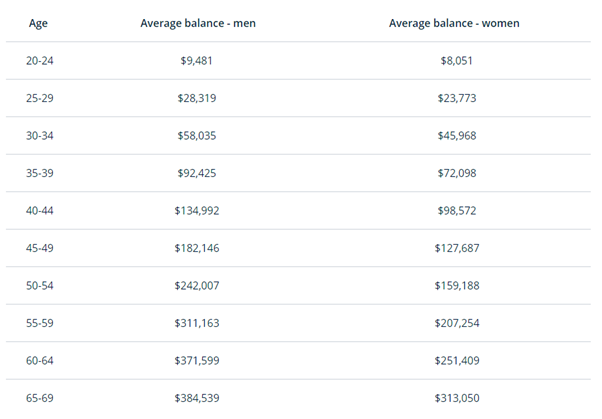
If your balance looks low, there could be several reasons why your super is lagging behind your peers – taking time out of the workforce to study, travel or care for older relatives, or perhaps being out of work, working part-time or earning a lower wage than others your age.
As the figures show, women are more likely to have lower super balances than their male counterparts – likely due to factors impacting their financial situation, such as taking time off work to raise children.
What to do if your super balance needs a boost?
If you check your super every 6-12 months and notice your balance isn’t as high as you’d like it to be, start with these quick and easy steps to give it a potential boost:
- Search for lost super. Money belonging to you might be sitting in an account you’ve forgotten about.
- If you have accounts with multiple super funds, think about consolidating it into one account. You could save on fees and charges that may be eating into your balance. However, you’ll need to check for exit or termination fees and ensure your insurance cover isn’t affected.
- Consider how your super is invested. Depending on how far you are from retirement you might think about switching it into a more growth-focused investment option. But bear in mind that returns aren’t guaranteed, and that higher risk accompanies the opportunity for higher returns. There’s also a risk you may lock in losses, so seek financial advice or contact your super fund.
Here are some ways to boost your balance over the long term by making additional contributions:
- Salary sacrificing: You can contribute extra cash into your super from your before-tax salary. The amount contributed will only be taxed at 15% if you earn under $250,000 a year or 30% if you earn $250,000 or more a year, rather than at your usual marginal tax rate. However, make sure your total concessional super contributions (including any your employer makes on your behalf) don’t exceed $25,000 per year. You’ll need to speak to your payroll department to set up a salary sacrifice arrangement.
- Personal tax-deductible contributions: If your employer doesn’t offer salary sacrifice, you’re unemployed, self-employed or you don’t want to salary sacrifice, you can make a personal tax-deductible contribution to your super. The amount you contribute is taxed at 15% if you earn under $250,000 a year, 30% if you earn $250,000 or more a year, and subject to the $25,000 per year limit.
- After-tax contributions (also known as non-concessional contributions): There’s a $100,000 limit per financial year on the amount of after-tax contributions you can make. If you are under age 65 at 1 July of the year the contribution is made, you can also ‘bring forward’ up to two years’ worth of after-tax contributions and make up to $300,000 contribution in a financial year.
- Spouse contributions: If your partner is out of work, a stay-at-home parent, working part-time or earning less than $40,000, adding to their super could benefit you both financially.
- Government contributions: If you’re a low or middle-income earner, you may be eligible for a co-contribution from the government when you add after-tax money to your super.
Need more help with your super?
To help make sure your retirement income will give you a comfortable life after work, speak to your financial adviser.
Source: AMP