

Tag Archives: Financial Planning
What assets can you have before losing your Age Pension?
By Robert Wright /February 28,2025/

There are many benefits to receiving an Age Pension or even a part pension, but there are limits to what level of income or assets you can have, to be eligible.
Regarding assets, the key limits as at 20 September 2024 are as follows:
To receive a full pension, assets (excluding the value of the primary residence) must be less than:
| Homeowner | Non-homeowner | |
| Single | $314,000 | $566,000 |
| Couple, combined | $470,000 | $722,000 |
- Indexed every 20 March, 1 July and 20 September. Source: Australian Government Services Australia.
To receive at least a part pension, assets must be less than:
| Homeowner | Non-homeowner | |
| Single | $695,500 | $947,500 |
| Couple | $1,045,500 | $1,297,500 |
| Couple – separated by illness | $1,233,000 | $1,485,000 |
- Indexed every 20 March, 1 July and 20 September. Recipients of Rent Assistance will have higher thresholds. Source: Australian Government Services Australia.
It’s important to note that if you get Rent Assistance, your cut off point will be higher. Use the Payment and Service Finder to find out your cut off point.
Asset reduction strategies
There are a number of strategies that may be used to reduce asset levels, which may result in qualifying for a part pension or increasing the current pension amount received.
However, before reducing your assets it is important to bear in mind whether your remaining savings can support any shortfall in your retirement income needs, as any increased pension amount may still be inadequate. Personal circumstances can also change and increase the reliance on your reduced savings. For example, future health issues may require a move into aged care, which can bring increased expenses.
With that in mind, here are six possible asset reduction strategies to help boost your pension:
- Gift within limits, for more than 5 years before qualifying age
If there is a desire to provide financial assistance to family or friends, gifting can reduce your assessable assets. The allowable amounts a single person or a couple combined may gift is $10,000 in a financial year or $30,000 over a rolling five financial year period. Any excess amounts will continue to count under the asset test (and deemed under the income test) for five years from the date of the gift. This is called deprivation.
If you are more than five financial years away from reaching your age pension age or from receiving any other Centrelink payments, you can gift any amount without affecting its eventual assessment once you reach age pension age.
- Homeowners can renovate
Your home is an exempt asset and any money spent to repair or improve it will form part of its value and will also be exempt from the assets test.
- Repay debt secured against exempt assets
Debts secured against exempt assets do not reduce your total assessable assets. An example is a mortgage against the family home, regardless of what the borrowed funds have been used to purchase. However, using assessable assets to repay these debts can reduce the overall assessed asset amount. Crucially, you must make actual repayments towards the debt; depositing or retaining cash in an offset account will not achieve this outcome.
- Funeral bonds within limits or prepaying funeral expenses
If you wish to set aside funds or pay for your funeral costs now, there are a couple of ways to do this which may reduce your assessable assets.
A person can invest up to $15,500 (as at 1 July 2024) in a funeral bond and this amount is exempt from the assets test. Members of a couple can have their own individual bond up to the same limit each. By contrast, if a couple invests jointly into a funeral bond, this must not exceed $15,500 i.e. it is not double the individual limit2.
In comparison, there is no limit to the amount that can be spent on prepaid funeral expenses. For the expenses to qualify, there must be a contract setting out the services paid for, state that it is fully paid, and must not be refundable. Importantly, both methods of paying for funeral costs are designed purely for this purpose and preventing assets from being accessed for any other reason.
- Contribute to younger spouse’s super and hold in accumulation phase
If you have a younger spouse who has not yet reached their Age Pension age and is eligible to contribute to super, contributing an amount into their super account may reduce your assessable assets. The elder spouse can even withdraw from their own super, generally as a tax free lump sum, to fund the contribution.
Investments held in the accumulation phase of super are not included in a person’s assessable assets if the account holder is below Age Pension age. Before using this strategy, any additional costs incurred should first be considered. Holding multiple super accounts may duplicate fees. Shifting funds into an accumulation account may increase the tax on the earnings on these investments to as much as 15%. Alternatively, earnings on the funds are tax free if invested in an account-based pension or potentially even personally.
Additionally, contributing to a younger spouse who is under Age Pension age, and still working, will ‘preserve’ these funds. They should also ensure they do not exceed their contribution caps3.
- Purchase a lifetime income stream
Lifetime income streams such as an annuity purchased after 1 July 2019 may be favourably assessed, according to the Social Services and Other Legislation Amendment (Supporting Retirement Incomes) Bill 20184. Where eligible, only 60% of the purchase price is assessed. This drops to 30% once the latter of age 84 (based on current life expectancy factors) or five years occurs.
To receive concessional treatment, the lifetime annuity must satisfy a ‘capital access schedule’ which limits the amount that can be commuted voluntarily or on death4. This is illustrated below:
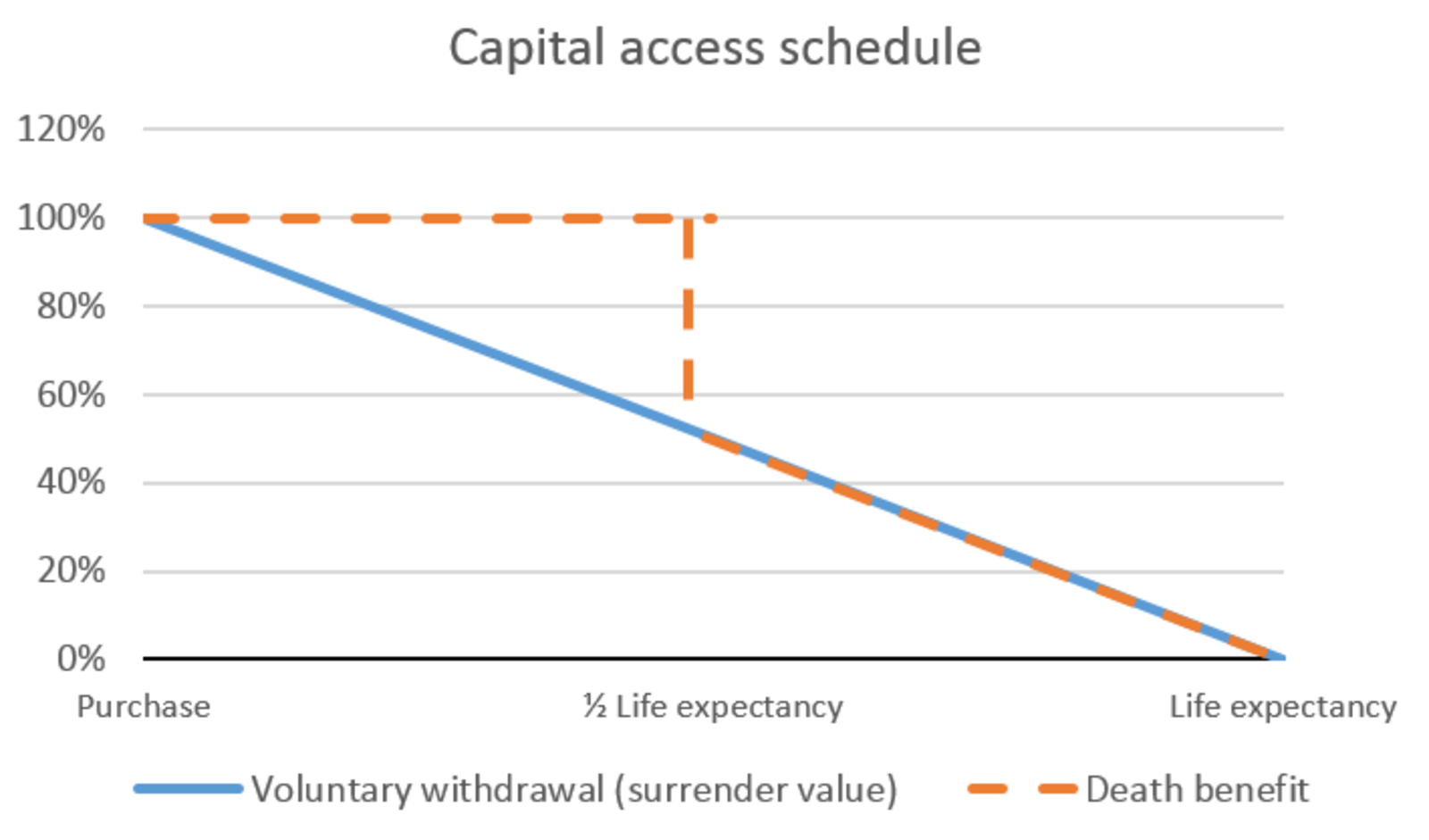
- Source: Parliament of Australia.
Voluntary commutations must follow a ‘straight line’ declining value, falling to nil at life expectancy. The death benefit can be up to 100% until the investor reaches half of their life expectancy, at which point it will follow the voluntary withdrawal value4.
Conclusion
Reducing your assessable assets within the relevant assets test threshold can provide many benefits such as increasing your existing pension or allowing you to qualify for a part pension, if you are currently above the upper asset test threshold.
While it is tempting to intentionally reduce your asset levels to gain these benefits, it is important to remember the Age Pension payment rate is determined by applying both an income and assets test. The test that results in a lower entitlement determines the amount receivable. If the income test is the harsher test, reducing your assessable assets may provide little or no benefit.
If the assets test is harsher, you should not lose sight of the fact that any reduction in your assets means there are fewer assets for you to call upon if required.
References:
1. https://www.servicesaustralia.gov.au/assets-test-for-age-pension?context=22526
2. https://www.servicesaustralia.gov.au/funeral-bonds-and-prepaid-funerals?context=22526
3. https://www.ato.gov.au/super/self-managed-super-funds/contributions-and-rollovers/contribution-caps/ and https://www.ato.gov.au/individuals-and-families/super-for-individuals-and-families/self-managed-super-funds-smsf/contributions-and-rollovers/contribution-caps
4. https://parlinfo.aph.gov.au/parlInfo/search/display/display.w3p;query=Id%3A%22legislation%2Fems%2Fr6224_ems_58c16ce0-95fa-4ef6-afe4-668b3e41fb62%22
Source: BT
Nine bad habits of ineffective investors: common mistakes investors make
By Robert Wright /November 20,2024/

Introduction
In the confusing and often seemingly illogical world of investing, investors often make various mistakes that keep them from reaching their financial goals. This note takes a look at the nine most common mistakes.
Mistake #1 Crowd support indicates a sure thing
“I will tell you how to become rich…Be fearful when others are greedy. Be greedy when others are fearful”. Warren Buffett, Investor and CEO
It’s normal to feel safer investing in an asset when your friends and neighbours are doing the same and media commentary is reinforcing the message that it’s the place to be. But “safety in numbers” is often doomed to failure. The trouble is that when everyone is bullish and has bought into an investment with general euphoria about it, it gets to a point where there is no one left to buy in the face of more positive supporting news but instead there are lots of people who can sell if the news turns sour. Of course, the opposite applies when everyone is pessimistic and bearish and have sold – it only takes a bit of good news to turn the value of the asset back up. So, the point of maximum opportunity is when the crowd is pessimistic (or fearful) and the point of maximum risk is when the crowd is euphoric (and greedy).
Mistake #2 Current returns are a guide to the future
“Past performance is not a reliable indicator of future performance”. Standard disclaimer
Faced with lots of information, investors often use simplifying assumptions, or rules, in order to process it. A common one of these is that “recent returns or the current state of the economy and investment markets are a guide to the future”. So tough economic conditions and recent poor returns are expected to continue and vice versa for good returns and good economic conditions. The problem with this is that when it’s combined with the “safety in numbers” mistake, it results in investors getting in at the wrong time (e.g. after an asset has already had strong gains) or getting out at the wrong time (e.g. when it is bottoming). In other words, buying high and selling low.
This is pertinent now with shares providing strong gains over the last two years – with US shares up 56%, global shares up 49% and Australian shares up 25% – despite lots of worries about interest rates, recession, commercial property and US banks, wars, elections, etc. This has brought with it a temptation to conclude we are in a “new era” where macro problems don’t matter and that even if they do central banks will protect us by slashing rates and pumping money in (the so-called “central bank put” which morphed from the “Greenspan put” many years ago) and governments will do the same with government spending.
Unfortunately, we have heard the “this time is different” argument many times before only to find out that it’s not – usually when we are most complacent! The reality is that shares have done well over the last two years because they came off a big cyclical fall in 2022 and the threats have not proved that serious economically. For instance, the much feared recession has failed to appear and the war in the Middle East has not disrupted global oil supplies (so far). And the “central bank put” did not prevent the tech wreck and the GFC (both saw US shares fall around 50%) and various other share market plunges. Just because shares have had strong returns over the last two years, despite lots of worries, doesn’t mean that the cycle has been abolished and that there is nothing at all to worry about.
Mistake #3 “Experts” will tell you what will happen
“Economists put decimal points in their forecasts to show that they have a sense of humour”. William Gillmore Simms, Novelist and Politician
The reality is that no one has a perfect crystal ball. It’s well known that forecasts as to where the share market, property market and currencies will be at a particular time have a dismal track record, so they need to be treated with care. Usually the grander the forecast, calls for “new eras of permanent prosperity” or for “great crashes ahead”, the greater the need for scepticism as either they get the timing wrong or it’s dead wrong.
Market prognosticators suffer from the same psychological biases as everyone else. And sometimes forecasts themselves can set in motion policy changes that make sure they don’t happen – such as rate cuts heading off sharp house price falls in the pandemic in 2020. The key value of investment experts is to provide an understanding of the issues around an investment and to put things in context. This can provide valuable information in terms of understanding the potential for an investment. But if forecasting was so easy, the forecasters would be rich and so would have retired!
Mistake #4 Shares can’t go up in a recession…
“It’s so good it’s bad, it’s so bad it’s good”. Anon
A common lament around in second half 2020, after share markets rebounded from their late March 2020 pandemic low, was that, “the share market is crazy as the economy is in deep recession and earnings are collapsing!” Of course, shares kept rising into 2022, economies recovered, and earnings rebounded. The reality is that share markets are forward looking, so when economic data and profits are really weak, the market has already factored it in.
History tells us that the best gains in stocks are usually made when the economic news is still poor, as stocks rebound from being undervalued and unloved, helped by falling interest rates. In other words, things are so bad they are actually good for investors! Of course, the opposite applies at market tops after a sustained economic recovery has left the economy overheated with no spare capacity and rising inflation and so the share market frets about rising rates. Hence things are so good they become bad! This seemingly perverse logic often trips up many investors.
Mistake #5 Letting a strongly held view get in the way
“The aim is to make money, not to be right”. Ned Davis, Investment Analyst
Many let their blind faith in a strongly held, often bearish view – “there is too much debt”, “aging populations will destroy returns”, “a house price crash is imminent”, “a Trump victory will see shares crash”, etc. – drive their investment decisions. This is easy to do as the human brain is wired to focus on the downside more than the upside, so we are easily attracted to doomsayers. They could be right one day but lose a lot of money in the interim. Giving too much attention to pessimists doesn’t pay for investors.
Mistake #6 Looking at your investments too much
“Investing should be like watching paint dry or watching grass grow. If you want excitement…go to Las Vegas”. Paul Samuelson, Economist
Checking up on how your investments are doing is a good thing, surely? But the danger is that the more investors are exposed to news around their investments, the more they may see them falling. Whereas share markets have historically generated positive returns more than 60% of the time on a monthly basis and more than 70% of the time on a calendar year basis, day to day it’s close to 50/50 as to whether the share market will be up or down.
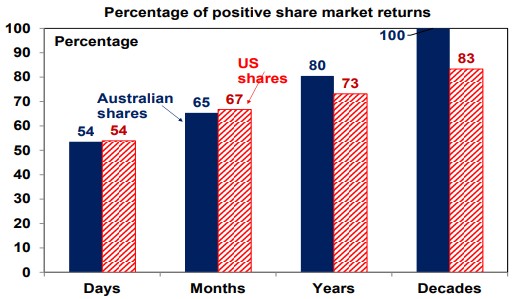
Daily & monthly data from 1995, data for years and decades from 1900. Source: Bloomberg, AMP
Being exposed to this very short term “noise” and the chatter around it can cause investors to have a greater exposure to lower returning but safer investments that won’t grow wealth. The trick is to turn down the noise and have patience. Evidence shows that patient people make better investors because they can look beyond short-term noise and are less inclined to jump into one investment after another after they have already had their run.
Mistake #7 Making investing too complex
“There seems to be a perverse human characteristic that makes easy things difficult”. Warren Buffett
With the increasing ease of access to investment options, ways to put them together and information and processes to assess them, investing is getting more complex. But when you overcomplicate your investments, it can mean that you can’t see the wood for the trees. You can spend so much time focusing on this stock or ETF versus that stock or ETF or this fund manager versus that fund manager, that you ignore the key driver of your portfolio’s risk and return which is how much you have in shares, bonds, real assets, cash, onshore versus offshore, etc. Or that you end up in things you don’t understand. Instead, it’s best to avoid the clutter, don’t fret the small stuff, keep it simple and don’t invest in things you don’t understand.
Mistake #8 Too conservative early in life
“Compound interest is the eighth wonder of the world. He who understands it, earns it, he who doesn’t, pays it”. Albert Einstein, Theoretical Physicist
Cash and bank deposits are low risk and fine for near term spending requirements and emergency funds, but they won’t build wealth over time. The following chart shows the value of $1 invested in various Australian assets since 1900 allowing for the reinvestment of interest and dividends along the way. That $1 would have grown to $955,656 if invested in shares but only to $263 if invested in cash. Despite periodic setbacks, shown with arrows (such as WWI, the Great Depression, WWII, stagflation in the 1970s, the 1987 share crash and the GFC), shares and other growth assets grow to much higher values over time thanks to their higher returns over the long term than cash and bonds and thanks to the magic of compound interest where higher returns build on higher returns through time.

Source: ASX. Bloomberg, RBA, AMP
Not having enough in growth assets early in their career can be a problem for investors as it can make it harder to adequately fund retirement later in life as they miss out on the magic of compounding higher returns on higher returns through time in growth assets like shares and property. Fortunately, compulsory superannuation in Australia helps manage this, although early super withdrawal for various purposes (through the pandemic, for medical needs and as proposed for housing) may set this back for some. For example, a 30 year old who withdraws $20,000 from their super could have around $184,000 (or $74,000 in today’s dollars) less when they retire at age 67 based on assumptions in the ASIC MoneySmart Super Calculator.
Mistake #9 Trying to time the market
“Far more money has been lost by investors in preparing for corrections, or anticipating corrections, than has been lost in the corrections themselves”. Peter Lynch, Fund Manager
In the absence of a tried and tested process, trying to time the market, i.e. selling before falls and buying ahead of gains is very difficult. Many of the mistakes referred to above kick in and it can be a sure way to destroy wealth. Perhaps the best example of this is a comparison of returns if the investor is fully invested in shares versus missing out on the best days. Of course, if you can avoid the worst days during a given period you will boost your returns. But this is very hard and many investors only get out after the bad returns occur, just in time to miss out on some of the best days and so hurt their returns. If you were fully invested in Australian shares from January 1995, you would have returned 9.5% p.a. (including dividends but not allowing for franking credits). But if by trying to time the market you miss the 10 best days the return falls to 7.5% p.a. If you miss the 40 best days, it drops to just 3.5% p.a. Hence, it’s time in the market that’s the key, not timing the market. The last two years provide a classic example of how hard it is to time markets – there has been a long worry list, so it’s been easy to be gloomy but timing markets on the back of this has been a loser as shares put in strong gains.
Concluding comment
I know it sounds kind of boring and like a cliché, but the easiest way to overcome many of these mistakes is to have a long-term investment plan that allows for your goals and risk tolerance and then stick to it.
Source: AMP
What is a distribution?
By Robert Wright /November 20,2024/

A managed fund generates income from its investments – for example, through share dividends, interest on cash or fixed interest investments in the fund, or any gains made when fund investments (like shares) are sold. So in short, a distribution is profit or income made by a fund and paid to investors.
How are distributions paid?
Managed investment funds are required to pay all realised income and capital gains to investors for the financial year. Income can be paid monthly, quarterly, half yearly or yearly, depending on the fund. You may receive your distribution as a cash payment, for instance as a payment to your designated bank account, or as an amount that is reinvested back into the fund. As an investor, you should also receive a statement that outlines the amounts and types of income generated by the fund and distributed to you, which may be helpful at tax time.
How are distributions calculated?
- The income of all individual investments in a fund for a given time period is calculated taking into account things like share dividends or interest payments.
- The fund’s deductible expenses (things like management fees and other payables) are then subtracted, leaving the total amount of income that can be paid out.
- That amount is then divided by the total number of units in the fund to provide an amount of distribution per unit. For example, if the distribution for a fund was $1 per unit and an investor owned 100 units in the fund, they would receive a distribution of $100.
What does the unit price have to do with distributions?
When you invest in a fund, you’re pooling your money with other investors to access a professionally managed portfolio of investments overseen by skilled investment managers. In exchange, you’re allocated a number of units that correspond to how much money you’ve invested – based on the fund’s unit price at the time of investment.
Why does the unit price fall after a distribution?
When you receive a distribution for the income generated by a fund’s investments, the value of the fund reduces by the amount of the total distribution. This results in a lower unit price because income from the fund’s investments is being paid from the fund to investors, reducing the total value of the fund’s assets – a figure that is divided by the total number of units owned in the fund to determine the unit price. This doesn’t mean you’ve lost money on your investment or that your investment in a particular fund has changed – rather, you retain the same number of units in the fund, which has simply decreased in value by the amount of the distribution paid to you. Distributions that are reinvested back into a fund are used to acquire more units in it. This means the value of your investment should not fall as you will be allocated additional units.
Why aren’t distributions paid to super funds?
While managed investment options (funds) outside of super pay distributions to investors, investment options within super do not. That’s because there is a different structure and purpose for super, which members can’t access until retirement. Generally, super balances fluctuate higher and lower over time depending on the contributions members make and the performance of the funds their super is invested in. Investment options within super contribute to super balances through the unit price, which changes daily based on the performance of each fund’s investments. Effectively, the distribution amount is retained in your super and forms part of your super balance, which over time can be used to acquire more investments in the options your super is invested in.
Source: Colonial First State
Mortgage versus super – a common dilemma
By Robert Wright /August 23,2024/

Conventional wisdom used to dictate Australians were better paying off their home loans, and then, once debt free turning their attention to building up their super. But with interest rates ramping up over the past two years and uncertainty as to when they are likely to reduce, what’s the right strategy in the current market?
It’s one of the most common questions financial advisers get. Are clients better off putting extra money into superannuation or the mortgage? Which strategy will leave them better off over time? In the super versus mortgage debate, no two people will get the same answer – but there are some rules of thumb you can follow to work out what’s right for you.
One thing to consider is the interest rate on your home loan, in comparison to the rate of return on your super fund. As banks ramped up interest rates following the RBA hikes over the past two years, you may find the returns you get in your super fund has potentially shrunk in comparison.
Super is also built on compounding interest. A dollar invested in super today may significantly grow over time. Keep in mind that the return you receive from your super fund in the current market may be different to returns you receive in the future. Markets go up and down and without a crystal ball, it’s impossible to accurately predict how much money you’ll make on your investment.
Each dollar going into the mortgage is from ‘after-tax’ dollars, whereas contributions into super can be made in ‘pre-tax’ dollars. For the majority of Australians, saving into super will reduce their overall tax bill – remembering that pre-tax contributions are capped at $30,000 annually and taxed at 15% by the government (30% if you earn over $250,000) when they enter the fund.
So, with all that in mind, how does it stack up against paying off your home loan? There are a couple of things you need to weigh up.
- Consider the size of your loan and how long you have left to pay it off
A dollar saved into your mortgage right at the beginning of a 30-year loan will have a much greater impact than a dollar saved right at the end.
- The interest on a home loan is calculated daily
The more you pay off early, the less interest you pay over time. In a higher interest rate environment many homeowners, particularly those who bought a home some time ago on a variable rate, will now be paying much more each month for their home loan.
- Offset or redraw facility
If you have an offset or redraw facility attached to your mortgage you can also access extra savings at call if you need them. This is different to super where you can’t touch your earnings until preservation age or certain conditions of release are met.
Don’t discount the ‘emotional’ aspect here as well. Many individuals may prefer paying off their home sooner rather than later and welcome the peace of mind that comes with clearing this debt. Only then will they feel comfortable in adding to their super.
Before making a decision, it’s also important to weigh up your stage in life, particularly your age and your appetite for risk.
Whatever strategy you choose you’ll need to regularly review your options if you’re making regular voluntary super contributions or extra mortgage repayments. As bank interest rates move and markets fluctuate, the strategy you choose today may be different from the one that is right for you in the future.
Case study where investing in super may be the best strategy
Barry is 55, single and earns $90,000 pa. He currently has a mortgage of $200,000, which he wants to pay off before he retires in 10 years’ time at age 65.
His current mortgage is as follows:
| Mortgage | $200,000 |
| Interest rate | 6.80% pa |
| Term of home loan remaining | 20 years |
| Monthly repayment (post tax) | $1,526.68 per month |
Barry has spare net income and is considering whether to:
- make additional / extra repayments to his home mortgage (in post-tax dollars) to repay his mortgage in 10 years, or
- invest the pre-tax equivalent into superannuation as salary sacrifice and use the super proceeds at retirement to pay off the mortgage.
Assuming the loan interest rate remains the same for the 10-year period, Barry will need to pay an extra $775 per month post tax to clear the mortgage at age 65.
Alternatively, Barry can invest the pre-tax equivalent of $775 per month as a salary sacrifice contribution into super. As he earns $90,000 pa, his marginal tax rate is 32% (including the 2% Medicare levy), so the pre-tax equivalent is $1,148 per month. This equals to $13,776 pa and after allowing for the 15% contributions tax, he’ll have 85% of the contribution or $11,710 working for his super in a tax concessional environment.
To work out how much he’ll have in super in 10 years, we’re using the following super assumptions:
- The salary sacrifice contributions, when added to his employer super guarantee contributions, remain within the $30,000 pa concessional cap.
- His super is invested in 70% growth / 30% defensive assets, returning a gross return of 3.30% pa income (50% franked) and 2.81% pa growth.
- A representative fee of 0.50% pa of assets has been used.
If these assumptions remain the same over the 10-year period, Barry will have an extra $161,216 in super. His outstanding mortgage at that time is $132,662 and after he repays this balance from his super (tax free as he is over 60), he will be $28,554 in front. Of course, the outcome may be different if there are changes in interest rates and super returns in that period.
Case study where paying off the mortgage may be the best strategy
40 year old Duy and 37 year old Emma are a young professional couple who have recently purchased their first apartment.
They’re both on a marginal tax rate of 39% (including the 2% Medicare levy) and they have the capacity to direct an extra $1,000 per month into their mortgage, or alternatively, use the pre-tax equivalent to make salary sacrifice contributions to super.
Given their marginal tax rates, it would make sense mathematically to build up their super.
However, they’re planning to have their first child within the next five years and Emma will only return to work part-time. They will need savings to cover this period, as well as assist with private school fees.
Given their need to access some savings for this event, it would be preferable to direct the extra savings towards their mortgage, and redraw it as required, rather than place it into super where access is restricted to at least age 60.
Before weighing up your options and considering which approach may be right for you, talk to your financial adviser.
Source: AMP