

Tag Archives: Financial Planning
Is it worth salary sacrificing into super?
By Robert Wright /August 23,2024/

Let’s explore the ins and outs of salary sacrificing into your super and help you determine if it’s worth considering as part of your financial strategy.
We’re all familiar with the concept of super. It’s that portion of our salary that employers are required to contribute to a super fund on our behalf, with the goal of providing us with financial security in retirement.
But what not everyone is aware of, is that relying solely on your employer’s contributions might not be enough to ensure a comfortable retirement. That’s where salary sacrificing into super comes into play.
What is salary sacrificing into super?
Salary sacrificing into super involves redirecting a portion of your pre-tax salary into your super fund. Instead of receiving this portion as part of your take-home pay, it goes straight into your super account.
Here’s how it works:
- Agreement – You and your employer agree to salary sacrifice a specific amount or percentage of your pre-tax salary into your super fund. This amount is in addition to the compulsory employer contributions.
- Pre-tax – The sacrificed amount is deducted from your gross (pre-tax) salary, reducing your taxable income. This means you pay less income tax on your take-home pay.
- Super contributions – The sacrificed amount is added to your superannuation contributions, helping you build a more substantial retirement nest egg.
The benefits of salary sacrificing into super
- Tax savings – One of the primary advantages of salary sacrificing into super is the potential for significant tax savings. The sacrificed amount is taxed at the concessional super tax rate of 15%, which is typically lower than the tax rate you pay on your income. This means you get to keep more of your money while still saving for retirement. You may pay additional 15% tax on all or part of your salary sacrifice if your income exceeds $250,000. In this case, the effective tax on your contributions may be up to 30%, which is still less than the highest tax rate of 45%.
- Faster retirement savings growth – By contributing more to your super fund through salary sacrificing, you’re accelerating the growth of your retirement savings. Your money is invested over an extended period, potentially leading to more substantial gains through compound investment returns. Compound investment returns refer to earning money not just on the original investment but also on the accumulated growth gained over the period since the investment was made.
- Lower taxable income – Since the sacrificed amount is deducted from your pre-tax salary, your taxable income is reduced. This can have several additional benefits, such as qualifying you for certain concessions, reducing the Medicare Levy and helping you stay in a lower tax bracket (salary sacrifice contributions are not subject to the Medicare Levy or the Medicare Levy Surcharge. This can lead to significant tax savings, especially for higher income earners.)
- Automatic savings – Salary sacrificing is an automated process. The money is taken out of your pay before you even see it, which can help you build disciplined savings habits.
- Long-term financial security – Salary sacrificing into super is a smart way to attain long-term financial security during your retirement years. It provides peace of mind, knowing that you’re taking proactive steps to build a comfortable retirement nest egg.
Things to consider before salary sacrificing into super
- Contribution caps – The annual limit on the amount you can salary sacrifice into super without incurring additional tax in Australia is $30,000 from 1 July 2024. The cap limits change over time so it’s important to be aware of the current contribution cap limit. Those who have a superannuation balance of less than $500,000 on 30 June 2024 may have a concessional cap of up to $162,500 in 2024/25. This includes the annual $30,000 cap, $25,000 for 2019/20 and 2020/21, and $27,500 for 2021/22, 2022/23 and 2023/24. This is based on the five-year carry forward rules.
- Your financial goals – Consider your overall financial goals when deciding how much to salary sacrifice into super. You should strike a balance between your short-term and long-term financial needs. If you have pressing financial commitments, it might not be wise to sacrifice too much of your current income. What kind of lifestyle do you envision for your retirement? The more comfortable you want it to be, the more you may need to save.
- Reduced take-home pay – Salary sacrificing means you’ll have less money in your take-home pay. This can be challenging if you’re on a tight budget or have immediate financial needs, such as your mortgage.
- Investment risk – Your salary sacrifice contributions are invested, and like any investment, they come with inherent risks. Depending on market performance, your super balance can fluctuate.
- Access to funds – Remember that once your money is in your super fund, you generally can’t access it until retirement or you meet certain conditions. Ensure you have enough liquid assets outside of super, such as cash or shares, to cover emergencies or short-term financial needs. Super is designed for retirement savings, so accessing your money before you reach preservation age can be challenging. Preservation age varies from 55 to 60, depending on when you were born. If you were born on or after 1 July 1964 your preservation age will be 60. From 1 July 2024, the preservation age will be 60.
- Seeking advice – It’s a good idea to consult with a financial adviser or accountant before implementing a salary sacrifice strategy. They can help you assess your unique financial situation and provide personalised recommendations.
Is it worth salary sacrificing into super?
The answer depends on your individual financial circumstances and goals. Do you have outstanding debts or immediate financial needs that should take priority over extra super contributions? It’s crucial to have a solid financial foundation before diverting funds into super.
For many Australians, especially those who can afford to do so, salary sacrificing into super can be a highly effective way to boost retirement savings, enjoy tax benefits, and secure long-term financial stability.
Higher income earners tend to benefit more from salary sacrificing due to the potential for substantial tax savings but the benefits are not exclusive to that income bracket.
It is sensible to strike a balance that suits your overall financial plan and to stay informed about any changes in legislation or contribution caps. As your financial circumstances are unique to you, consider seeking professional advice to help you make the best decision for your future.
Source: MLC
Decoding cognitive biases: what every investor needs to be aware of
By Robert Wright /August 23,2024/

Common human biases that investors should understand when it comes to investing is extremely important. These biases are ingrained in human nature, leading to tendencies to oversimplify, rely on quick thinking or exhibit excessive confidence in judgments, which may lead to investment mistakes. By gaining insight into these biases, investors may be able to make better decisions to help reduce risk and improve their investment outcomes in the long-term.
Numerous cognitive biases can affect how decisions are made. The key to mitigating these biases lies in recognising their presence, identifying when they might arise and then either making appropriate adjustments or obtaining help to moderate their impact.
Seven cognitive biases that might arise at various stages of an investor’s investing journey.
- Herding: The tendency to follow and mimic the actions of a larger group.
- Confirmation bias: The preference for information that confirms one’s existing beliefs or hypotheses.
- Overconfidence effect: Excessive confidence in one’s own investment decisions and abilities.
- Loss aversion: When the fear of loss is felt more intensely than the elation of gains.
- Endowment effect: Overvaluing assets because they are owned.
- Neglect of probability: Disregarding the actual likelihood of events and often overemphasising rare occurrences at the expense of more probable outcomes.
- Anchoring bias: The tendency to rely too heavily on a past reference or a single piece of information when making decisions.
Herding
The herd mentality occurs when people find reassurance and comfort in a concept that is widely adopted or believed by many others. In recent times, we have seen the herd mentality with the events that surrounded the GameStop stock event. Where many people saw the rise in stock prices and without proper investment research followed the trend of many others and invested.
This impacted a lot of investors who bought the stock due to the fear of missing out and the hype it created. We believe, to be a successful investor, you must be able to analyse and think independently. Speculative bubbles are typically the result of herd mentality. Herd mentality in investing can overshadow rational decision making and could increase the risk of financial losses.
Investors need to recognise the feeling of pressure to conform to popular opinion or follow the crowd and instead consider conducting research and analysis before making decisions, as well as seeking alternative views to challenge the consensus.
Confirmation bias
Confirmation bias is the tendency to favour information that corroborates pre-existing beliefs or theories. In our view, confirmation bias can lead to significant errors in investing. Investors may develop an inflated sense of certainty when they encounter consistent evidence supporting their choices. This overconfidence can create an illusion of infallibility, with an expectation that nothing can go wrong.
Overconfidence bias
Overconfidence bias in investing is where investors overestimate their knowledge, intuition and predictive capabilities, often leading to poor financial decisions. This bias can present itself through various ways such as excessive trading, under-diversification and the general disregard for potential risks.
Investors with overconfidence bias tend to believe they can time the market or have the ability to pick the winning stocks better than most, which in turn may also result in overtrading and increased transaction costs. Overconfidence can also lead to a lack of proper risk assessment and analysis, as investors might underestimate the likelihood of negative events or industry dynamics affecting their investments.
An example of overconfidence bias occurred during the dot-com bubble of the late 1990s and early 2000s. Many investors were overly optimistic about the growth potential of internet related companies. This led to inflated stock prices as more and more people invested in these companies without proper evaluation of their actual worth.
Loss aversion
Loss aversion is where a real or potential loss is perceived as much more severe than an equivalent gain. The pain of losing is often far greater than the joy in gaining the same amount.
This overwhelming fear of loss can cause investors to behave irrationally and make bad decisions, such as holding onto a stock for too long or too little time. For example, an investor whose stock begins to tumble, despite clear signs that recovery is unlikely, may be unable to bring themselves to sell due to the fear of loss in the portfolio. On the flip side, when a stock in the portfolio surges, they may quickly cash out, not wanting to see the possibility of those profits disappearing.
When an investor clings onto failing stocks, departs with successful stocks too quicky and fear governs their investment decision, it’s known as the disposition effect. It’s a direct consequence of loss aversion, leading investors to make overly cautious choices that ultimately undermine their financial goals.
So, understanding this bias may help investors make rational decisions to grow their portfolios while managing risk effectively.
Endowment effect
Closely related to the concept of loss aversion is the endowment effect. This effect arises when individuals place a greater value to items because they own them, as opposed to identical items that they do not own. It’s a cognitive bias where ownership elevates the perceived value of an item beyond its objective market value.
For example, an investor may develop a strong attachment to a particular stock. It could be the very first stock they ever invested in, or they may favour the company for a particular personal reason such as aligning with their values. If this stock begins to fall and financial experts are advising to sell, because of the value bias this investor has they may be unwilling to sell. The investor perceives the stock’s value as greater than what the market dictates, purely because of ownership. It is a delicate balance that is needed to be able to determine between attachment and sound financial decision making and can be challenging for some investors.
To help mitigate the endowment effect, investors should regularly review their portfolios and consider the help of a financial adviser. Establish clear, predefined criteria for selling assets, aligned with financial goals. Develop a detailed investment plan with specific financial goals, a well defined investment strategy is crucial to prevent emotional decision making. Understanding and focusing on long-term investment goals can also help in maintaining objectivity.
Neglect of probability
Humans often overlook or misjudge probabilities when making decisions, including investment decisions. Instead of considering a range of possible outcomes, many people tend to simplify and focus on a single estimate. However, the reality is that any outcome an investor anticipates may just be their best guess or most likely scenario. Around this expected outcome, there’s a range of potential results, represented by a distribution curve.
This curve can vary widely depending on the specific characteristics of the business involved. For instance, companies which are well established and have strong competitive positions, tend to have a narrower range of potential outcomes compared to less mature or more volatile companies, which are more susceptible to economic cycles or competitive pressures.
Another error investors may make is to overestimate or misprice the risk of very low probability events. That does not mean that ‘black swan’ events cannot happen but that overcompensating for very low probability events can be costly for investors.
Anchoring bias
Anchoring bias is the inclination to excessively rely on a previous reference or a single piece of information when making decisions. Numerous academic studies have explored the impact of anchoring on decision making. Typically, these studies prompt individuals to fixate on a completely random number (such as their birth year or age) before asking them to assign a value to something. The findings consistently demonstrate that people’s responses are influenced by the random number they focused on prior to being asked the question.
Looking at a recent share price is a common way investors may anchor their decisions. Some people even use a method called technical analysis, which looks at past price movements to predict future ones. However, just because a stock’s price was high or low in the past doesn’t tell us if it’s a good deal now.
Source: Magellan
Will cash remain king?
By Robert Wright /May 28,2024/

Cash has been one of the best performing defensive assets over the past three years. When compared with global bonds (a riskier asset class), a typical portfolio of term deposits would have returned a cumulative 12.6% in comparison to -8.5% for global bonds over the three years to December 2023. With interest rates expected to stay higher for longer, cautious investors would be right to question whether other asset classes are worth the risk. But are the tides changing?
On paper cash still appears to be king; however, these healthy returns are attributed to accelerated inflation and rising interest rates, an environment we may be moving away from. Inflation has been trending downwards for months and rate cuts are predicted to begin before the end of 2024.
In this paper we explain why we believe now is a good time to revisit your asset allocation.
What is a bond?
A bond is a loan made by an investor to a borrower, generally a company or government. Typically, the borrower pays the investor interest (coupons) periodically over the term of the loan and then returns the initial value (principal) of the loan back to the investor at an agreed upon future date.
Bond values are linked to the borrowers perceived ability to pay back the loan as well as interest rates. For example, when interest rates rise, newly issued bonds offer higher coupons, making them more attractive and equivalent existing bonds with lower coupons less attractive, reducing their value.
How do bonds differ from term deposits?
Bonds are expected to provide higher returns over the long term because investors require compensation for assuming investment risk. Bonds also provide the opportunity for capital growth as well as higher income. This compares with term deposits where interest payments are lower but guaranteed by a bank – providing more security. Whilst income is guaranteed, the real value of a term deposit often diminishes over time due to inflation, which erodes your purchasing power (figure 1).

Figure 1 also shows that bonds are subject to greater risk over shorter time horizons which means they won’t be suitable for everyone. Your initial investment can go down in value and when you invest in funds this can be offset through the distributions, reducing your income. This primarily occurs when interest rates are rising and become unpredictable as they have in recent times.
Investors need to determine, with support from their adviser, whether trading term deposits capital guarantee for the potential increased return of a bond investment is suitable to their circumstances.
Why now?
In an environment where inflation is trending down and rates are expected to be cut, long term bonds should perform well as this is the environment when you typically experience the most capital growth (see figure 2). Term deposit rates are also forward looking. In other words, you don’t need to wait for central banks to reduce cash rates before you start to see term deposit returns fall. There are already signs of this happening. Whilst very recent, 1-year term deposit rates came down by 0.05% in January and we expect this trend to continue (although this won’t necessarily be a smooth journey). Whilst seemingly insignificant, this could be meaningful for larger investors. Particularly where capital growth has no role to play and investors don’t require the capital guarantee of cash.
What happens if the economy deteriorates?
If a recession were to occur, interest rates are more likely be cut quicker to encourage spending, resulting in bond prices rising. This would be supported by increased demand as investors move away from higher risk assets such as equities. If we don’t enter a recession and achieve a soft-landing scenario, rates will likely trend down more slowly to bring inflation in line with central banks’ targets; once again favouring bonds due to the inverse relationship between interest rates and bond values.

Conclusion
We believe it is critical to take a diversified approach to investing to help manage portfolio risks through different market conditions. The balance and mix of assets will depend on each investor’s ability and willingness to take on investment risk as well as how much of their capital they need guaranteed.
That said, we believe now is a great time to be reassessing your asset allocation. Investors looking for capital growth who don’t need capital guarantees should consider introducing bonds into, or back into, their investment portfolio and doing so before central banks begin to cut rates.
While cash rates may seem alluring, it is important to remember the distinct roles bonds and cash play in a portfolio. Cash is best reserved for short-term spending needs that require a guarantee as it will not provide the long-term capital growth and inflation protection of other assets.
It may seem daunting as we have been through a period of significant market volatility but over the long term, we have high conviction that bonds will provide better risk adjusted return outcomes for investors who are able to take on the increased risks offered by bonds.
As always, we recommend speaking to your financial adviser to get tailored advice based on your unique circumstances prior to making any investment changes.
Source: Perpetual
Seven lasting impacts from the COVID pandemic
By Robert Wright /May 28,2024/

Key points
- Seven key lasting impacts from the Coronavirus pandemic are: “bigger” government; tighter labour markets; reduced globalisation and increased geopolitical tensions; higher inflation; worse housing affordability; working from home; and a faster embrace of technology.
- On balance these make for a more fragmented and volatile world for investment returns. But it’s not all negative.
Introduction
It’s four years since the COVID lockdowns started. The pandemic ended when it morphed into the less deadly Omicron variant in late 2021, but just as a sound can reverberate around a room the effects of the pandemic continue to reverberate in economies. Putting aside the long-term health impacts this note looks at 7 key lasting economic impacts.
- Bigger government and more public debt
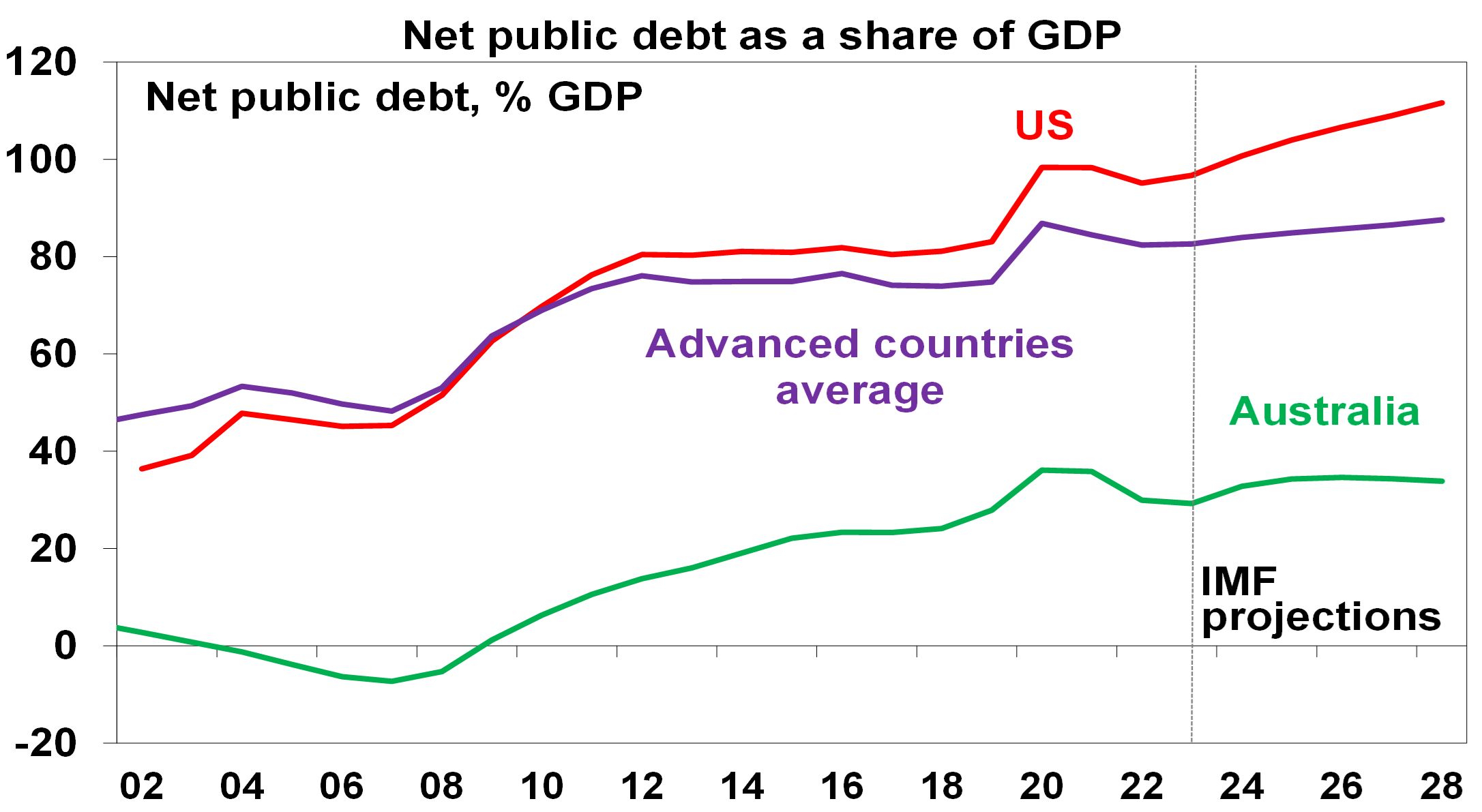
The malaise of the 1970s ushered in “smaller” government in the 1980s in the Thatcher, Reagan, Hawke and Keating era. But the political pendulum started to swing back to “bigger” government after the GFC and COVID has given it another push. Memories of the problems of high government intervention in the 1970s have faded and there is rising support for the view that government is the solution to most problems – via regulation, taxes, spending or education campaigns. The pandemic added to support for “bigger” government: by showcasing the power of government to protect households and businesses from shocks; enhancing perceptions of inequality; and adding support to the view that governments should ensure supply chains by bringing production back home. It’s combining with a desire for governments to pick and subsidise clean energy “winners”.

Source: IMF, Australian Government, AMP
IMF projections for government spending in advanced countries show it settling nearly 2% of GDP higher than pre-COVID levels. The success of governments in protecting households from the worst of the pandemic has also reinforced expectations they would do the same in the next crisis. The pandemic ushered in even bigger public debt just as the GFC did. While high inflation helped lower debt to GDP ratios in 2022 it’s settling at higher levels than pre-pandemic.
Source: IMF, AMP
Implications – While there may initially be a feel good factor, the long-term outcome of “bigger” government is likely to be less productive economies, lower than otherwise living standards and less personal freedom. It will take time before this becomes apparent though. Meanwhile, higher public debt means: less flexibility to respond with fiscal stimulus to a crisis; a greater incentive for politicians to inflate their way out; and interest payments being a high share of tax revenue.
- Tighter labour markets and faster wages growth
In the pre-pandemic years, wages growth was relatively low and a key driver was high levels of underemployment, particularly evident in Australia. After the pandemic, labour markets have tightened reflecting the rebound in demand post pandemic, lower participation rates in some countries and a degree of labour hoarding as labour shortages made companies reluctant to let workers go. As a result, wages growth increased, possibly breaking the pre-pandemic malaise of weak wages growth.

Source: ABS, AMP
Implications – Tighter labour markets run the risk that wages growth exceeds levels consistent with 2% to 3% inflation.
- Reduced globalisation/more geopolitical tensions
A backlash against globalisation became evident last decade in the rise of Trump, Brexit and populist leaders pushing a nationalist gender when the benefits of free trade were being questioned. Also, geopolitical tensions were on the rise with the relative decline of the US and faith in liberal democracies waning resulting in a shift from a unipolar world dominated by the US, to a multipolar world as regional powers (Russia, Iran, Saudi Arabia and notably China) flexed their muscles. The pandemic inflamed both – with supply side disruptions adding to pressure for the onshoring of production; conflict over the source of and management of coronavirus; it heightened tensions between the west and China; and it appears to have added to nationalism and populism. So, the days of global free trade agreements and falling defence spending seem long gone for now. Rather we are seeing more protectionism (e.g. with subsidies and regulation favouring local production) and increased defence spending.
Implications – Reduced globalisation risks leading to reduced potential economic growth for the emerging world and reduced productivity if supply chains are managed on other than economic grounds. And combined with increased geopolitical tensions resulting in more defence spending it could result in a more inflation prone world than was the case.
- Higher prices, inflation and interest rates
A big downside of the pandemic support programs was the surge in inflation. The combination of massive money printing along with a big increase in government payments to households (e.g. Job Keeper) resulted in a massive boost to spending once lockdowns were lifted which combined with supply chain disruptions, also flowing from the pandemic, to cause a surge in inflation. Inflation is now starting to come under control as the monetary easing and spending boost has been reversed and supply has improved again but the pandemic has likely ushered in a more inflation prone world by boosting “bigger” government; adding to a reversal in globalisation; and adding to geopolitical tensions. All of which combine with aging populations to potentially result in more inflation.
Implications – Higher inflation than seen pre-pandemic means higher than otherwise interest rates over the medium term which reduces the upside potential for growth assets like shares and property.
- Worse housing affordability
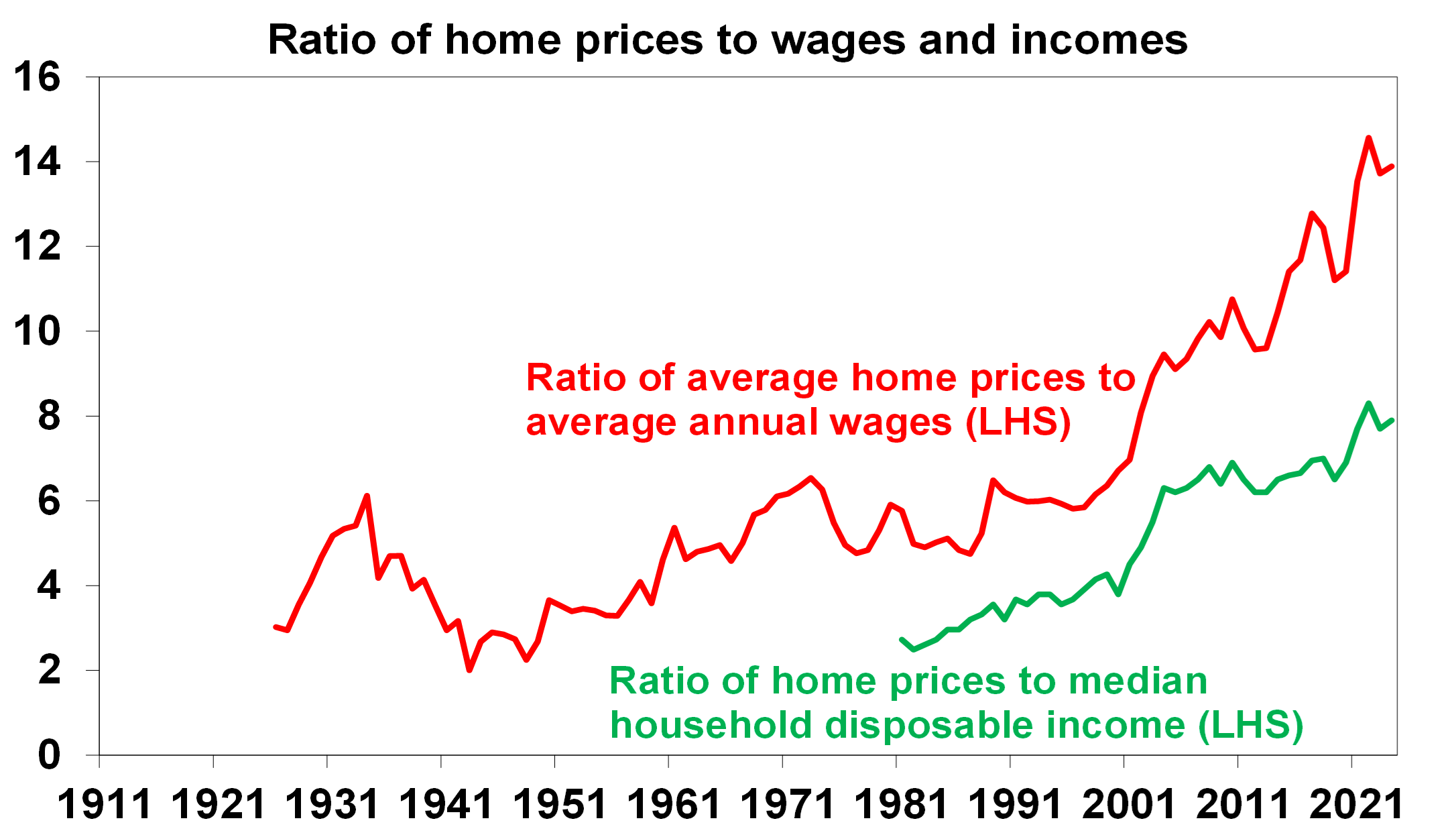
At the start of the pandemic, it was thought the economic downturn and higher unemployment and a freeze in immigration would cause a collapse in home prices and they did initially fall. But not by much as it was quickly turned around by policy measures to support household income, allow a pause in mortgage payments and slash interest rates and mortgage rates to record lows. What’s more the lockdowns and working from home drove increased demand for houses over units and interest in smaller cities and regional locations. As a result, Australian home prices surged to record levels. Meanwhile the impact of higher interest rates in the last two years on home prices was swamped by housing shortages as immigration surged in a catch up. The end result is now record low levels of housing affordability for buyers (who are hit by a double whammy of higher prices relative to incomes – see the next chart – and higher mortgages rates) and renters (who have seen surging rents).
Source: ABS, CoreLogic, AMP
Implications – Ever worse housing affordability means ongoing intergenerational inequality and even higher household debt.
- Working from home likely here to stay
While there has been a return to the office, for many its only two or three days a week. Basically, the lockdowns resulted in a step jump towards working from home (WFH). A UK study of over 2000 firms is indicative. It showed that while around 90.8% of employees were fully onsite in 2018, last year this had fallen to 62.3%, with 30.2% with hybrid (working in the office and at home) arrangements. Similarly, the ABS found 37% of employed people in Australia regularly worked from home. Of course, this masks a huge range with industries with a high proportion of computer-based workers having more hours working at home. And firms expect this to remain the case. There are huge benefits to physically working together around culture, collaboration, idea generation and learning but there are also benefits to working from home with no commute time, greater focus, less damage to the environment, better life balance and for companies – lower costs, more diverse workforces and happier staff. So the ideal is probably a hybrid model. The proportion of workers in a hybrid model may even rise as new firms are quicker to embrace WFH.
Working arrangements for UK employees

Source: K Shah, and others, Managers say working from home here to stay, CEPR
Implications – Less office space demand as leases expire resulting in higher vacancy rates/lower rents, more people living in cities as vacated office space is converted and reinvigorated life in suburbs and regions.
- Faster embrace of technology
Lockdowns dramatically accelerated the move to a digital world. Everyone was forced to embrace new online ways of doing things. Many have now embraced online retail, working from home and virtual meetings. It may be argued that this fuller embrace of technology will enable the full productivity enhancing potential of technology to be unleased. The rapid adoption of AI will likely help.
Implications – This has meant a faster embrace of online retailing (up from 7% of retailing pre-pandemic to around 11%) at the expense of traditional retailing, virtual meeting attendance becoming the norm for many (even in the office) and business travel settling at a lower level.
Concluding comments
Perhaps the biggest impact is that the pandemic related stimulus broke the back of the ultra-low inflation seen pre-pandemic. Together with bigger government and reduced globalisation, this means a more inflation-prone world. So, a return to pre-pandemic ultra-low inflation and interest rates looks unlikely. It’s not all negative though – apart from the faster technology uptake, the global and Australian economies have come through the last four years in far better shape than might have been imagined at the start of the lockdowns!
Source: AMP